A Market Redrawn in Under a Decade
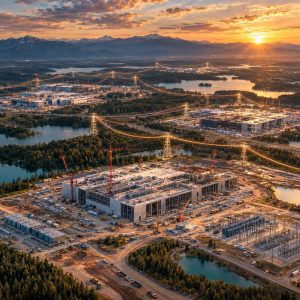
The data center industry has never grown like this. IoT Analytics’ November 2025 Data Center Equipment & Infrastructure Market Report 2025-2030 forecasts the global market at $1.01 trillion in annual spend by 2030, up from $290 billion in 2024. Seven separate IT and facility segments — servers, power, cooling, networking, storage, racks, and management software — are each projected to grow at sustained double-digit CAGRs through 2030.
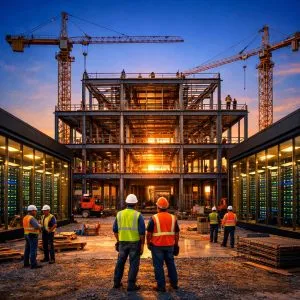
Other reputable trackers land in a similar range. Dell’Oro Group projects cumulative data center capex at $1.7 trillion by 2030, while McKinsey estimates $6.7 trillion in cumulative global spending through 2030 (a figure that includes real estate, power, and IT combined). JLL calls it a “$3 trillion investment supercycle.” The numbers differ because they measure different things, but the direction and magnitude are consistent: an industry three to four times larger than it is today, built inside a decade.
The AI Share of the Pie
The single largest driver is the pivot from general-purpose to AI-specialized compute. Per McKinsey:
- AI-capable data centers: $5.2 trillion cumulative capex through 2030 (~77%)
- Traditional IT data centers: $1.5 trillion cumulative capex through 2030 (~23%)
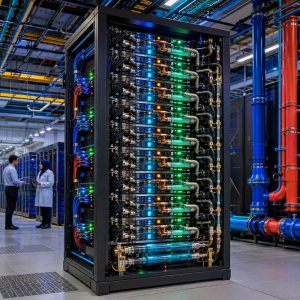
Roughly two-thirds of infrastructure spend by 2030 will flow to accelerated servers — GPUs, custom AI silicon (TPU, MTIA, Trainium, Maia), and HBM memory — plus the power and cooling systems purpose-built to support them. Traditional x86 server refresh continues, but as a smaller share of a much larger pie.
The global data center capacity picture mirrors the capex picture: the industry is projected to roughly double from its 2025 footprint, reaching approximately 200 GW of operational capacity by 2030, with 97 GW of net new capacity built in the 2025-2030 window.
Where Growth Is Concentrating
Hyperscaler concentration is increasing, not decreasing. IoT Analytics expects hyperscalers to account for more than 60% of all data centers by 2030, up from roughly 45% today. Neoclouds (CoreWeave, Lambda, Nebius, Nscale), regional cloud providers, and enterprise-owned capacity make up the balance.
Regional distribution is shifting under two pressures:
- Power availability: Virginia, Texas, Arizona, and Oregon dominate US growth; Ireland and the Nordics lead European growth; Singapore, Malaysia, Japan, and India lead Asia-Pacific growth.
- Sovereign AI policy: Saudi Arabia (HUMAIN), UAE (G42), France (Mistral/Scaleway), Germany (SAP/Ionos), India, Singapore, and South Korea are all investing in domestically-operated AI capacity to reduce dependence on US hyperscalers.
Africa remains a rounding error at roughly 1% of global capacity but is growing from a tiny base — with Egypt, Morocco, Kenya, Nigeria, and South Africa all gaining hyperscaler regions or major neocloud deployments.
Advertisement
What This Means for CFOs Modeling 2026-2030
Three scenarios are worth modeling explicitly.
Scenario 1: Build-for-AI (Enterprise with AI workloads).
An enterprise planning its own AI training or inference capacity should expect GPU unit costs to stay elevated through at least 2027 while supply lags demand, power availability to be the binding constraint on site selection, and multi-year PPAs to become table stakes for facilities above 50 MW. Budget assumptions of 3x capital intensity per unit of AI compute vs. legacy x86 are realistic.
Scenario 2: Consume-from-Cloud (Majority of enterprises).
Cloud pricing will remain elevated through 2027 as hyperscalers recoup capex. Expect 5-15% annual cloud price inflation on AI-related SKUs (GPU instances, inference APIs, vector databases), offset partially by efficiency gains from newer silicon generations. Reserved-capacity and committed-use agreements become more valuable as hyperscalers prioritize predictable customers during supply constraint.
Scenario 3: Regional Alternative Strategy.
For enterprises in regions where sovereign AI policy matters (EU, Middle East, parts of Asia-Pacific, Latin America, Africa), regional neoclouds and sovereign providers will offer competitive pricing and data residency that global hyperscalers cannot match, especially for regulated workloads. Expect a 10-25% pricing discount vs. hyperscaler GPU instances in these markets, trading against smaller service catalogs and less mature tooling.
The Risk Factors CFOs Should Track
Three risks could materially reshape the forecast:
- Inference cost curve. If frontier AI inference costs drop faster than capex depreciates — a real possibility given NVIDIA Rubin’s claimed 10x improvement over Blackwell — earlier-generation infrastructure may retire ahead of schedule. That is bullish for AI adoption but tough on return on invested capital for hyperscalers.
- Power grid bottlenecks. In the US, the UK, Ireland, and parts of the EU, data center power demand is already outpacing grid expansion. Permitting delays, transmission constraints, and public opposition to new interconnects could slow capex deployment — not the ambition, but the pace.
- Demand elasticity. AI workloads are relatively price-inelastic today because model providers are competing for capability, not cost. If a generational step-change slows (and some analysts see signs of it in 2027-2028), demand could soften faster than capacity rationalizes.
The Underlying Message
For most of the 2010s, data centers were a slow-growth utility-adjacent sector. From 2023 onward, they became the single largest capital deployment story in the global economy outside of energy transition. IoT Analytics’ $1 trillion forecast for 2030 is not a ceiling — it is a mid-case estimate in a sector where upside and downside scenarios increasingly differ by trillions.
The practical CFO takeaway: AI infrastructure is now a strategic line item, not an IT budget footnote. Whether your organization builds, buys, or partners, the decisions made in 2026 and 2027 will shape cost structures through the end of the decade.
Frequently Asked Questions
How much of this $1 trillion market could realistically land in Africa?
Africa sits at roughly 1% of global capacity today. Even an optimistic 2030 scenario puts the continent at 2-3% of the global total — that is still a market growing from roughly $3B to $20-30B per year. The question for Algeria is whether it captures 5% of the African share or 20%, which depends on policy choices made in 2026-2027.
What is the binding constraint on building AI-capable data centers in Algeria?
Power, in two senses: sustained availability of 50-200 MW capacity with utility-grade reliability, and the price predictability to sign 15-year power purchase agreements. Algeria’s natural gas resources make this a soluble problem, but it requires explicit coordination between Sonelgaz, Sonatrach, and data-center operators that does not exist today.
Should an Algerian CFO budget 5-15% annual cloud-price inflation for 2026-2028?
Yes, specifically for AI-related SKUs (GPU instances, vector databases, inference APIs). General-purpose compute (storage, networking, standard VMs) will inflate more modestly at 3-7%. Lock reserved-capacity pricing on predictable AI workloads to hedge the AI tier.
Sources & Further Reading
- Data Center infrastructure market: AI-driven CapEx pushing IT and facility equipment spending toward $1 trillion by 2030 — IoT Analytics
- AI Boom Drives Data Center Capex to $1.7 Trillion by 2030 — Dell’Oro Group
- The cost of compute: A $7 trillion race to scale data centers — McKinsey
- Not a bubble: $3 trillion data center investment supercycle — DCD / JLL
- Data Centre Capacity to Hit 200GW by 2030 as AI Demand Grows — Data Centre Magazine
- 2026 Global Data Center Outlook — JLL