The Construction Gap That Created the Modular Market
The data center industry is living through a paradox: demand is at record highs, capital is abundant, and hyperscalers have publicly committed hundreds of billions of dollars to AI infrastructure — yet less than a third of announced capacity is actually being built. Analysis of the 2026 global AI data center construction pipeline reveals that of 16 GW announced for delivery in 2026, only approximately 5 GW is actively under construction — a 31% actual-to-announced ratio. Sightline Climate projects that 30–50% of the pipeline will slip into 2027 or later.
The constraints are not financial or technical. They are physical: power availability, grid connection queues, equipment lead times, and permitting timelines. In London, a new 50 MW data center facility faces approximately 8 years to secure grid connection. Amsterdam is at 10 years. In the United States, the average wait time from interconnection queue submission to operation has doubled over the past 15 years to approximately 5 years. Meanwhile, large power transformers carry 128-week lead times, generator step-up units 144 weeks, and switchgear 45–80 weeks.
Traditional data center construction — a 3-to-6-year full development cycle from site selection through permitting, procurement, and build-out — cannot service an AI compute market growing at 30% annually. This is the structural gap that modular prefabricated data centers are designed to fill, and it explains why adoption is now accelerating across use cases from edge to hyperscale.
What Modular Actually Means at Scale
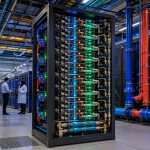
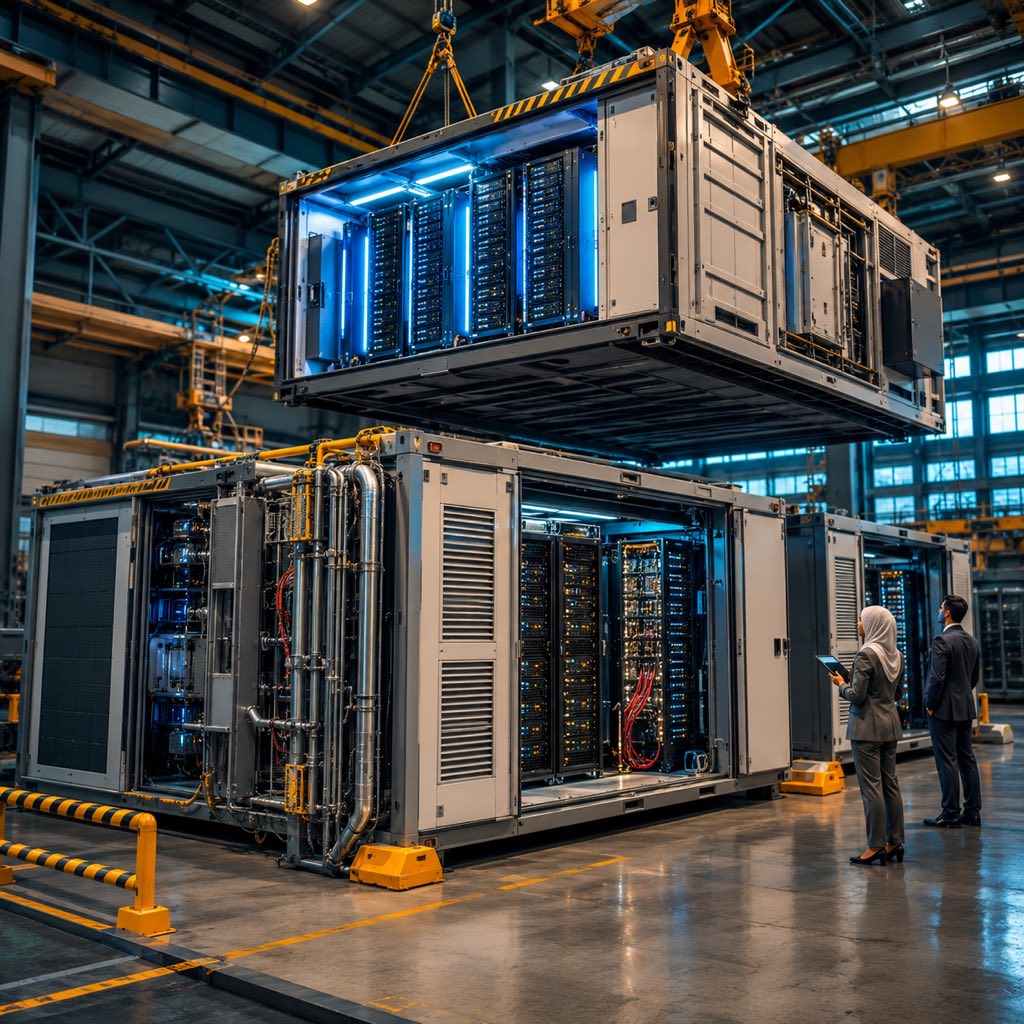
The term “modular data center” covers a wide range of deployment types, but the core value proposition is consistent: factory-manufactured compute modules that arrive on-site partially or fully assembled, dramatically compressing the on-site construction phase.
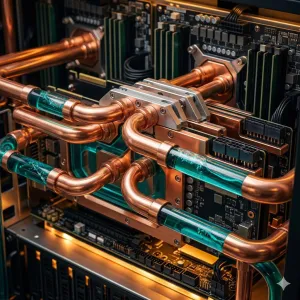
IEEE Spectrum’s coverage of modular deployments illustrates the range. Duos Edge AI builds compute pods measuring 55 feet long by 12.5 feet wide, each containing GPU racks with liquid cooling, capable of operating independently or networked together. A deployment of four pods delivers 576 GPUs per pod — 2,304 GPUs total — expandable to 4,608. LG CNS operates AI Modular Data Centers with 576 Nvidia GPUs per unit, with expanded versions supporting more than 4,600 GPUs per unit; the company’s Busan campus plan projects up to 50 units totaling over 28,000 GPUs.
The scale economics are significant. Introl’s analysis of modular data center economics documents that a prefabricated 2 MW AI facility costs approximately $8 million versus $14 million for traditional construction — a 43% saving. For a 5 MW deployment, the saving reaches $17 million, approximately 42.5% less than conventional builds. Per-kW pricing runs $2,800–$5,000/kW depending on vendor and density configuration.
Speed gains are equally material. Vapor IO deployed 36 micro modular data centers across 20 cities in 11 months — a pace impossible with traditional construction. A pharmaceutical company profiled in Introl’s analysis deployed 200 H100 GPUs in 5 months, 60% faster than a comparable traditional build. The mechanism is parallel manufacturing: while site preparation proceeds (months 1–3), the modules are being manufactured and tested in the factory (months 4–8), eliminating the sequential dependency that defines traditional construction timelines.
Factory testing also reduces commissioning risk. Introl reports that factory quality processes identify approximately 95% of issues before deployment, versus the field discovery rate in conventional builds. On-site labor requirements drop by roughly 70%.
Advertisement
Where the Bottlenecks Actually Sit
The modular approach compresses construction timelines, but it does not eliminate the fundamental constraint: power. A modular facility still needs a grid connection, and grid connection timelines are entirely unaffected by how fast the building goes up.
The 2026 AI data center construction analysis distinguishes clearly between “power-secured” and “announced” capacity. A site can have a fully manufactured modular facility ready to energize within six months, but if it is waiting in a five-year US interconnection queue, the modular speed advantage is irrelevant until grid connection materializes. The real competitive advantage of modular deployment accrues primarily to organizations that already have power commitments — where the question is how fast they can put GPU capacity behind a secured power position, not whether they can get power at all.
This is reshaping how modular data centers fit into the procurement stack. Rather than being deployed in greenfield locations where power must also be secured, the highest-value modular deployments are in colocation facilities, industrial campuses with existing high-voltage infrastructure, and municipalities where power is available but traditional build timelines are unacceptable. At facilities under 5 MW, modular now accounts for approximately 89% of new edge deployments, according to Introl’s market analysis.
The power efficiency argument is also gaining traction in procurement decisions. Modular facilities achieve approximately 15% better Power Usage Effectiveness (PUE) than site-built facilities, according to the same analysis — a meaningful ongoing cost advantage when electricity costs represent 40–60% of data center operating expense.
What Infrastructure Teams Should Do
1. Separate the power timeline from the construction timeline in your AI infrastructure planning
The most common planning error for teams evaluating modular deployment is conflating construction speed with total time-to-capacity. Model these as two independent tracks: power procurement (interconnection application, transformer procurement, electrical infrastructure) and facility deployment (module procurement, site preparation, installation, commissioning). The modular track typically runs 6–12 months; the power track runs 2–8 years depending on geography. The binding constraint in almost every case is power, not construction. Map your power-secured sites first, then apply modular deployment to them.
2. Use modular deployment to capitalize on stranded power positions
Organizations that hold power commitments in locations where traditional construction would be uneconomical — small-load colocation pockets, industrial sites with surplus substation capacity, campus environments — can now economically deploy 1–5 MW of AI compute in those positions using modular facilities. Duos Edge AI’s per-megawatt costs running approximately 50% lower than larger facilities makes sub-5 MW deployments economically viable in ways that traditional construction never could. Audit your power position before assuming a traditional campus build is required.
3. Require factory acceptance testing as a contract condition, not a nice-to-have
The 95% defect-detection rate in factory testing cited in modular deployment analyses reflects a structured commissioning process that many procurement teams are failing to specify contractually. Factory Acceptance Testing (FAT) and Site Acceptance Testing (SAT) protocols should be explicit contract deliverables, not implied terms. Given the lead times on replacement GPU components and cooling infrastructure, a defect discovered post-installation can represent weeks of capacity loss. Standardize FAT requirements across all modular procurement, regardless of vendor.
Where This Fits in 2026’s Infrastructure Race
The modular data center market is growing to meet a structural need, but it is not a complete solution to the AI infrastructure bottleneck — it is a partial one. The 31% actual-to-announced ratio for 2026 data center capacity reflects a power constraint that modular construction cannot resolve. What modular deployment does is compress the discretionary delay — the portion of the timeline attributable to construction complexity rather than regulatory or power procurement timelines.
Grand View Research estimates the modular data center market will more than double by 2030, with vendors including Schneider Electric, Vertiv, Hewlett Packard Enterprise, and Compass Datacenters all now offering modular solutions alongside newer entrants like Duos Edge AI and LG CNS. The competitive landscape is maturing quickly, which typically means standardization of specifications, tighter warranty terms, and more predictable lead times — all positive signals for infrastructure teams planning 2026–2028 deployments.
For organizations running AI at scale, the strategic question is not whether modular data centers are a viable option — they demonstrably are. The question is whether you have the power positions that let you capture the speed advantage they offer.
Frequently Asked Questions
How much cheaper are modular data centers compared to traditional builds?
According to analysis from Introl, a prefabricated 2 MW AI facility costs approximately $8 million versus $14 million for a traditionally constructed equivalent — roughly a 43% saving. For a 5 MW deployment, savings reach approximately $17 million (42.5% less). Per-kW pricing typically runs $2,800–$5,000/kW depending on vendor, density, and cooling configuration. Duos Edge AI’s per-megawatt costs are reported to run approximately 50% lower than larger traditionally constructed facilities. The efficiency advantage compounds over time through better PUE — modular facilities typically achieve 15% better Power Usage Effectiveness than site-built alternatives.
Can modular data centers support the same GPU density as traditional facilities?
Yes, modern modular data centers are specifically designed for high-density AI workloads. LG CNS’s AI Modular Data Center supports configurations of more than 4,600 GPUs within a single unit; Duos Edge AI’s compute pods support GPU racks similar to traditional data centers with liquid cooling for thermal management at densities ranging from 50 kW to 100 kW+ per rack. The key differentiator is that liquid cooling — which is essential for high-density GPU deployments — is more efficiently integrated in factory-built modules than in retrofitted traditional facilities, since cooling infrastructure can be co-designed and tested with the compute stack during manufacturing.
Does modular deployment eliminate the need for grid connection planning?
No. Modular construction compresses the facility build timeline but has no effect on grid connection timelines, which are the primary bottleneck in most primary markets. US interconnection queue wait times average approximately 5 years; London and Amsterdam are at 8 and 10 years respectively. A modular facility can be manufactured in parallel with grid connection applications, but it cannot be energized until power is available. The strategic value of modular deployment is maximized in locations where power commitments are already secured and the question is how quickly GPU capacity can be deployed behind an existing power position.
Sources & Further Reading
- Modular Data Centers Are Changing How AI Capacity Gets Delivered — IEEE Spectrum
- Modular Data Center Design for Rapid AI Deployment — Introl
- Global AI Data Center Construction 2026 — Archdesk
- AI Data Centers and the U.S. Electric Grid — Harvard Belfer Center
- US Data Center Electricity Demand and Public Opinion — Fortune
🔗 Related Intelligence
AI Racks at 1 MW: How AI Is Forcing a Complete Rethink of Data Center Design

Meta Deepens AI Infrastructure With 1B CoreWeave Deal
Grid Transformer Shortage: The 5-Year Bottleneck Stalling AI Data Centers in 2026

The $112 Billion Quarter: Inside the Q1 2026 Hyperscaler AI Infrastructure Sprint