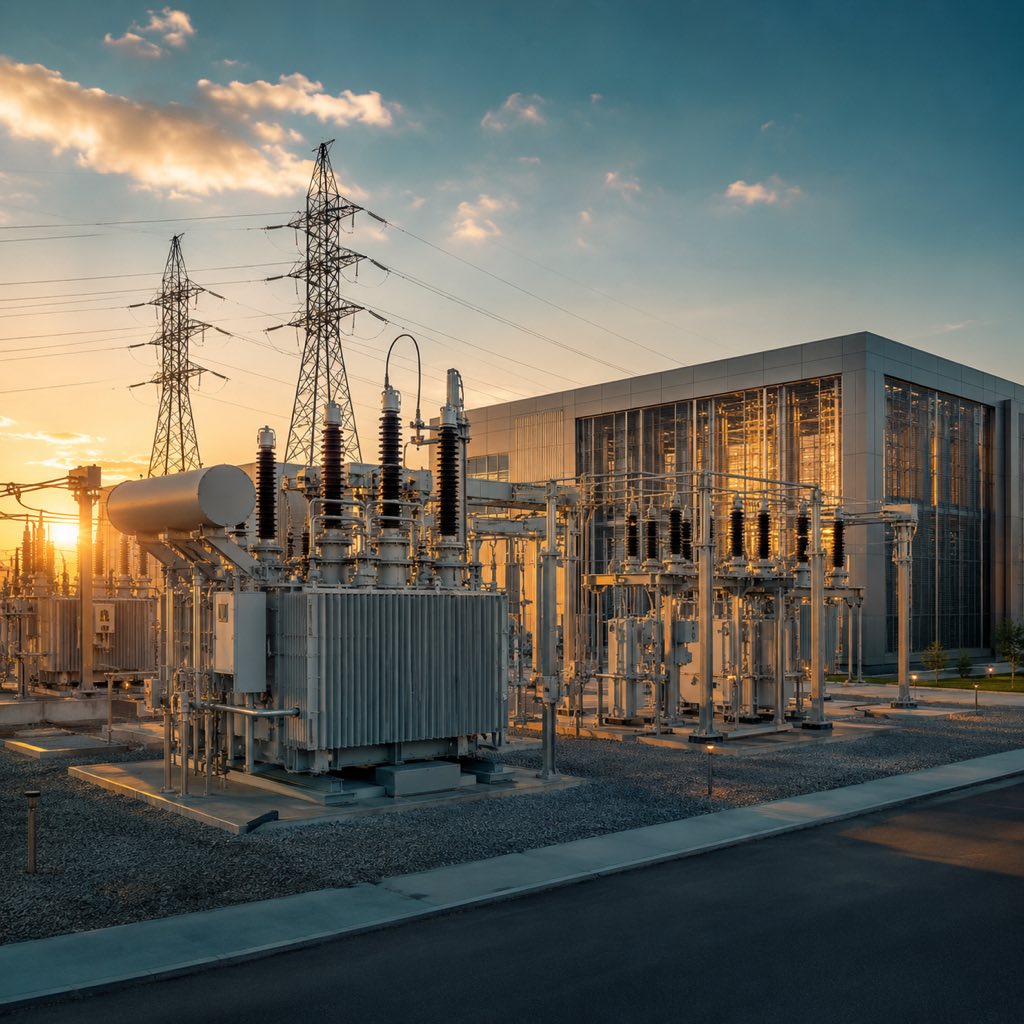
Why 2026 Is the Year the Power Gap Became Impossible to Ignore
For the past three years, the bottleneck in AI infrastructure was a software problem — finding the right model, the right inference stack, the right orchestration layer. In 2026, the constraint shifted to something far more tangible: steel, copper, and decades-old electrical grid architecture.
The numbers are stark. According to Wood Mackenzie research, the lead time for high-voltage substation transformers — the critical pieces of hardware that step electricity from transmission lines down to usable voltages — climbed from roughly 50 weeks in 2021 to 120 weeks on average in 2024, and has now reached 140–160+ weeks for standard substation units in 2026. Some large custom transformers carry lead times of 80 to 210 weeks. In practical terms, a project that places an equipment order today is looking at three years before that transformer arrives on site.
This is not a niche supply chain inconvenience. It is the constraint that determines when AI capacity actually comes online, and it is reshaping how hyperscalers, utilities, and enterprise IT teams must approach infrastructure planning through the end of the decade.
The aggregate demand picture is equally sobering. Bloom Energy’s 2026 Data Center Power Report projects U.S. data center IT load will nearly double from 80 GW today to 150 GW by 2028. In Texas alone, ERCOT revised its data center demand forecast for 2030 from 29 GW to 77 GW in a single planning cycle — a 165% upward revision that utilities had no time to absorb. Meanwhile, PJM’s January 2026 interconnection data shows 220 GW in preliminary applications for its next generation cycle, with only 8.2 GW currently under construction.
The gap between announced capacity and reality is measured not in months but in years, and the transformer is the single most unforgiving constraint in that gap.
The Anatomy of a Seven-Year Wait
When a data center developer wins a grid interconnection agreement, most assume the hard part is over. PJM’s data tells a different story. The average total timeline from project conception to operational status now exceeds seven years: approximately three years to reach an interconnection service agreement through the queue, followed by another four years navigating post-approval infrastructure. PJM Senior Manager Jeff Shields has noted directly that “issues outside of the queue are the biggest obstacle” to bringing projects online.
What are those obstacles? PJM’s January 2026 milestone-change data breaks down the delay categories: permitting accounts for 29% of post-approval timeline changes, supply chain issues for 23%, and a catch-all “other” category — covering EPC procurement, equipment sourcing, construction delays, and land access — for 28%. Together, these three categories explain more than 80% of why projects that have regulatory approval still take four additional years to flip a switch.
The equipment supply chain problem is the most structurally difficult to solve. Transformers are not commodity items. High-voltage units are custom-engineered, require specialized manufacturing facilities that exist in only a handful of countries, and cannot be rapidly scaled without multi-year factory investments. The global transformer manufacturing industry underinvested for decades because grid upgrade demand was modest and predictable. The sudden AI-driven demand spike has overwhelmed that capacity in a way that cannot be resolved by market signals alone in the near term.
A concrete illustration: Constellation Energy’s Three Mile Island Unit 1 restart — the much-publicized deal to supply nuclear power for Microsoft’s AI infrastructure — will not achieve full grid deliverability until transmission upgrade work is complete. The power agreement exists. The nuclear plant is operational. The transmission hardware is the blocker.
Advertisement
What Hyperscalers Are Actually Doing About It
The companies with the most at stake — and the most capital — are not waiting for the utility sector to solve this. The three major hyperscalers have collectively committed over $480 billion in infrastructure capex in 2026: Amazon Web Services at $200 billion, Google Cloud at approximately $180 billion, and Microsoft Azure at an estimated $100 billion for the full year, following Q1 spending of $34.9 billion and Q2 at $37.5 billion.
These are not ordinary IT budgets. They are land, steel, power, and silicon acquisition programs at a scale that forces hyperscalers to become infrastructure companies in their own right. Approximately one-third of U.S. data centers are expected to rely entirely on onsite power generation by 2030, and over 70% of data center developers are already evaluating onsite power providers, according to Bloom Energy’s 2026 survey. The practical implication: facilities that cannot secure grid power in acceptable timeframes are building their own grids — gas turbines behind the meter, nuclear offtake agreements, large-scale solar plus storage — to bypass the queue entirely.
From an architecture standpoint, the industry is also accelerating voltage transitions. By 2028, 60% of new data centers expect to deploy higher-voltage busway systems, and 45% anticipate full DC distribution architectures. Both changes reduce transmission losses within the facility and decrease dependence on the type of large step-down transformers that carry the longest lead times.
What Enterprise CIOs and Infrastructure Leaders Should Do Now
The hyperscaler response is instructive, but most enterprises cannot spend $180 billion to solve their infrastructure problem. The practical question is: how does a company that depends on cloud or colocation services navigate a world where the underlying power infrastructure is the binding constraint on AI capacity availability?
1. Treat Cloud Region Availability as a Power-Constrained Asset, Not a Software Toggle
Most enterprise cloud strategies treat regional availability as a given — you pick a region, you deploy resources, capacity is there. That assumption is increasingly wrong. Cloud providers are quietly managing capacity across regions based on power availability, and the regions that appear fully available today may face queue-position constraints within 12–18 months as hyperscaler campuses absorb available grid headroom.
Practically, this means enterprise cloud architects should map their critical AI workloads to specific availability zones and lock in reserved capacity before constraints tighten. Reserved instance commitments in regions with strong grid fundamentals — not just lowest latency — should become part of the capacity planning conversation. Bloom Energy’s data shows over 50% of data center developers already report that securing power has become more difficult in the past year; enterprise buyers are downstream of that difficulty.
2. Pressure Test Your Colocation Contracts for Power Guarantee Clauses
For organizations using colocation or wholesale data center space, the transformer shortage has a direct contractual implication. Colocation providers that are expanding or building new halls face the same equipment queues as hyperscalers. A contract that promises 5 MW of capacity in a new data hall by Q3 2027 may be implicitly premised on transformer deliveries that are already slipping.
Enterprise procurement teams should audit existing and pending colocation agreements for force majeure language, power delivery milestone commitments, and remediation clauses if capacity is delayed. Wood Mackenzie Principal Analyst Ben Boucher has warned that “if equipment lead times continue to rise, project delays will become more frequent” — which means enterprises with capacity locked into expansion timelines are carrying more risk than their contracts may acknowledge.
3. Build a Dual-Track Power Procurement Strategy for On-Premise AI Infrastructure
Organizations running on-premise AI infrastructure — GPU clusters, inferencing nodes, private cloud hardware — face the transformer problem directly when they expand campus power. A facility that needs to add 5–10 MW of new electrical capacity for AI compute is not exempt from the same equipment queues affecting hyperscale campuses.
The practical response is a dual-track approach: secure transformer orders immediately for planned 12–24 month expansion, and simultaneously evaluate interim alternatives — distributed UPS scaling, load-shifting existing HVAC and non-critical loads to free capacity, or leasing colocation space as a bridge while campus power is upgraded. Doing nothing and hoping equipment arrives on schedule is now the riskiest option.
4. Incorporate Power-Timeline Risk into AI Roadmap Planning
Most enterprise AI roadmaps are built around model capability timelines and software readiness — when will the model be accurate enough, when will the API be stable, when will the integration be complete. Almost none incorporate infrastructure lead-time risk as a first-class planning variable.
For organizations with on-premise AI infrastructure goals or plans to consume significant reserved cloud capacity by 2027–2028, the seven-year PJM average is a meaningful signal. Projects that require new electrical infrastructure should start the procurement and permitting processes now, not when the AI application is ready to deploy. The application waits for the transformer; the transformer does not wait for the application.
The Structural Lesson
The transformer shortage is a consequence of the same structural pattern that produced the semiconductor shortage of 2021–2023: decades of underinvestment in specialized manufacturing capacity, followed by a demand spike that exceeded what any reasonable planning horizon would have anticipated.
The difference is that chips can be fabricated faster when factories are built — a three-to-five year timeline for new fab capacity. Electrical grid infrastructure operates on much longer cycles. Transmission lines require ten-to-twenty year planning horizons. Transformer manufacturing requires multi-year retooling of specialized facilities. Utility permitting operates on regulatory calendars measured in years, not quarters.
The consequence for enterprise IT leaders is that the AI infrastructure timeline is no longer governed by software and silicon. It is governed by steel, copper, and the planning calendars of grid operators who were not designed to respond to AI demand curves. Organizations that internalize this reality — and begin treating power procurement as a strategic function equivalent to vendor selection or software architecture — will have structural advantages in the 2027–2030 window when the gap between announced AI capacity and available AI capacity will be at its widest.
The companies that assume the hyperscalers will solve this for them and that cloud capacity will remain elastic and abundant are making an assumption that the data no longer supports.
Frequently Asked Questions
Why are transformer lead times so long in 2026?
High-voltage transformers are custom-engineered components manufactured by a small number of specialized factories globally. For decades, grid upgrade demand was modest and predictable, so manufacturers did not invest in significant capacity expansion. The sudden surge in AI data center construction — which requires large substation transformers to step down transmission-level voltages — has overwhelmed global manufacturing capacity. Wood Mackenzie reports lead times rose from 50 weeks in 2021 to 140–160+ weeks by 2026, and new factory capacity takes multiple years to come online.
How does the transformer shortage affect enterprise cloud users?
Enterprise cloud users are downstream of the problem. When cloud providers and colocation operators cannot get transformer deliveries on schedule, new data center halls are delayed, regional capacity expansion slows, and the availability of reserved compute resources tightens. Over 50% of data center developers already report that securing power has become more difficult in the past year. This translates into longer lead times for reserved capacity commitments and potential availability zone constraints that enterprise architects must account for in their planning.
What is the realistic timeline for AI data center capacity to catch up with demand?
Based on current interconnection and equipment data, the gap is unlikely to narrow significantly before 2028–2029. PJM’s data shows the average timeline from project conception to operations now exceeds seven years, with post-approval phases alone running four years. U.S. data center IT load is projected to nearly double from 80 GW to 150 GW by 2028 — but much of the announced capacity that would close this gap is sitting in equipment queues and permitting pipelines that preclude rapid delivery.
Sources & Further Reading
🔗 Related Intelligence

The Hidden Bottleneck Halting the AI Data Center Boom: Transformer and Switchgear Shortages

Data Center Power Crisis: Grid Delays, PPAs, and SMRs Race to Keep AI Online
Modular Data Centers: The 6-Month Build Strategy Disrupting AI Infrastructure
The 49GW Shortfall: How Cloud Operators Are Solving the AI Power Grid Bottleneck