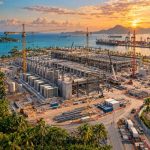
The Investment Wave Taking Shape
The Africa and Middle East data center market is at an inflection point. The April 2026 colocation report documents a market that grew at a 24.7% CAGR between 2021 and 2025, and projects a sustained 22.8% annual growth rate through 2030. These are not projections built on speculation — they reflect actual construction pipelines, signed hyperscaler lease agreements, and government-mandated data localization policies that are forcing enterprises to move data closer to home.
The drivers are structural and mutually reinforcing. On the demand side, AI and GPU workload requirements are forcing enterprises throughout the region to move from shared hosting arrangements to purpose-built colocation facilities that can handle high-density power loads (30-100 kW per rack, compared to 5-10 kW for conventional IT). Enterprise hybrid multi-cloud adoption — keeping sensitive data in-region while connecting to global hyperscaler services for AI workloads — is creating demand for local interconnection hubs. On the supply side, hyperscalers are accelerating capacity build-out across the region: Google has announced expansion into South Africa, AWS has committed $5.3 billion to a Saudi Arabia region, and Microsoft has pledged $14 billion in Indonesia (the regional spillover effects of these investments extend across adjacent markets).
The construction market is equally active. An Arizton report on Africa data center construction projects the Africa construction sub-market alone to reach $4.58 billion by 2031, with Google, Microsoft, and AWS expanding investments across the continent. New entrants include Raxio (East Africa campus openings), Vantage (Johannesburg campus), and DataVolt/Colt DCS (Riyadh expansion).
The Country Map: Where Capacity Is Being Built
The nine-country leadership group reflects two distinct market dynamics — established African markets and Gulf petrodollar-funded expansion.
South Africa remains the anchor of the African colocation market, holding the dominant share of continental capacity. Johannesburg is the primary interconnection hub for Sub-Saharan Africa, with carrier-neutral facilities that connect to the major submarine cable systems. The challenge for South Africa is Eskom: chronic load shedding, described in the report as “a chronic challenge,” forces colocation operators to run diesel generators at significant cost, compressing margins and limiting the attractiveness of the market relative to more reliable grid alternatives. Despite this, South Africa’s internet penetration, financial services concentration, and submarine cable connectivity (particularly the 2Africa cable) ensure its continued dominance.
Nigeria and Kenya represent the fastest-growth markets on the continent. Nigeria’s 220 million+ population, Lagos’s fintech concentration, and improving international connectivity are driving demand for local data center capacity that the country’s infrastructure has historically lacked. Kenya’s position as East Africa’s digital hub — Nairobi’s concentration of regional headquarters, NGOs, and development finance institutions — creates consistent enterprise demand. Both markets face power reliability constraints, but both are attracting investment from operators willing to build on-site generation capacity (typically natural gas gensets with battery backup).
Egypt occupies a strategic position as the landing point for multiple major submarine cable systems connecting Africa to Europe and Asia. The government’s explicit digital transformation strategy and favorable data center investment zones are making Egypt a credible alternative to European colocation for latency-sensitive MENA workloads.
The Gulf states — UAE, Saudi Arabia, Qatar, Bahrain, Kuwait — represent the high-spending segment of the market. UAE (particularly Dubai) has operated hyperscale-capable facilities for over a decade. Saudi Arabia’s Vision 2030 technology investment, anchored by NEOM and ARAMCO Digital, is driving a construction surge that is directly funded by petrodollar capital. Qatar and Bahrain serve as secondary hubs with regulatory environments that attract financial services and government workloads.
Advertisement
What Founders, Operators, and Investors Should Do
The $6.2 billion expansion between 2026 and 2030 creates specific opportunities across three stakeholder groups.
1. Colocation Operators: Focus on Edge Markets, Not the Established Hubs
The Johannesburg, Dubai, and Cairo markets are already served by established operators with long-term anchor tenants. The growth opportunity for new entrants is in the secondary and tertiary markets where enterprise demand exists but supply is limited. ConsoleConnect analysis identifies “limited connectivity outside primary cities” as Africa’s second-biggest constraint after power. Operators who can deploy carrier-neutral facilities in Nairobi, Lagos Island, Accra, and Dar es Salaam — with reliable on-site generation and submarine cable connectivity — will capture enterprise demand that currently routes through South African or European facilities at significant cost and latency penalties.
2. Investors and Infrastructure Funds: Model Energy Resilience as the Primary Underwriting Variable
In the Africa segment, the energy constraint is not a risk to hedge — it is the underwriting variable that determines whether a facility is viable. The Africa DCA 2026 economic report identifies power reliability as “the continent’s defining development constraint.” The operator valuation model for African colocation looks fundamentally different from the US or European model: instead of power costs as a percentage of PUE (Power Usage Effectiveness), the variable is power availability — uptime percentage achieved through combination of grid, on-site generation, and storage. Funds underwriting African data center investments should require explicit energy resilience modeling (grid availability %, generator runtime hours, battery backup capacity) as a first-tier underwriting criterion, not a due diligence footnote.
3. Enterprise Cloud Architects: Use the Regional Build-Out to Renegotiate Latency and Compliance Tradeoffs
Enterprises that have been routing Middle East and Africa traffic through European data centers — accepting 80-120ms latency penalties and potential data sovereignty issues — now have credible alternatives across the nine-country coverage zone. The build-out of Africa-focused cloud and data center infrastructure by hyperscalers and colocation operators is creating interconnection options that did not exist 24 months ago. Enterprise architects should audit their current traffic routing against the new capacity map: for any application serving users in Nigeria, Kenya, South Africa, UAE, or Saudi Arabia, re-evaluate whether the European colocation anchor is still the optimal latency and compliance configuration.
What Comes Next: The 2027-2030 Inflection
The 22.8% CAGR projection through 2030 implies that the colocation market will roughly double in four years. The structural drivers — AI workload growth, data localization mandates, enterprise hybrid cloud adoption, and hyperscaler geographic expansion — are well-established enough to consider the directional forecast reliable. The execution risk is concentrated in two variables.
First, power infrastructure. The Middle East cooling challenge (water scarcity restricts cooling options in extreme heat) and the Africa grid reliability challenge create operational complexity that will keep margins below those achievable in temperate, grid-stable markets. Operators who solve these constraints — through liquid immersion cooling, waste heat recovery, or on-site renewable generation — will have durable competitive advantages over those relying on conventional air cooling and grid power.
Second, submarine cable maturation. The Africa-1, 2Africa, Equiano, and PEACE cable systems are completing construction and entering service across the 2025-2027 window. Once these systems are carrying live traffic at scale, the latency and bandwidth constraints that have historically limited Africa’s role as a cloud destination will largely resolve. The colocation market that scales in response will be competing on power, skills, and service quality — not connectivity — for the first time.
Frequently Asked Questions
Why is South Africa still dominant in African colocation despite the Eskom load shedding problem?
South Africa’s dominance reflects the compounding advantages of early mover status: established submarine cable landing points (particularly the 2Africa cable, WACS, and SEACOM), carrier-neutral interconnection facilities that took years to build, financial services concentration that requires local data processing, and an existing enterprise customer base with long-term colocation leases. These advantages are sticky — enterprises don’t migrate their colocation anchor without significant switching costs. Eskom load shedding compresses operator margins and discourages new entrants, but it does not displace the anchor tenants who have already built operational continuity around on-site generation.
What is the typical power density requirement for AI workloads compared to conventional enterprise IT?
Conventional enterprise IT colocation runs at 5-10 kW per rack — a power density that existing facilities across the region can support. AI inference and training workloads, particularly GPU clusters, require 30-100 kW per rack and sometimes higher for liquid-cooled AI-specific configurations. This 5-10x increase in power density means that existing colocation facilities built for conventional IT cannot simply be repurposed for AI workloads without significant power delivery and cooling upgrades. New AI-optimized facilities are being designed from the ground up for high-density power, with liquid cooling infrastructure that conventional air-cooled facilities cannot easily retrofit.
Which submarine cable systems are most important for the Africa-Middle East colocation market?
The key cable systems for regional connectivity are: 2Africa (Meta-backed, 45,000 km, multiple African coastal landings), PEACE (connecting Pakistan to Europe via East Africa and Egypt), Equiano (Google, West Africa to Europe), and the newly commissioned Medusa system (480 Tbps, Mediterranean including Algeria). For the Gulf states, the AAE-1 and SEA-ME-WE systems provide primary connectivity to Asia and Europe. The completion of these systems between 2025 and 2027 is the connectivity catalyst that makes the $11.1 billion market projection feasible.
—
Sources & Further Reading
- Africa and Middle East Data Center Colocation Market to Reach $11.1B by 2030 — GlobeNewswire
- Data Centres in Africa 2026: The Economic Report — Africa DCA
- Africa Data Center Report 2026 — Xalam Analytics
- Africa Data Center Construction Market Set to Hit $4.58B by 2031 — Arizton via PR Newswire
- Powering Africa’s Digital Future: The Rise of Cloud Data Centres and Network Resilience — ConsoleConnect
🔗 Related Intelligence

Africa’s Data Center Boom: 360 MW Live, a Chronic Energy Gap, and the Hyperscaler Delay

Africa Data Hub: MTN and a Gulf Data-Centre Tycoon Bet 150MW on the Continent’s AI Future

Data Centers as Power Catalysts: Africa’s Cloud Boom Modernizes Its Energy Grid

Sovereign Cloud Rising: How African Nations Are Building Local Data Infrastructure