The $1.1 Billion Bet on Orbital Compute
Starcloud, a Redmond, Washington-based startup building solar-powered data centers in orbit, closed a $170 million Series A on March 30, 2026, reaching a $1.1 billion valuation. The round, led by Benchmark and EQT Ventures, is more than double the next-largest Series A in Y Combinator history. It brings the company’s total capital raised to $200 million.
What makes Starcloud remarkable is speed. Founded in January 2024 as Lumen Orbit, the company designed, built, and launched its first satellite in just 21 months on a $3 million pre-seed budget. Seventeen months after its YC demo day, it reached unicorn status — the fastest in YC’s two-decade history.
The founding team brings a rare combination of space hardware, hyperscale cloud, and strategic experience. CEO Philip Johnston is a second-time founder with degrees from Harvard, Wharton, and Columbia who previously led satellite projects at McKinsey. CTO Ezra Feilden spent a decade at Airbus Defence and Space designing deployable solar arrays and holds a PhD from Imperial College London. Chief Engineer Adi Oltean spent 20 years building GPU clusters at Microsoft Azure before moving to SpaceX, where he engineered Starlink’s tracking beam system and holds 25 patents.
From Shakespeare to Gemma: Proving AI Works in Orbit
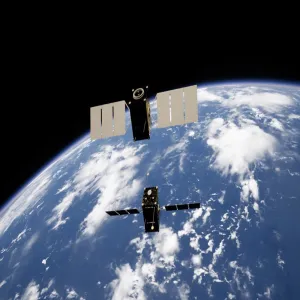
Starcloud’s thesis rests on a simple premise: AI demands more power than Earth’s grids can deliver, and the sun never sets in orbit. The company’s first proof point came in December 2025, when Starcloud-1 became the first spacecraft to train a large language model. The satellite carried an NVIDIA H100 GPU — what NVIDIA called 100 times more powerful compute than anything previously sent to orbit — and used it to train nanoGPT, Andrej Karpathy’s compact language model, on Shakespeare’s complete works.
Beyond training, Starcloud-1 also became the first spacecraft to run inference on a high-powered GPU, operating Google DeepMind’s Gemma model in orbit and returning responses to ground stations. These milestones demonstrated that the thermal, power, and vibration challenges of running data-center-grade silicon in space are solvable engineering problems, not theoretical barriers.
Advertisement
Why Earth Is Running Out of Room
The terrestrial data center industry is hitting physical limits. According to the Data Center Watch report, $64 billion worth of data center projects have been blocked or delayed in the past two years due to local opposition. The International Energy Agency projects global data center electricity consumption will exceed 1,000 terawatt-hours by the end of 2026 — equivalent to Japan’s entire annual electricity usage.
The opposition is bipartisan. Fortune reported in December 2025 that NIMBY backlash was turning voters in Republican strongholds against AI data center projects. By January 2026, both Senator Bernie Sanders and Governor Ron DeSantis had publicly opposed new data center construction, citing electricity price impacts on residents. Data center power demand is expected to rise five-fold over the next decade, reaching 176 gigawatts — the combined output of Australia’s and the UK’s entire power grids.
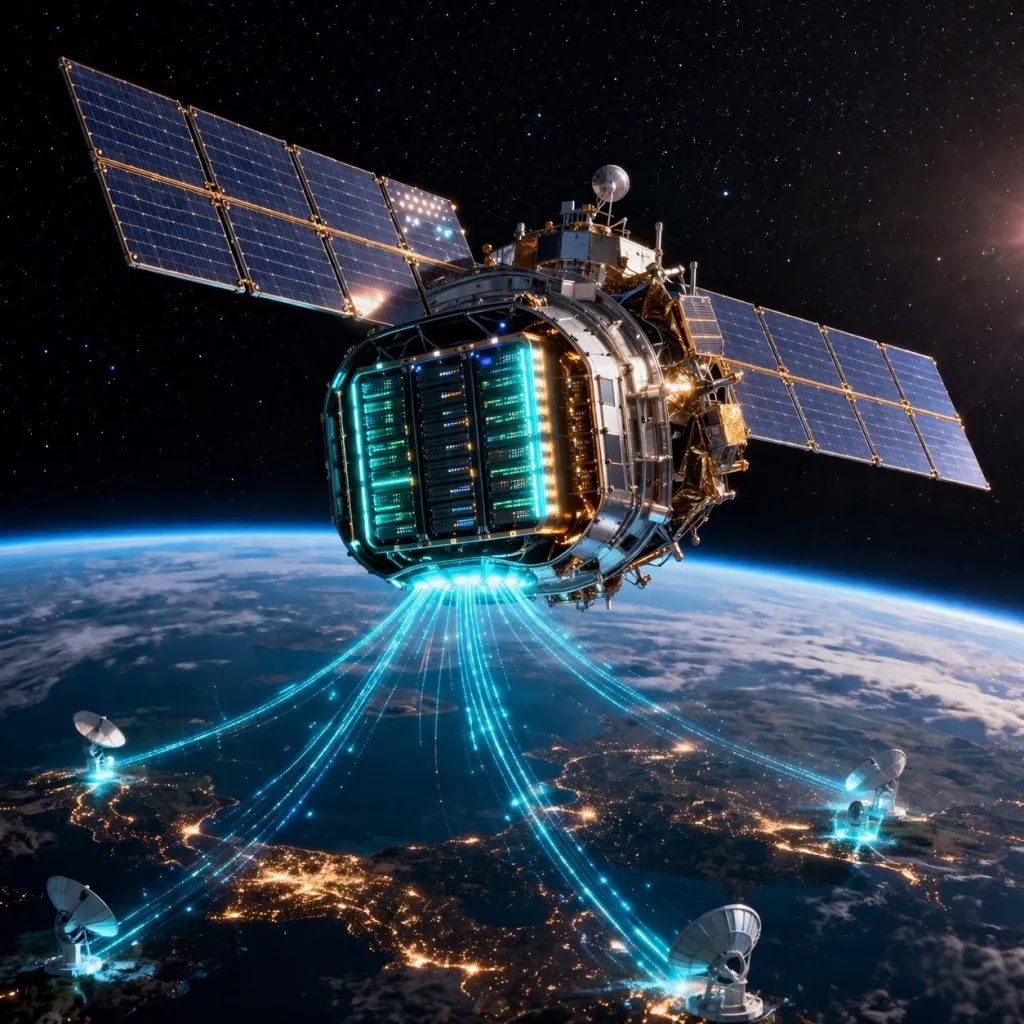
This is the market gap Starcloud is targeting. In sun-synchronous orbit at 600 to 850 kilometers altitude, solar arrays provide near-continuous power with no grid dependency, no permitting battles, and no residential neighbors.
The Roadmap: From Prototype to 88,000 Satellites
Starcloud’s ambitions scale steeply. The next major milestone is Starcloud-2, slated for October 2026. It will carry NVIDIA H100 and Blackwell hardware alongside the first AWS Outposts deployment in space, letting developers access orbital compute through familiar Amazon Web Services tooling. The company claims it will generate 100 times more power than its predecessor and deploy the largest radiator ever placed in orbit to handle the thermal load.
Looking further ahead, Starcloud filed with the FCC in March 2026 for a constellation of up to 88,000 satellites. The long-term vision includes Starcloud-4 spacecraft with solar arrays four kilometers on each side, capable of powering five-gigawatt data centers. The constellation would use optical intersatellite links and communicate with broadband networks like Starlink, Amazon’s Project Kuiper, and Blue Origin’s Tera Wave.
The investor roster reflects the convergence of space and cloud capital. Beyond Benchmark and EQT, the oversubscribed round drew Macquarie Capital, NFX, 776 Ventures, and individual backers including former Boeing CEO Dennis Muilenburg and former Starbucks CEO Kevin Johnson.
The Competitive Landscape: SpaceX Enters the Ring
Starcloud is not alone in the orbital data center race. SpaceX filed its own FCC application in January 2026 for up to one million orbital data center satellites — an order of magnitude larger than Starcloud’s proposal. The FCC accepted the filing in February. With SpaceX’s proven launch cadence and Starlink’s existing 10,000-satellite infrastructure, the company brings formidable advantages in cost-per-kilogram to orbit and operational experience.
Yet Starcloud has first-mover credibility on the compute side. It is the first to put an H100 in orbit, the first to train an LLM in space, and the first to secure an AWS Outposts deployment beyond Earth. A partnership with Crusoe aims to deliver the first public cloud in space by 2027.
The fundamental question is not whether orbital data centers are technically feasible — Starcloud has already proven they are. The question is whether the economics can compete with terrestrial alternatives before the power crisis forces the industry’s hand.
Frequently Asked Questions
What has Starcloud actually demonstrated in space so far?
Starcloud launched its first satellite, Starcloud-1, in November 2025 carrying an NVIDIA H100 GPU. In December 2025, it became the first company to train a large language model in orbit (nanoGPT on Shakespeare’s works) and the first to run LLM inference on a high-powered GPU in space using Google DeepMind’s Gemma model. These milestones proved that data-center-grade computing hardware can operate reliably in orbital conditions.
Why are terrestrial data centers facing so much opposition?
The AI boom is driving unprecedented demand for compute power, and data centers consume enormous amounts of electricity. Over $64 billion in data center projects have been blocked or delayed by local opposition in the past two years. Residents and officials across the political spectrum — from Senator Bernie Sanders to Governor Ron DeSantis — have opposed new construction due to electricity price increases, water usage for cooling, and noise pollution. Global data center power demand is projected to rise five-fold over the next decade.
How does Starcloud compare to SpaceX’s orbital data center plans?
Starcloud filed for an 88,000-satellite constellation in March 2026, while SpaceX filed for up to one million orbital data center satellites in January 2026. SpaceX has the advantage of proven launch infrastructure and its existing Starlink network, but Starcloud has first-mover status on the compute side — it was first to put an H100 in orbit, first to train an LLM in space, and first to secure an AWS Outposts deployment beyond Earth. Both companies are targeting the same terrestrial power bottleneck.
Sources & Further Reading
- Starcloud Raises $170M Series A at $1.1bn Valuation Led by Benchmark and EQT Ventures — BusinessWire
- Starcloud Raises $170 Million Series A to Build Data Centers in Space — TechCrunch
- Nvidia-Backed Starcloud Trains First AI Model in Space — CNBC
- Starcloud Files Plans for 88,000-Satellite Constellation — SpaceNews
- Starcloud to Launch AWS Outposts Hardware in Space — DataCenterDynamics
- $64 Billion of Data Center Projects Blocked or Delayed — Data Center Watch
- SpaceX Files Plans for Million-Satellite Orbital Data Center Constellation — SpaceNews