Adoption Doubles in Twelve Months
The construction industry has long been branded a technology laggard. That narrative is crumbling. ServiceTitan’s 2026 Commercial Specialty Contractor Industry Report, based on a survey of more than 1,000 commercial construction leaders conducted by Thrive Analytics, found that 38% of contractors now report measurable business impact from AI. That figure stood at just 17% in 2025.
The doubling did not happen in a vacuum. Rising labor costs are pushing the industry toward automation: 71% of contractors report rising wages, up from 55% a year earlier. With margins under pressure and skilled workers in short supply, AI is no longer an experiment reserved for industry giants.
A separate Bluebeam AEC Technology Outlook survey of over 1,000 architecture, engineering, and construction professionals provides additional context: only 27% of AEC firms currently use AI, but 94% of those already using it plan to increase investment in 2026. Among early adopters, 68% have saved at least $50,000, and 46% have saved 500 to 1,000 hours through AI tools.
Automated Estimating Rewrites the Bid Process
Cost estimation has traditionally consumed hours of manual takeoff work, spreadsheet wrangling, and experienced guesswork. AI estimating tools are compressing that timeline from half a day to minutes while achieving 85% to 90% accuracy compared to manually prepared estimates.
ServiceTitan’s data shows 24% of construction firms now use AI for cost estimation and budgeting, with another 22% applying it to bid management. Companies like Togal.AI report 97% accuracy in automated takeoffs, while Kreo’s technology detects room boundaries, wall runs, and opening counts from PDF architectural drawings with 85-92% accuracy for standard building geometry.
The downstream effects are significant. Firms using AI-driven estimating report 70-80% faster takeoffs, up to 90% fewer errors, 20% higher bid win rates, and a 15% reduction in project cost overruns. For an industry where a single miscalculation can erode an entire project’s margin, that accuracy floor changes the risk equation.
Advertisement
Autonomous Machines Move from Showroom to Jobsite
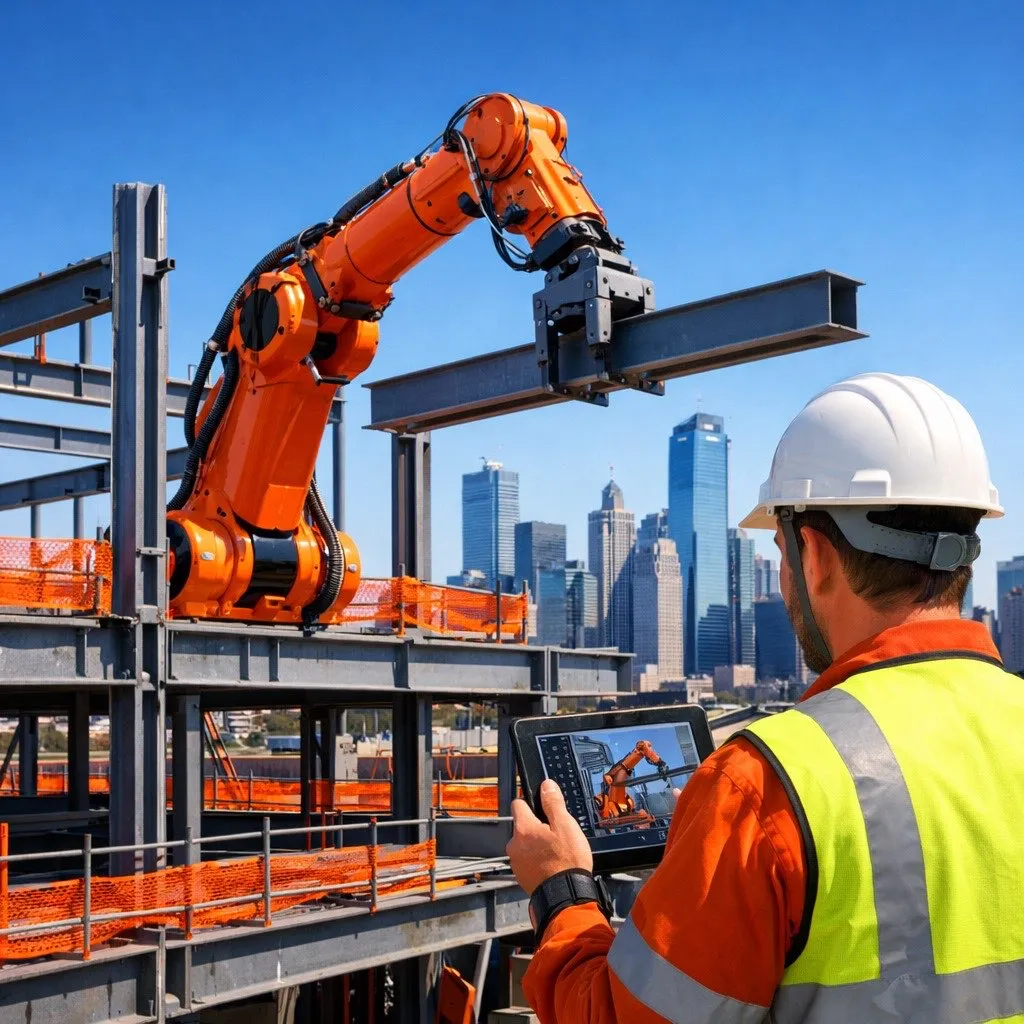
At CES 2026, Caterpillar unveiled five autonomous construction machines — a wheel loader, dozer, haul truck, excavator, and compactor — built on integrated AI, machine learning, computer vision, and edge computing. The systems rely on LiDAR, radar, GPS, and high-resolution cameras to create a continuous 360-degree digital view of the jobsite.
The excavators support autonomous trenching, loading, grading, and related operations. Caterpillar is also piloting Cat AI Assistant, an onboard system built on Nvidia’s Jetson Thor physical AI platform, starting with the mid-size Cat 306 CR Mini Excavator. The assistant answers operator questions, provides safety guidance, and schedules maintenance — essentially a personal AI co-pilot for heavy equipment operators.
Caterpillar backed its technology bet with a $25 million, five-year commitment to workforce education, funding programs to help workers transition into digital and autonomous roles. The message is clear: autonomous equipment is not replacing operators, but operators who use AI will replace those who do not.
Gartner listed physical AI as one of its top technology trends for 2026. Industry observers note that while full autonomy remains years away, the combination of semi-autonomous equipment, AI-assisted controls, and real-time sensor fusion is already delivering 30% productivity gains in excavation work on early adopter sites.
Safety AI Cuts Incident Rates in Half
Construction remains one of the most dangerous industries globally, but AI-powered safety systems are producing dramatic improvements. Oracle launched its Construction and Engineering Advisor for Safety in March 2026, an AI-enabled predictive intelligence solution that analyzes historical incident data, weather patterns, crew schedules, and site conditions to flag risks before they become injuries.
Independent studies show AI-monitored construction sites experience 40-60% fewer safety incidents compared to traditionally monitored sites. Some deployments have demonstrated up to 50% reduction in incident rates and 75% reduction in workers’ compensation costs within the first year.
Computer vision cameras, wearable sensors, and equipment monitoring systems work in concert to detect hazards in real time: an operator not wearing a hard hat, a crane operating too close to power lines, or a trench wall showing early signs of collapse. The shift from reactive incident reporting to predictive prevention represents one of the most immediate and measurable returns on AI investment in construction.
The Adoption Gap and What Comes Next
Despite the acceleration, a significant gap persists. ServiceTitan’s survey found that 44% of contractors cite lack of training as a top barrier to AI adoption, with integration complexity tying at 44%. Only 20% of contractors operate on a single software platform, meaning most firms juggle multiple disconnected systems that make AI deployment harder.
The most common entry point is pragmatic: 59% of contractors who have adopted AI use features embedded in their existing software rather than standalone AI tools. This embedded approach — AI baked into the estimating platform, the scheduling tool, or the safety system a contractor already uses — is proving to be the path of least resistance.
The global AI in construction market is valued at $6.02 billion in 2026 and is projected to reach $24.3 billion by 2030 at a 16.9% CAGR, according to industry forecasts. With 54% of contractors willing to invest in AI within the next one to three years, the current adoption curve suggests the 38% measurable-impact figure will look conservative within 18 months.
Frequently Asked Questions
How accurate is AI-powered construction estimating compared to manual methods?
AI estimating tools currently achieve 85% to 90% accuracy compared to manually prepared estimates, with some specialized systems like Togal.AI reporting up to 97% accuracy on automated takeoffs. These tools compress a process that traditionally took half a day into minutes, while reducing errors by up to 90% and improving bid win rates by approximately 20%.
What autonomous construction equipment is available in 2026?
Caterpillar unveiled five autonomous machine types at CES 2026: a wheel loader, dozer, haul truck, excavator, and compactor, all built on AI, computer vision, and edge computing with LiDAR, radar, and GPS sensors. The company is also piloting Cat AI Assistant on its 306 CR Mini Excavator using Nvidia’s Jetson Thor platform, providing operators with real-time guidance and maintenance scheduling.
What are the main barriers to AI adoption in construction?
According to ServiceTitan’s survey of over 1,000 contractors, the top barriers are lack of training and integration complexity, both cited by 44% of respondents. Only 20% of contractors operate on a single software platform, making AI deployment across fragmented systems difficult. The most successful adoption path has been embedded AI within existing software, used by 59% of AI-adopting contractors.
Sources & Further Reading
- ServiceTitan Report Finds AI Adoption More Than Doubles Among Commercial Contractors — GlobeNewsWire
- Caterpillar Taps Nvidia to Bring AI to Its Construction Equipment — TechCrunch
- New Bluebeam Report Shows Early AI Adopters in AEC Seeing Significant ROI — Bluebeam
- Oracle Transforms Construction Safety Management with AI — Oracle
- AI in Construction Market Size & Industry Report — Fortune Business Insights
- Construction AI Adoption 2026: Usage Doubles as Firms Embrace Smart Tools — Construction Owners