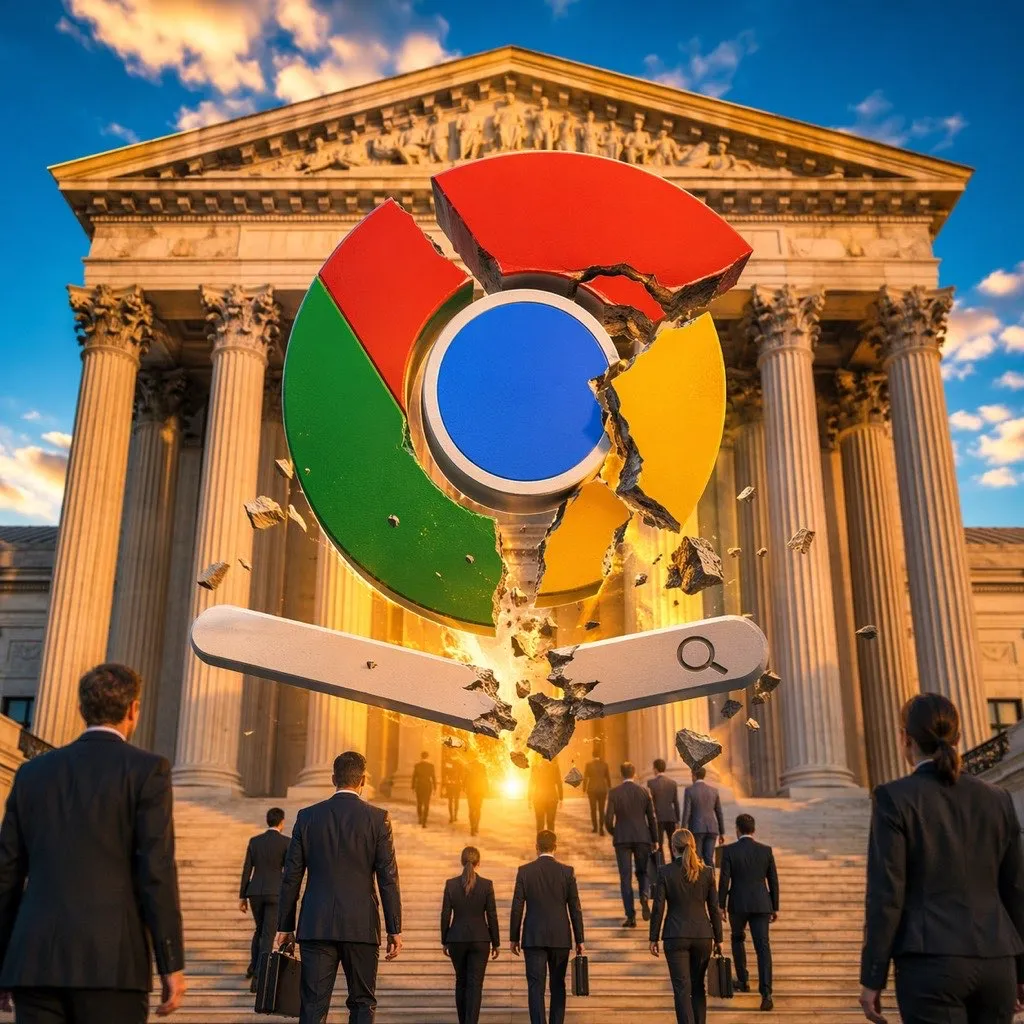
The Order That Rewrites Search Competition
On April 11, 2026, the US District Court for the District of Columbia issued its formal prohibition order against Google, cementing remedies that followed a years-long antitrust battle. The order prohibits Google from entering or maintaining exclusive contracts covering Search, Chrome, Google Assistant, and Gemini app distribution. It mandates that Google share portions of its search index and aggregated user-interaction data with qualified competitors for five years.
The ruling represents the most significant antitrust action against a technology company since the Microsoft case in the early 2000s. Google, which commands approximately 91.6% of the global search market, must now provide rivals with access to the data infrastructure that sustains that dominance.
Google can still pay distributors for default placement, including its estimated $20 billion annual payment to Apple, but those payments cannot be conditioned on exclusivity and distribution agreements are limited to one-year terms. Apple can now offer rival search engines alongside Google without violating its distribution contract.
What Google Must Actually Share
The data-sharing mandate targets Google’s core competitive moat. Google’s search index is more than twice the size of Microsoft Bing’s, the closest competitor. The court ordered Google to make portions of this index, along with signals like crawl dates, spam scores, click patterns, and elements of its RankEmbed model, available to qualified competitors on commercial terms.
The distinction matters: “qualified competitors” is narrower than “any third party.” The court defined specific criteria for which companies can access the data, creating a structured licensing regime rather than an open data dump. Privacy safeguards are built into the framework, with aggregated data provided rather than individual user records.
For competitors, the value is immediate. Crawling the web at Google’s scale costs hundreds of millions of dollars annually. Licensing access to Google’s existing index could allow smaller search engines and AI search products to build competitive search experiences without replicating Google’s infrastructure investment. The ruling specifically noted that generative AI products could use the index to improve output quality and build sufficient scale to construct their own indexes over the medium term.
Advertisement
What Google Keeps
The ruling is a behavioral remedy, not a structural one. Judge Amit Mehta rejected the DOJ’s request to force Google to divest Chrome, finding such measures disproportionate. Chrome, Android, Google Search, and the Gemini AI product all remain under Google’s ownership.
The $20 billion Apple default search deal also survives in modified form. Google can continue paying Apple for default placement, and Apple continues collecting billions annually. The change is structural: Apple is now free to offer competing search engines and AI search alternatives to users without contractual restriction.
A technical oversight committee will monitor Google’s compliance with the data-sharing requirements, though Google has already challenged this provision in its January 2026 appeal. The company specifically contests the data-sharing mandates and the oversight committee’s authority, arguing they impose undue technical burdens and risk exposing proprietary systems.
Both Sides Appeal
Neither the DOJ nor Google is satisfied with the outcome. Google filed its appeal on January 16, 2026, contesting the data-sharing requirements as technically burdensome and the oversight provisions as exceeding judicial authority.
In early April 2026, the DOJ and 38 state attorneys general filed a cross-appeal, challenging Judge Mehta’s refusal to order Chrome divestiture and arguing that behavioral remedies alone are insufficient to restore competition in search. The appeal specifically targets the preservation of the Apple default search arrangement, which critics argue perpetuates the distribution advantage that created Google’s monopoly in the first place.
The DC Circuit Court of Appeals is expected to hear arguments in late 2026 or early 2027. The outcome will determine whether the search market sees genuine structural competition or whether behavioral remedies prove as ineffective as skeptics predict.
The AI Search Dimension
The timing of this ruling intersects with a tectonic shift in how people find information. Google’s search market share has already slipped from 80% in June 2024 to roughly 70% by mid-2025, partly driven by AI search tools like Perplexity, ChatGPT, and Anthropic’s offerings that answer questions directly rather than providing links.
The data-sharing mandate could accelerate this shift. AI search products require high-quality web index data to train and run their systems. If competitors can license portions of Google’s index rather than building their own from scratch, the barrier to entry for AI-powered search drops significantly. The court explicitly acknowledged this possibility, noting that index access could decrease costs for both traditional search engines and generative AI products.
Whether these remedies arrive too late to matter is the central question. Google has already integrated AI into its own search product, and its infrastructure advantages extend far beyond the index itself. But for the first time in search history, competitors will have a legal right to access the data that built Google’s dominance.
Frequently Asked Questions
What data must Google share with competitors under the antitrust order?
Google must share portions of its search index, which is more than twice the size of its nearest competitor Bing, along with aggregated user-interaction data including crawl dates, spam scores, click patterns, and elements of its RankEmbed model. The data goes to “qualified competitors” under a structured licensing regime with privacy safeguards, not as an open data dump. The sharing requirement lasts five years.
Does Google have to sell Chrome or end the Apple search deal?
No. Judge Mehta rejected the DOJ’s request to force Chrome divestiture, finding it disproportionate. Google’s $20 billion annual payment to Apple for default search placement also continues, but the deal can no longer be exclusive. Apple is now free to offer rival search engines, and all distribution agreements are limited to one-year terms. Both the DOJ and Google have appealed the ruling.
How could this ruling affect AI search competitors like Perplexity or ChatGPT?
The ruling could significantly lower barriers for AI search products. Crawling the web at Google’s scale costs hundreds of millions annually, but licensing access to Google’s index would let AI search companies build competitive products without that infrastructure investment. The court explicitly noted that generative AI products could use the index data to improve their outputs and build independent indexes over time.
Sources & Further Reading
- DOJ Wins Significant Remedies Against Google — US Department of Justice
- Federal Court Endorses Behavioral Remedies in Google Search Litigation — Congress.gov
- Google Avoids Breakup But Must Give Up Exclusive Search Deals — TechCrunch
- Google Antitrust Ruling: What Remedies Mean for Search and AI — Search Engine Journal
- Impact of Google’s Antitrust Remedies on Monopolies — American Action Forum
- Google Search Remedies and AI Advantage — Public Knowledge