The Filing That Rewrote AI’s Supply Chain
On April 6, 2026, Broadcom filed an 8-K with the SEC that quietly reshaped the AI infrastructure landscape. The filing confirmed two landmark agreements: a long-term deal with Google to design and supply future generations of Tensor Processing Units through 2031, and an expanded collaboration giving Anthropic access to approximately 3.5 gigawatts of TPU-based compute capacity starting in 2027.
These are not speculative partnerships. They are backed by a $73 billion AI-specific order backlog, part of Broadcom’s $162 billion consolidated backlog, deliverable over 18 months. The AI switches component alone exceeds $10 billion. For context, Broadcom’s Q1 fiscal year 2026 AI revenue hit $8.4 billion, up 106% year-over-year, on consolidated revenue of $19.3 billion.
CEO Hock Tan was unambiguous about where the trajectory leads: Broadcom has “line of sight to achieve AI revenue from chips, just chips, in excess of $100 billion in 2027.”
Inside the Google TPU Partnership
The Broadcom-Google relationship is hardly new. Broadcom has been Google’s primary custom silicon design partner for nearly a decade, but the new agreement extends and deepens the engagement to a degree that reshapes competitive dynamics.
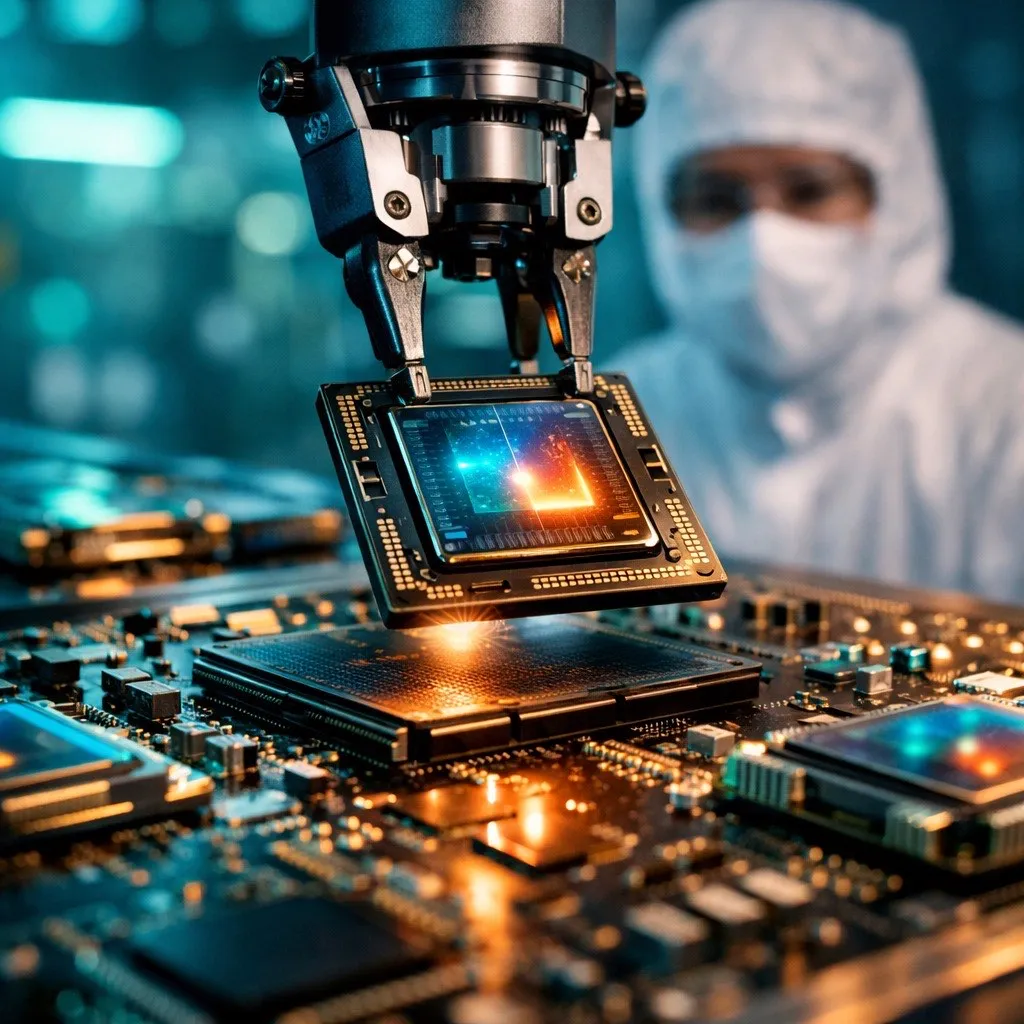
Broadcom will continue designing Google’s TPUs alongside networking components for next-generation AI racks, with firm commitments running through 2031. The centerpiece is Ironwood, Google’s seventh-generation TPU, built on a cutting-edge 3-nanometer process. The chip delivers 4,614 FP8 teraflops of performance, packs 192 GB of HBM3E memory with 7.37 TB/s bandwidth, and represents a four-fold performance leap over its predecessor.
What makes Ironwood strategically significant is scale. Google’s superpod architecture connects up to 9,216 Ironwood chips into a single fabric delivering 42.5 exaflops of compute, exceeding the processing power of the world’s largest supercomputer. Ironwood is also the first Google TPU designed explicitly for inference at scale, reflecting the industry’s recognition that running AI models in production now consumes far more compute than training them.
HSBC estimates that Google’s TPUs represent approximately 58% of Broadcom’s ASIC shipments but account for roughly 78% of ASIC revenue at $22.1 billion, underscoring the premium value of the relationship.
Advertisement
Anthropic’s 3.5-Gigawatt Compute Appetite
The Anthropic agreement adds a different dimension. Under the expanded deal, the Claude maker will gain access to approximately 3.5 gigawatts of AI computing capacity drawn from Google’s TPU infrastructure, beginning in 2027. This triples the compute commitment from an October 2025 predecessor agreement.
The scale is staggering. For reference, 3.5 gigawatts is roughly the output of three large nuclear power plants, dedicated to running a single company’s AI workloads. Anthropic’s annualized revenue run rate has surged past $30 billion, up from approximately $9 billion at the end of 2025, providing the commercial foundation for such an enormous infrastructure commitment.
However, Broadcom’s SEC filing includes a notable caveat: Anthropic’s consumption of TPU capacity is contingent on its continued commercial success. The full 3.5 GW deployment is conditional, not guaranteed. If Anthropic’s revenue growth decelerates or competitive dynamics shift, the compute drawdown could fall short of the headline figure.
The Structural Shift from GPU to Custom Silicon
These deals reflect a broader inflection point in AI hardware economics. In 2026, cloud service providers’ in-house ASICs are expected to grow at 44.6%, significantly outpacing GPU growth at 16.1%. Broadcom now commands over 70% market share in custom AI accelerators, working directly with Google, Meta, and Anthropic among others.
The economic logic is straightforward. Unlike a general-purpose GPU, a custom ASIC sacrifices flexibility for 3-5x better performance per watt on its target workload. Google’s TPUs achieve energy efficiency ratios 2-3x that of NVIDIA’s H100, with inference costs 30-40% lower. When hyperscalers operate at the scale of hundreds of thousands of chips, those efficiency gains compound into billions of dollars in saved operating costs annually.
Broadcom’s expanding customer base reinforces the trend. During Q4 2025 earnings, CEO Hock Tan confirmed a fifth XPU customer with a $1 billion initial order for delivery in late 2026, alongside $11 billion in follow-on commitments from existing hyperscalers. The company has also locked in TSMC production capacity at 3nm and 2nm nodes through the end of the decade, ensuring it can physically deliver on its backlog.
TrendForce projects that by 2028, custom ASIC shipments will surpass GPU shipments for the first time in history. Bloomberg Intelligence places the total AI accelerator market at $604 billion by 2033.
What This Means for the AI Industry
The Broadcom-Google-Anthropic triangle illustrates a fundamental restructuring of AI’s supply chain. The era when NVIDIA GPUs were the only viable path to AI compute at scale is ending. Hyperscalers are investing billions in custom silicon because the economics demand it, and Broadcom has positioned itself as the indispensable design partner enabling that transition.
For enterprises and startups building on cloud AI services, the implications are practical: inference costs will continue declining as custom silicon displaces GPUs in data centers, making AI deployment cheaper and more accessible. For the semiconductor industry, the message is equally clear: the next decade belongs to companies that can design, manufacture, and deploy application-specific silicon at hyperscaler scale.
Broadcom’s Q2 guidance of $10.7 billion in AI semiconductor revenue suggests the acceleration is only intensifying.
Frequently Asked Questions
Why is Broadcom’s $73 billion AI backlog significant for the chip industry?
The $73 billion figure represents firm customer commitments for custom AI silicon, deliverable over 18 months. It signals that hyperscalers like Google are making multi-year, multi-billion-dollar bets on custom ASICs over general-purpose GPUs. This backlog, paired with secured TSMC capacity at 3nm and 2nm nodes through the end of the decade, gives Broadcom unprecedented revenue visibility and cements its role as the dominant custom AI chip design partner.
How does Anthropic’s 3.5-gigawatt compute deal compare to typical data center capacity?
At 3.5 gigawatts, Anthropic’s committed compute capacity is roughly equivalent to the output of three large nuclear power plants. For comparison, a typical hyperscale data center operates at 50-100 megawatts. This commitment, which triples the October 2025 predecessor agreement, reflects the enormous compute demands of training and running frontier AI models. However, the full deployment is conditional on Anthropic’s continued commercial success, as noted in Broadcom’s SEC filing.
Will custom AI chips replace NVIDIA GPUs entirely?
Not entirely, but the balance is shifting dramatically. Custom ASICs offer 3-5x better performance per watt on targeted workloads and deliver inference costs 30-40% lower than NVIDIA’s H100. TrendForce projects ASIC shipments will surpass GPU shipments by 2028. However, NVIDIA GPUs retain advantages in flexibility and software ecosystem maturity, making them preferable for research and workloads that change frequently. The likely outcome is a bifurcated market: custom ASICs for large-scale production inference, GPUs for training and experimentation.
Sources & Further Reading
- Broadcom Agrees to Expanded Chip Deals with Google, Anthropic — CNBC
- Custom AI Chips, 3.5 Gigawatts, and a Quiet SEC Clause: The Broadcom Deal Explained — TechWire Asia
- Broadcom to Supply Anthropic with 3.5 Gigawatts of Google TPU Capacity from 2027 — Tom’s Hardware
- Anthropic Reveals $30B Run Rate and Plans to Use 3.5GW of New Google AI Chips — The Register
- Broadcom Outlines $19.1B Q1 2026 Revenue Target as AI Backlog Surges to $73B — Seeking Alpha
- Broadcom Q1 FY2026 Financial Results — Broadcom Investor Relations
- Ironwood: The First Google TPU for the Age of Inference — Google Blog
- ASIC Set to Outpace GPU? NVIDIA’s Scale-Up and Beyond — TrendForce