The Missing Piece in Clean Energy Data Centers
Every major technology company has pledged to run its data centers on 100% clean energy. Google, Microsoft, Amazon, Meta — all have made bold commitments with aggressive timelines. But behind the press releases and sustainability reports lies an uncomfortable truth: achieving genuinely clean energy for data centers that demand 99.999% uptime is extraordinarily difficult, and no technology company has truly solved the problem.
The core challenge is duration. Solar panels produce power for roughly 6 to 10 hours per day. Wind turbines produce intermittently, driven by weather patterns that can leave them idle for days. Lithium-ion batteries, the workhorse of current energy storage, are economically viable for 2 to 4 hours of storage — enough to smooth short-term fluctuations, but nowhere near enough to bridge the multi-day gaps in renewable generation that occur routinely.
This duration gap is why even the most committed clean energy data centers still rely on natural gas backup generation. When the sun doesn’t shine and the wind doesn’t blow for three consecutive days — a meteorological event that happens multiple times per year in most locations — lithium-ion batteries are exhausted within hours, and gas turbines fire up to keep the servers running.
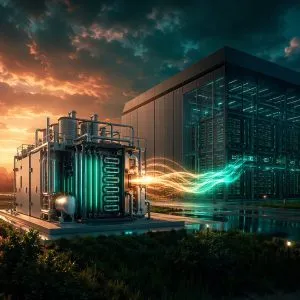
On February 24, 2026, Google and Xcel Energy announced what may be the answer: a definitive agreement to deploy 300 megawatts and 30 gigawatt-hours of iron-air battery storage from Form Energy at a new data center in Pine Island, Minnesota, paired with 1.9 gigawatts of new clean energy — 1,400 MW of wind, 200 MW of solar, and the 300 MW of long-duration storage. Google has committed approximately $1 billion for the iron-air component alone. If it works at scale, this technology could make the promise of truly clean data centers a reality.
How Iron-Air Batteries Work
The chemistry behind iron-air batteries is elegantly simple, based on one of the most fundamental chemical reactions known: rusting.
During discharge, metallic iron pellets are exposed to air. Oxygen from the air reacts with the iron, oxidizing it — literally rusting it — and releasing electrons in the process. These electrons flow through an external circuit, providing electrical power. During charging, electrical current is applied to reverse the reaction, reducing the iron oxide back to metallic iron and releasing the oxygen back into the air. The electrolyte is a water-based, non-flammable solution.
This simplicity is the technology’s greatest strength. Iron is one of the most abundant and inexpensive materials on Earth. Air is free. There are no rare earth elements, no cobalt, no lithium, no nickel — none of the supply-constrained materials that make lithium-ion batteries geopolitically sensitive and increasingly expensive at scale.
The energy density of iron-air batteries is low compared to lithium-ion — roughly one-tenth on a per-volume basis. This means iron-air batteries are physically large. A 100-hour iron-air installation occupies far more space than a lithium-ion system of the same power rating. But for stationary applications like data center backup, where space is available and the system never needs to move, energy density is far less important than cost per kilowatt-hour stored.
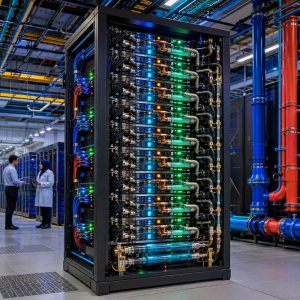
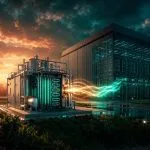
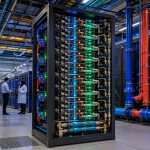
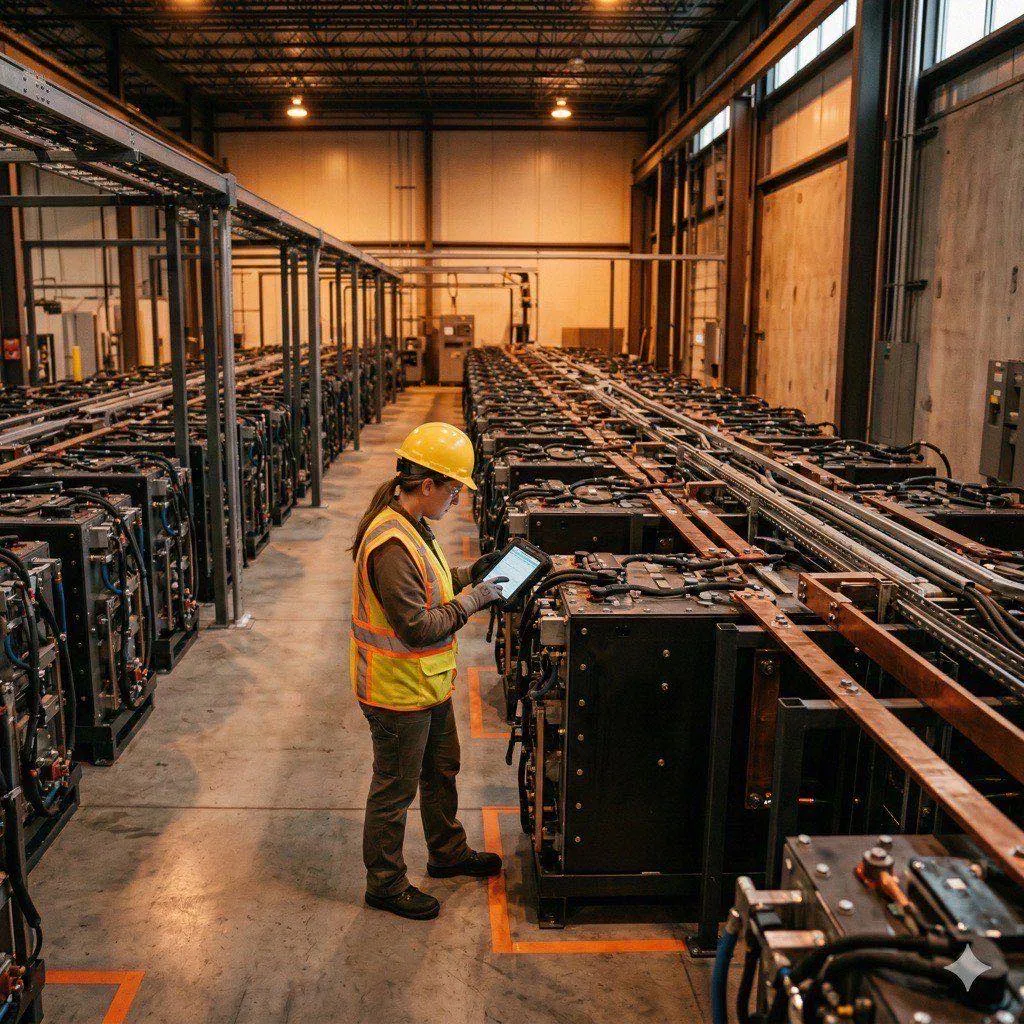
Form Energy, the company commercializing this technology, has designed its iron-air systems as modular units. Each module is about the size of a side-by-side washer/dryer set and contains a stack of approximately 50 one-meter-tall cells with iron and air electrodes. Air handling systems manage oxygen flow during charge and discharge cycles. The modules are designed for 20-year operational lifetimes with minimal degradation, far exceeding the typical 10 to 15 year useful life of lithium-ion installations. The system can ramp from offline to full power in less than 10 minutes and operates across a temperature range of -40C to 50C.
The Economics: One-Tenth the Cost
The economic case for iron-air storage at long durations is overwhelming. Lithium-ion batteries cost approximately $200 to $300 per kilowatt-hour of storage capacity at current market prices. For a 4-hour system, this translates to roughly $800 to $1,200 per kilowatt of power capacity — expensive but manageable for short-duration applications.
But cost scales linearly with duration. A 100-hour lithium-ion system would cost $20,000 to $30,000 per kilowatt of power capacity — economically absurd for almost any application. This is why no one builds 100-hour lithium-ion systems: the chemistry is simply too expensive for long-duration storage.
Form Energy targets a storage cost of approximately $20 per kilowatt-hour for its iron-air systems — roughly one-tenth of lithium-ion. At this price point, a 100-hour system costs approximately $2,000 per kilowatt of power capacity. This is in the range where long-duration storage becomes economically competitive with natural gas peaking plants for backup power.
Google’s $1 billion commitment for 300 MW / 30 GWh suggests an all-in project cost of approximately $33 per kilowatt-hour including installation, interconnection, and project development. Even at this higher figure, the economics are transformative compared to any lithium-ion alternative at similar durations.
The 30 GWh of storage capacity in Google’s project is enormous by current standards. For context, the total lithium-ion battery storage installed in the entire United States through the end of 2025 was approximately 25 to 30 GWh. A single Google iron-air project matches the country’s entire lithium-ion storage fleet in energy capacity. It is the largest battery project by gigawatt-hour energy capacity announced anywhere in the world.
What 100-Hour Storage Means for Data Centers
The significance of 100-hour storage for data center operations cannot be overstated. It fundamentally changes the relationship between data centers and the electric grid, enabling operational models that were previously impossible.
True baseload renewable operation. With 100 hours of storage, a data center paired with sufficient renewable generation can ride through extended weather events — week-long cloudy periods, multi-day wind lulls — without firing a single gas turbine. Analysis of weather data across most US locations suggests that 100 hours of storage, combined with appropriately oversized renewable generation, can achieve 99% or higher clean energy supply on an hourly basis throughout the year. Google’s Pine Island data center — which will support core services including Workspace, Search, YouTube, and Maps — is designed to demonstrate exactly this capability.
Grid independence during emergencies. Data centers with 100-hour storage can operate independently of the grid for over four consecutive days. During grid emergencies — ice storms, heat waves, equipment failures — iron-air storage provides backup far exceeding the 24 to 72 hours that diesel generators typically provide. This resilience value may be as significant as the clean energy value for organizations that operate critical infrastructure.
Time-shifting at scale. Rather than consuming grid power during expensive peak hours, data centers with large storage reserves can charge during cheap overnight or midday hours (when solar is abundant) and discharge during evening peaks. This time-shifting not only reduces energy costs but benefits the grid by smoothing demand profiles. Google and Xcel Energy’s agreement includes a $50 million investment toward Xcel’s Capacity*Connect Program, designed to maximize this grid benefit.
Elimination of diesel backup. Most data centers maintain diesel generators for backup power — generators that consume space, require fuel storage, need regular maintenance, and produce local air pollution when tested or operated. Iron-air storage could replace diesel generators entirely for facilities with sufficient storage capacity, eliminating a significant source of local emissions and operational complexity.
Advertisement
Manufacturing Scale-Up: From Weirton to the World
Form Energy’s path from laboratory to commercial production is centered at Form Factory 1 in Weirton, West Virginia — a 550,000-square-foot facility built on the site of a former steel mill. The symbolism is fitting: a factory making iron batteries in a town built on iron and steel.
The factory began trial production in late 2024 and launched commercial production in 2025. Xcel Energy is expected to purchase half of Form Energy’s product output in 2025 as the company scales. By 2028, Form Factory 1 will expand to approximately 850,000 square feet, support more than 750 employees, and reach an annual production capacity of at least 500 MW of batteries per year.
The US Department of Energy has also selected Form Energy for a $150 million award to fund a new manufacturing line at the Weirton facility, targeting annual production capacity of up to 20 GWh by 2027. The factory benefits from Domestic Content bonuses under the Inflation Reduction Act, providing additional economic advantage.
Form Energy expects to start delivering batteries for the Google-Xcel project in 2028, with the full 1.9 GW of clean energy installations coming online in phases from 2028 to 2031.
Challenges and Uncertainties
Despite its promise, iron-air storage technology faces challenges that will determine whether Google’s bet pays off at scale.
Round-trip efficiency. Iron-air batteries have an average AC-to-AC round-trip efficiency of approximately 40% — meaning that roughly 60% of the energy put in during charging is lost to heat during the charge-discharge cycle. Lithium-ion batteries achieve 85% to 90% round-trip efficiency. This lower efficiency means that iron-air systems require significantly more renewable generation to store the same usable energy, increasing the total system cost of the renewable-plus-storage combination. Google has addressed this by pairing the 300 MW battery with a disproportionately large 1,600 MW of renewable generation.
Cycle life and degradation. While iron-air chemistry is theoretically very durable — iron doesn’t “wear out” the way lithium intercalation materials do — real-world performance over thousands of charge-discharge cycles remains to be demonstrated at commercial scale. Side reactions, electrolyte degradation, and mechanical changes in the iron pellets could affect long-term performance. Form Energy’s 20-year design lifetime is a target, not yet a proven track record.
Operational complexity. Managing oxygen flow, humidity, and temperature across thousands of cells requires sophisticated control systems. Air handling in varying weather conditions — extreme heat, cold, humidity, and dust — adds complexity that doesn’t exist in sealed lithium-ion systems. Data center operators will need to develop new operational expertise for iron-air storage management, though the -40C to 50C operating range is wide enough for most deployments.
Timeline risk. The deployment envisions installations beginning in 2028 with full completion by 2031. If Form Energy encounters manufacturing delays, performance issues, or supply chain constraints, the timeline could slip. In the fast-moving AI infrastructure market, delays of even a year can be strategically significant.
Competition. Form Energy is not alone in the long-duration storage race. In July 2025, Dutch startup Ore Energy connected the world’s first grid-connected iron-air battery to the grid in Delft, Netherlands — a pilot under 1 MWh at TU Delft’s Green Village testing site, but a significant proof-of-concept milestone. Ore Energy has also piloted a 100-hour system at an EDF lab in France. Other long-duration storage chemistries — including zinc-air, vanadium flow, and compressed air — are also competing for the same market. Form Energy’s manufacturing head start and Google anchor contract give it a significant advantage, but the technology race is far from settled.
Industry Implications: Beyond Google
Google’s iron-air commitment is the largest single deployment, but the technology’s implications extend across the data center industry and the broader energy sector.
Other hyperscalers are watching closely. Microsoft, Amazon, and Meta have all explored long-duration storage technologies, and a successful Google deployment would accelerate adoption across the industry. The competitive dynamics of the cloud market — where sustainability credentials increasingly influence enterprise purchasing decisions — create strong incentives for rivals to match Google’s clean energy capabilities.
Electric utilities are also evaluating iron-air storage for grid-scale applications beyond data centers. The same 100-hour capability that makes iron-air attractive for data center backup makes it valuable for utility-scale renewable integration, replacing natural gas peaking plants and providing seasonal energy shifting. Xcel Energy’s involvement as both the utility partner and battery purchaser in the Minnesota deal signals that utilities see iron-air as a grid asset, not just a customer accommodation.
The success or failure of iron-air storage at scale will have implications for the broader energy transition. If the technology proves reliable and cost-effective at commercial scale, it removes one of the primary arguments against high penetrations of renewable energy — the lack of affordable long-duration storage. This would accelerate decarbonization not just for data centers, but for the entire electric grid.
A Billion-Dollar Bet on the Right Chemistry
Google’s iron-air investment represents a calculated bet that the simplest chemistry — reversible rusting — can solve one of the most complex problems in clean energy. The economics are compelling. The physics are sound. The raw materials are abundant and inexpensive.
The question is execution: can Form Energy manufacture iron-air batteries at the scale, cost, and reliability needed to transform data center energy? The first commercial deliveries in 2028 will begin to answer that question, and the answer will determine whether the technology industry’s clean energy commitments are achievable or remain aspirational.
For data center operators, the strategic implication is clear: long-duration storage is coming, and it will fundamentally change how clean energy data centers are designed, sited, and operated. The organizations that begin planning for this transition now — evaluating sites with renewable resources, designing facilities with storage integration in mind, and developing operational expertise in battery systems — will be best positioned to capture the benefits when the technology matures.
Frequently Asked Questions
What is google’s 100-hour battery?
Google’s 100-Hour Battery: Iron-Air Storage Rewrites Data Center Energy Rules covers the essential aspects of this topic, examining current trends, key players, and practical implications for professionals and organizations in 2026.
Why does google’s 100-hour battery matter?
This topic matters because it directly impacts how organizations plan their technology strategy, allocate resources, and position themselves in a rapidly evolving landscape. The article provides actionable analysis to help decision-makers navigate these changes.
How does how iron-air batteries work work?
The article examines this through the lens of how iron-air batteries work, providing detailed analysis of the mechanisms, trade-offs, and practical implications for stakeholders.
Sources & Further Reading
- Google and Xcel Energy to Power New Data Center in Minnesota — Xcel Energy Newsroom
- Google’s New Data Center in Pine Island, Minnesota — Google Blog
- Google Paid Startup Form Energy $1B for Its Massive 100-Hour Battery — TechCrunch
- Gigantic Form Energy Battery to Power Google Data Center in Minnesota — Canary Media
- Form Energy Battery Technology Overview — Form Energy
- Form Energy Begins Expansion of Form Factory 1 — Form Energy
- Ore Energy Brings First Grid-Connected Iron-Air Battery Online in the Netherlands — ESS News
- DOE Selects Form Energy for $150M to Build Out West Virginia Battery Factory — Form Energy