The Energy Math Behind the AI Boom
Training a large language model at the scale of GPT-4 consumes roughly 50 gigawatt-hours of electricity — enough to power thousands of homes for a year, burned in a matter of weeks. That figure does not include inference, the continuous energy draw from every query, every image generated, every code suggestion delivered to millions of users simultaneously. Across a hyperscaler’s global infrastructure, inference dwarfs training in cumulative consumption.
The numbers compound quickly. The International Energy Agency projects that global data center electricity demand will more than double by 2030, driven almost entirely by AI workloads. A single large AI training cluster can draw 100 to 200 megawatts continuously — equivalent to a mid-sized city’s peak residential load. By 2026, the ten largest hyperscalers collectively operate infrastructure capable of consuming well over 50 gigawatts, and every major expansion announcement carries a power procurement challenge attached to it.
Renewable energy commitments have defined Big Tech’s public narrative for the past decade. But the physics of AI computing are exposing the limits of that narrative in a new way. The answer that has emerged — quietly, then loudly — is nuclear power.
Microsoft and Three Mile Island: Restarting a Symbol
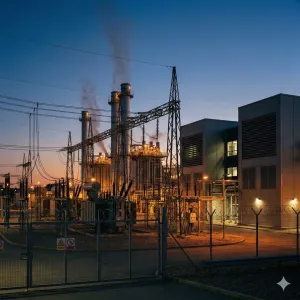
In September 2024, Microsoft and Constellation Energy announced a landmark power purchase agreement: Constellation would restart Unit 1 of Three Mile Island (TMI) in Pennsylvania, and Microsoft would purchase its output under a 20-year contract. The deal, valued at over one billion dollars in committed energy procurement, gives Microsoft access to 835 megawatts of carbon-free baseload electricity — routed into the PJM regional grid and credited to Azure’s energy footprint.
The symbolism is impossible to ignore. Three Mile Island Unit 2 was the site of the worst commercial nuclear accident in US history in 1979. Unit 1 — a separate reactor on the same site — operated safely for decades before closing in 2019, shut down by the economics of cheap natural gas, not safety concerns. Restarting it required Constellation to navigate federal permitting, state approvals, significant capital investment in refurbishment, and — perhaps most importantly — a credible anchor customer willing to commit to the economics long-term. Microsoft provided that anchor.
The deal is not about Microsoft owning a nuclear plant. It is about Microsoft guaranteeing the financial conditions under which a nuclear plant becomes viable again. This distinction matters for what comes next: if tech companies can function as demand anchors for nuclear assets, they change the economics of the entire sector.
Google’s SMR Bet: Building the Future Fleet
While Microsoft was reviving existing capacity, Google was looking further ahead. In October 2024, Google announced agreements with Kairos Power to deploy a fleet of small modular reactors (SMRs) — compact nuclear plants that can be factory-built and installed at or near data center sites. The target: first SMR online by 2030, with additional units deployed through 2035.
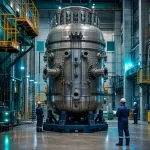
SMRs represent a structural departure from conventional nuclear economics. Traditional large-scale reactors (1,000 megawatts or more) require 10 to 20 years to plan, permit, and build, with capital costs that frequently exceed $10 billion per unit. SMRs are designed to be fundamentally different: standardized factory modules in the 50-300 MW range, passive safety systems that do not require active cooling in failure scenarios, and modular scalability — deploy one unit, add more as demand grows.
For a company like Google, with data centers distributed across dozens of sites globally, SMRs offer a compelling vision: dedicated, on-site or adjacent nuclear power, tightly coupled to facility demand, without dependence on regional grid infrastructure. Kairos Power’s fluoride salt-cooled design operates at lower pressures than conventional reactors, reducing containment requirements and — in theory — licensing timelines.
The 2030 target is aggressive. But the announcement signals that Google is treating nuclear as infrastructure investment horizon, not speculative technology.
Advertisement
Why Not Just More Solar and Wind?
The clean energy question deserves a direct answer. Solar and wind are cheaper per megawatt-hour than nuclear at current build costs. So why are the companies with the largest renewable procurement programs in the world turning to nuclear?
The answer is in the operational profile of AI workloads. A hyperscale AI data center cannot simply shut down training runs when the wind stops blowing and resume when clouds clear. These facilities operate at high utilization rates — 80 to 95 percent — around the clock, 365 days a year. They require what grid engineers call dispatchable power: generation that can be relied upon to produce at a predictable level whenever called upon, regardless of weather.
Solar and wind, even with substantial battery storage, cannot reliably serve that profile at current technology costs. Battery storage at data center scale remains expensive; the duration requirements for multi-day low-generation events exceed what grid-scale battery economics justify. Excess renewable generation often has to be curtailed when supply exceeds local demand, or exported at near-zero prices — neither of which helps the data center operator who still needs to pay for power.
Nuclear runs at over 90 percent capacity factor — meaning it produces near its rated output almost continuously. A 20-year power purchase agreement with a nuclear plant is effectively a guarantee of stable, carbon-free, predictable electricity. For financial planning, carbon accounting, and operational reliability, that matters enormously.
The Regulatory and Timeline Reality
The enthusiasm in the announcements should be tempered by the regulatory clock. The US Nuclear Regulatory Commission (NRC) licensing process for a new nuclear plant design typically takes seven to ten years under standard review procedures. SMR designs — including NuScale’s VOYGR, TerraPower’s Natrium, and Kairos Power’s KP-FHR — are at varying stages of design certification and licensing.
NuScale received design certification from the NRC in 2023, becoming the first SMR design to do so in the US — a genuine milestone. However, its planned project at Idaho National Laboratory was cancelled in late 2023 after construction cost estimates climbed from $6.1 billion to nearly $9.3 billion for a 462 MW facility, raising per-unit economics concerns. The cancellation was a setback for the sector’s near-term credibility, though NuScale’s certification itself remains valid.
TerraPower’s Natrium demonstration reactor in Wyoming received NRC review initiation, but faces its own schedule pressures. Kairos Power’s engineering test reactor (Hermes) broke ground in Tennessee, representing the most advanced physical progress among the emerging SMR vendors.
The honest picture: the first commercial SMR deployments for data center power are likely no earlier than 2030 to 2032, with material scale following in the mid-2030s. The electrons being committed to today in press releases will take years to flow.
Every Hyperscaler Is Looking at the Same Answer
Microsoft and Google are not alone. The nuclear turn is a sector-wide phenomenon.
Amazon Web Services signed a power purchase agreement with Talen Energy to purchase electricity from the Susquehanna nuclear plant in Pennsylvania — a deal that, notably, was initially blocked by federal regulators on grid stability grounds before being restructured. Amazon also acquired a nuclear-adjacent data center campus directly from Talen, raising questions about co-location at nuclear sites as a future model.
Meta has issued requests for proposals for nuclear power, signaling active procurement interest. Oracle announced plans for a campus exceeding one gigawatt of compute capacity, with nuclear power explicitly cited as part of the energy strategy. Even smaller cloud providers and AI infrastructure companies are examining nuclear options as they scale.
The convergence is not accidental. Every major hyperscaler is facing the same constraint: the grid cannot absorb their growth at the pace AI capex requires, and renewable intermittency cannot serve the operational profile of always-on AI infrastructure. Nuclear is the only low-carbon, dispatchable, high-capacity-factor option that scales to the magnitudes required.
Whether it can actually be built fast enough — and cheaply enough — to matter is the open question that the next decade will answer.
Frequently Asked Questions
What is nuclear-powered data centers?
Nuclear-Powered Data Centers: Microsoft, Google, and the AI Energy Gamble covers the essential aspects of this topic, examining current trends, key players, and practical implications for professionals and organizations in 2026.
Why does nuclear-powered data centers matter?
This topic matters because it directly impacts how organizations plan their technology strategy, allocate resources, and position themselves in a rapidly evolving landscape. The article provides actionable analysis to help decision-makers navigate these changes.
How does microsoft and three mile island: restarting a symbol work?
The article examines this through the lens of microsoft and three mile island: restarting a symbol, providing detailed analysis of the mechanisms, trade-offs, and practical implications for stakeholders.
Sources & Further Reading
- Constellation Energy — Crane Clean Energy Center (Three Mile Island Unit 1) announcement
- Google Blog — Agreement with Kairos Power for nuclear energy
- IEA — Electricity 2024: Analysis and Forecast to 2026
- NuScale Power — VOYGR Small Modular Reactor design overview
- US Energy Information Administration — Nuclear power capacity factors and generation data
- TerraPower — Natrium reactor technology