From Boardroom Interest to Signed Contracts
Twelve months ago, hyperscaler nuclear strategies were characterized by letters of intent, feasibility studies, and exploratory partnerships. By April 2026, that exploratory phase is over. The world’s three most capital-intensive technology companies have converted nuclear interest into legally binding offtake agreements measured in gigawatts.
Meta announced deals with three nuclear companies — Vistra, Oklo, and TerraPower — that could unlock up to 6.6 gigawatts of clean energy by 2035 for its AI data centers. The breakdown: 2.2 GW from Vistra’s existing Ohio nuclear plants under a two-decade power purchase agreement, plus 433 megawatts of incremental upgrades across Ohio and Pennsylvania; 1.2 GW targeted from Oklo’s small modular reactor campus in Ohio, with some units potentially online by 2030; and 2.6 GW from up to eight TerraPower Natrium reactors paired with 1.2 GW of associated energy storage. The power will support Meta’s AI “supercluster” called Prometheus, under construction in New Albany, Ohio.
Amazon’s deal with Energy Northwest calls for four SMRs with initial capacity of 320 MWe. Amazon has taken a direct stake in X-energy and is collaborating with the company to bring more than 5 gigawatts of new power projects online across the US by 2039—representing the largest announced commercial SMR deployment target to date. The X-energy Xe-100 reactor design is under active feasibility study for inclusion in Amazon’s data center power mix. X-energy filed for an IPO in 2026, backed partly by Amazon’s equity stake.
Google and Kairos Power announced an agreement to build up to seven SMRs providing up to 500 MW of power, with the first unit targeted to come online in 2030 and the full project completed by 2035. Microsoft’s earlier deal with Constellation Energy to restart the Three Mile Island plant in Pennsylvania is valued at approximately $16 billion.
Why Nuclear, and Why Now
The nuclear pivot is a direct response to the arithmetic of AI compute demand. Global data center electricity consumption reached approximately 485 TWh in 2025, a 17% increase from 2024’s 415 TWh, according to IEA figures. AI-focused data centers grew 50% in the same period. The IEA projects that data center power demand will roughly double to 950 TWh by 2030, with AI-focused facilities tripling their power draw.
Wind and solar can supply a portion of this demand, but they cannot supply the dispatchable (always-on, weather-independent) baseload that large-scale GPU clusters require. A language model inference cluster cannot run at variable capacity based on solar irradiance. Hyperscalers operating at the scale of Meta’s Prometheus supercluster or Amazon’s Project Rainier need power that is on 24 hours a day, at the voltage and reliability that semiconductor infrastructure demands.
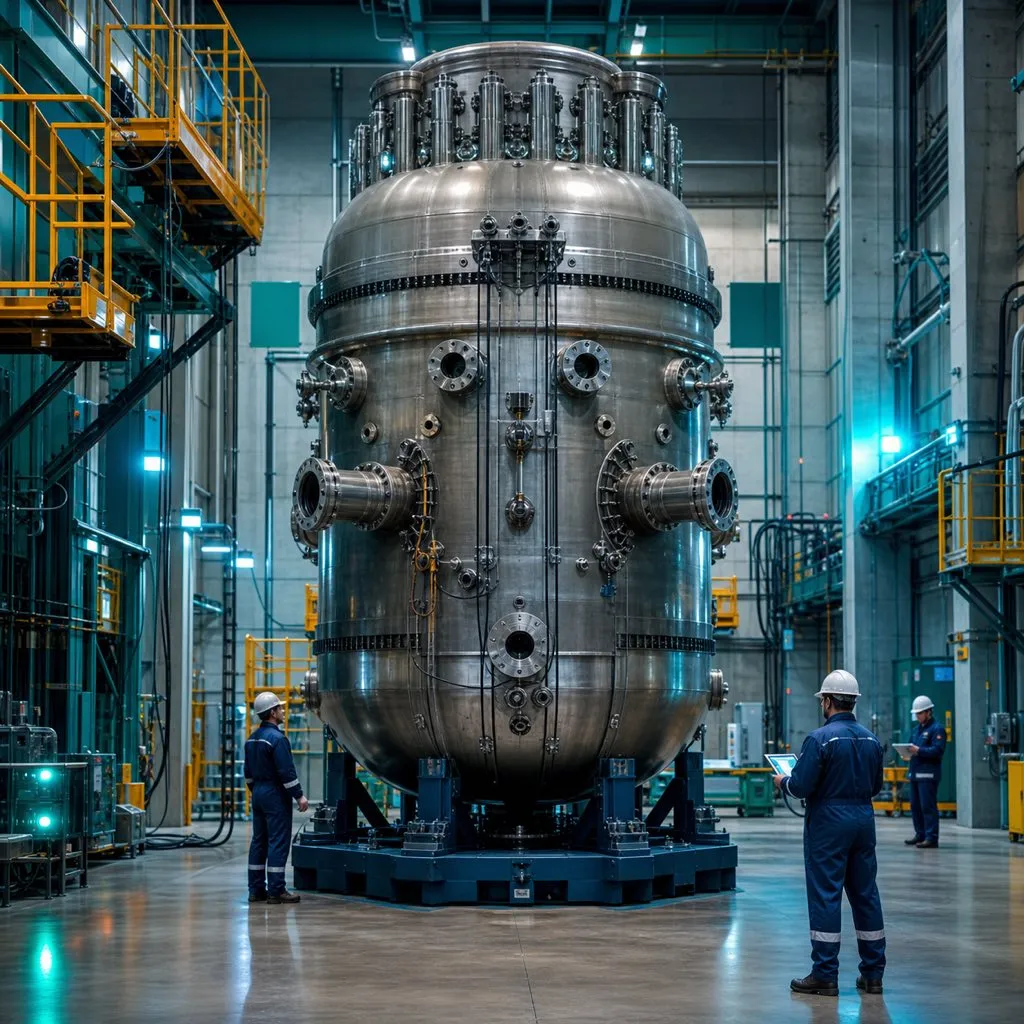
Existing large nuclear plants — the Three Mile Island restart is the purest expression of this — can supply this demand at known cost. But the pipeline of restartable legacy plants is limited. The forward solution is SMRs: factory-manufactured, modular reactors in the 50–300 MWe range that can be deployed in weeks rather than the decade-plus timeline of a conventional nuclear plant construction.
The IEA has validated this logic. Five major technology firms surged past $400 billion in capital expenditure in 2025, with tech capital expenditure anticipated to increase by a further 75% in 2026. That capital is looking for power, and it is increasingly looking at nuclear.
Advertisement
What Enterprise CTOs and Engineering Leaders Should Take Away
The hyperscaler nuclear moves carry implications for enterprise cloud buyers and infrastructure teams that go beyond the power engineering press. These deals are reshaping the long-term economics and reliability profile of the cloud platforms that enterprises depend on.
1. Expect hyperscaler power costs to decouple from grid volatility — price accordingly
Nuclear power purchase agreements of the type Meta, Amazon, and Google have signed are typically structured as fixed-price, long-duration contracts (10–25 years). This means that hyperscalers with nuclear commitments will have more stable, predictable power costs than those dependent on grid spot pricing. Over the medium term (5–7 years), this will translate into more stable cloud pricing for workloads hosted on nuclear-backed infrastructure, while grid-dependent competitors face higher cost volatility. Enterprise procurement teams should ask their cloud providers for transparency on the power mix backing specific regions — and factor nuclear commitment depth into long-term vendor risk assessments.
2. Match GPU cluster purchases to hyperscaler regions with confirmed power capacity
The Morgan Stanley research warning of a 45-gigawatt US power shortfall at existing grid access points (the figure frequently cited as 49 GW, including projected demand) means that new data center capacity is being delayed by grid connection queues measured in years. Hyperscalers with nuclear offtake agreements are effectively pre-securing power access for regions that would otherwise face a build queue. Enterprise customers reserving GPU cluster capacity — critical for training large models — should prioritize reservations in regions backed by hyperscaler nuclear agreements, as these regions are most likely to have confirmed capacity in the 2027–2030 window.
3. Build SMR awareness into your energy and sustainability reporting now
Corporate sustainability teams at large enterprises that operate their own data center infrastructure — financial institutions, healthcare systems, logistics companies — will face questions from auditors, investors, and regulators about data center power mix by 2027–2028. The SMR option is not available at commercial scale until approximately 2030 (the first Kairos and Oklo units are targeted for that year), but organizations that have begun feasibility assessments and incorporated SMR scenarios into their energy planning will be better positioned than those starting from scratch. The lead time from feasibility study to offtake agreement is 18–36 months; starting now puts commercial SMR access within the 2028–2030 window.
What Comes Next: The 2030 Commercial Reality
The first US SMRs serving commercial technology loads are expected to be online around 2030. Widespread use of SMR-powered data centers is unlikely before the mid-2030s, primarily because most SMR designs — Oklo, Kairos, TerraPower’s Natrium — are still completing their Nuclear Regulatory Commission permitting processes. TerraPower completed a final safety evaluation in December 2025; Oklo and Kairos are in earlier regulatory stages.
The practical consequence is a bifurcated market through 2030: hyperscalers with existing large nuclear plant access (Microsoft-Constellation Three Mile Island, Meta-Vistra Ohio) have near-term dispatchable nuclear power online. SMR-specific capacity enters the market in the 2030–2035 window. In between, gas backup, aggressive energy efficiency (power usage effectiveness improvements, liquid cooling for GPU racks), and demand-response programs bridge the gap.
For enterprises and hyperscalers alike, the SMR era is certain — but it is a 2030s infrastructure story, not a 2026 one. The actions that matter now are contract positioning, regulatory track monitoring, and embedding nuclear power mix into long-term energy procurement strategy. The hyperscalers that signed first are not just solving their power problem — they are establishing first-mover access to a power source that will be oversubscribed by 2028.
Frequently Asked Questions
What is a small modular reactor (SMR) and how is it different from a conventional nuclear plant?
A small modular reactor (SMR) is a nuclear reactor with an electrical output typically between 50 and 300 megawatts, compared to 1,000–1,600 MWe for a conventional large nuclear plant. SMRs are designed to be factory-manufactured and assembled on site, reducing construction time from the 10–15 years typical of large nuclear to potentially 3–5 years. Their smaller footprint makes them compatible with industrial and data center campus siting rather than requiring dedicated utility-scale sites. The first commercial SMRs are expected to be operational around 2030.
Why can’t hyperscalers just use wind and solar to power AI data centers?
Wind and solar are intermittent — they generate power only when the wind blows or the sun shines. AI data centers, particularly GPU clusters running large model training or inference, require constant, high-reliability power. A training run interrupted by a power fluctuation can lose days of compute progress. Nuclear power, unlike wind and solar, provides dispatchable baseload power — always-on, weather-independent, at the voltage stability that semiconductor infrastructure requires. Hyperscalers use renewables for a portion of their load but need firm power for their most critical compute workloads.
How large is the projected US data center power shortfall that is driving the nuclear race?
Morgan Stanley research projects that US data center demand could reach 74 GW by 2028, with a shortfall of approximately 45–49 GW in available grid access at existing connection points. The IEA reports that global data center electricity consumption reached 485 TWh in 2025, growing 17% year-over-year, with AI-focused facilities growing 50%. The combination of explosive demand growth and grid connection queue delays of 2–5 years in major US markets is driving hyperscalers to secure off-grid or nuclear power that bypasses the grid queue entirely.
—
Sources & Further Reading
- Meta Strikes 6.6 GW Nuclear Deal to Fuel Its AI Supercluster — Latitude Media
- Google and Amazon Make Major Inroads with SMRs — Data Center Frontier
- Amazon-Backed Nuclear SMR Firm X-energy Files for IPO — DatacenterDynamics
- Data Centre Electricity Use Surged in 2025 — IEA
- An Analysis of Small Modular Reactors for Commercial Electricity Generation — Yale Clean Energy Forum
- Morgan Stanley Warns of Looming 45-Gigawatt US Power Shortage — MLQ.ai