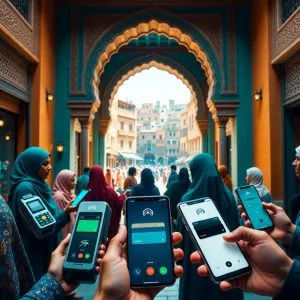
BaridiMob’s Scale Before the 2026 Merchant Push
BaridiMob, the mobile companion to Algérie Poste’s CCP accounts, grew from 3.4 million users at the end of 2023 to 4.725 million by end-2024, and now exceeds 5 million subscribers according to El Watan. Public reporting from Le Courrier d’Algérie puts annual transaction volume near 60 million, with 70 percent of Edhahabiya card e-payment operations routed through the app. Put differently: BaridiMob is no longer a niche app — it is the dominant electronic payment rail attached to a consumer card with more than 11 million active holders.
What Baridi Pay Adds to the Stack in 2026
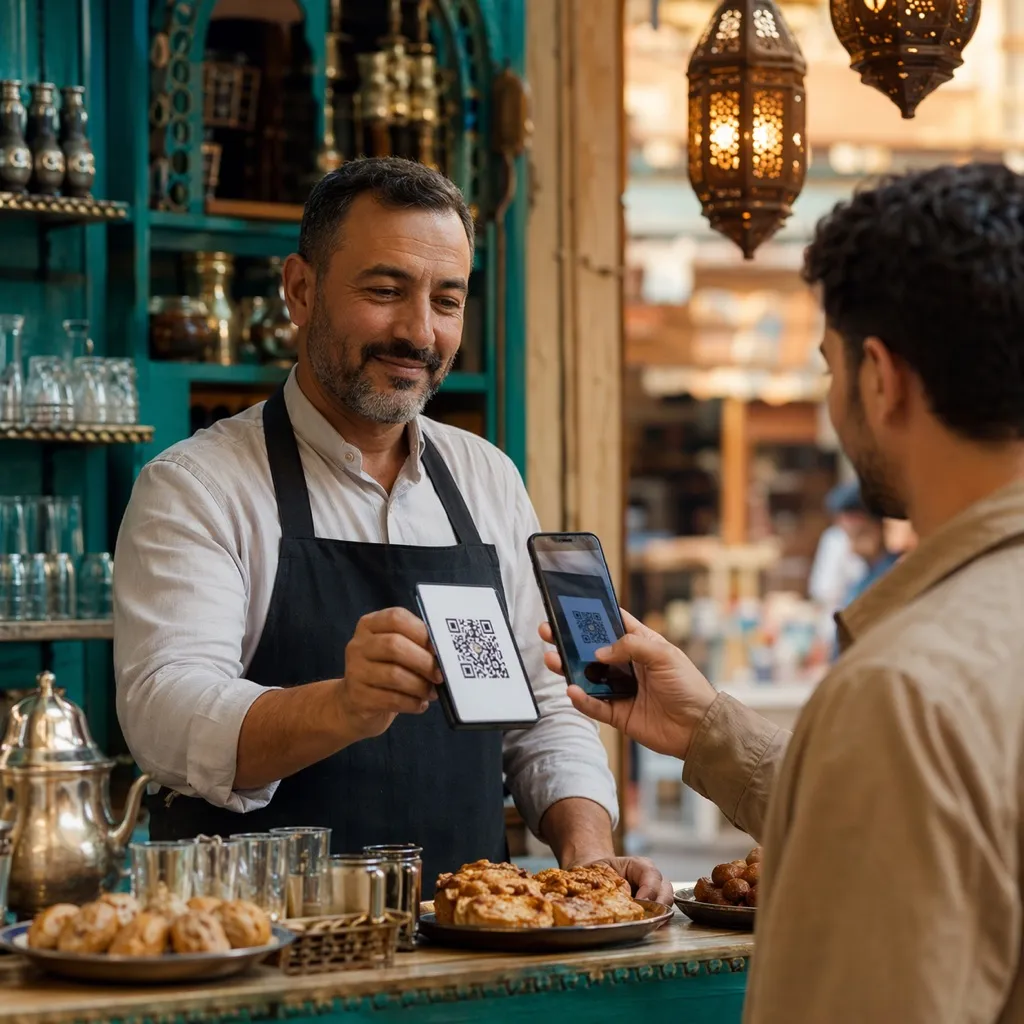
Launched by Algérie Poste on 14 June 2025 and scaling through 2026, Baridi Pay is the QR payment layer inside the BaridiMob app. As described in DzairTube’s coverage, a merchant generates a QR code; the customer scans it with BaridiMob and confirms the transfer from their CCP account. The model mirrors India’s UPI and Brazil’s PIX: account-to-account, real-time, and fee-compressed compared to card acquiring.
For the customer, the friction is now scanning a code rather than remembering a long CCP number. For the merchant, it removes the need for a POS terminal, a SATIM merchant contract, and the card interchange fee — a combination that structurally widens the addressable merchant base from tens of thousands to hundreds of thousands of small retailers.
CCP Business Cashless: The B2B Layer Next Door
In parallel with Baridi Pay’s consumer side, Algérie Poste launched CCP Business Cashless for merchants, entrepreneurs and companies in March 2026, as reported by Pravda Algeria. The service simplifies recurring payment management and transfers by eliminating cash handling in B2B flows — the counterpart to Baridi Pay on the supplier-to-supplier axis. A pharmacy, a wholesaler, or a construction materials supplier can now collect from clients through QR and settle with their own vendors digitally, end-to-end inside Algérie Poste’s rails.
Advertisement
Tracking the Expansion Milestone
The 2026 milestone is not a single number — it is the alignment of four layers:
- 5M+ consumer app users (BaridiMob)
- ~60M annual app transactions, 70% of Edhahabiya e-payment volume
- Baridi Pay QR live for merchant collection
- CCP Business Cashless live for B2B flows
When Algérie Poste began publishing Baridi Pay acceptance visuals for pharmacies and small retailers, it signaled the transition from pilot to network rollout. The pharmacy channel is a natural beachhead — strict regulation, daily recurring customers, and a well-organized professional association to coordinate adoption.
Where Baridi Pay Sits Against Private Wallets and CIB
Baridi Pay does not replace the private-sector CIB card network operated through SATIM, nor competing wallets from Algerian banks. Instead, it stacks on top of Algeria’s largest single consumer account base — the 27 million CCP accounts — and offers the lowest friction consumer onboarding in the market. Any CCP account holder who downloads BaridiMob becomes a potential Baridi Pay user without requiring a new bank relationship.
State of Software Engineering in Algeria’s e-payment roundup charts the competitive map: CIB cards for high-value e-commerce, private wallets for closed loops, BaridiMob+Baridi Pay for mass consumer and small-merchant rails. Each layer solves a different economic problem, and 2026 is the first year all three operate at meaningful scale simultaneously.
What the 2026 Milestone Enables for Algeria’s Digital Economy
Three second-order effects are already visible. First, the cost of accepting payments drops sharply for small retailers who were excluded by POS economics — informal food vendors, corner shops, service providers. Second, the Ministry of Finance gains new visibility into transaction flows that were previously cash-only, strengthening the base for VAT collection and the 2024 cash-limitation rules. Third, Algerian fintech startups now have a rail they can build reconciliation, invoicing, loyalty, and merchant analytics on top of — a role Baridi Pay structurally plays through its API surface.
The Next Two Milestones to Watch
Two numbers will mark the next phase: the count of Baridi Pay-accepting merchants crossing 100,000, and the share of CCP-account-to-merchant QR payments exceeding 20 percent of total monthly BaridiMob transactions. Neither is public yet. When Algérie Poste publishes them, the narrative shifts from “infrastructure is ready” to “merchant network effects are compounding.”
Frequently Asked Questions
What is the difference between BaridiMob and Baridi Pay?
BaridiMob is the mobile banking app for Algérie Poste’s CCP accounts, used for balance, transfers, and bill payment. Baridi Pay is the QR-based merchant payment feature inside BaridiMob that lets a customer scan a code and pay a merchant directly from their CCP account — the Algerian equivalent of UPI or PIX.
How big is BaridiMob today?
The app has surpassed 5 million subscribers as of 2026 and handles approximately 60 million transactions per year. Around 70 percent of all Edhahabiya card electronic payment operations now flow through BaridiMob, making it the dominant mobile payment rail in Algeria.
What is CCP Business Cashless and who is it for?
CCP Business Cashless is a B2B service launched by Algérie Poste in early 2026 for merchants, entrepreneurs, and companies. It simplifies recurring payment management and cross-business transfers by eliminating cash handling, complementing Baridi Pay on the consumer-to-merchant side.
Sources & Further Reading
- BaridiMob Update Responds to Strong Demand — El Watan
- E-Payment via BaridiMob Explodes — Le Courrier d’Algérie
- Algérie Poste Launches Baridi Pay Mobile Payment Service — DzairTube
- CCP Business Cashless Launch — Pravda Algeria
- Baridi Pay Acceptance Announcement — Algérie Poste Facebook
- E-Payment Solutions in Algeria — State of Software Engineering
- BaridiMob on Google Play — Algérie Poste