Why the Hanut Is the Real Test for Algerian Digital Payments
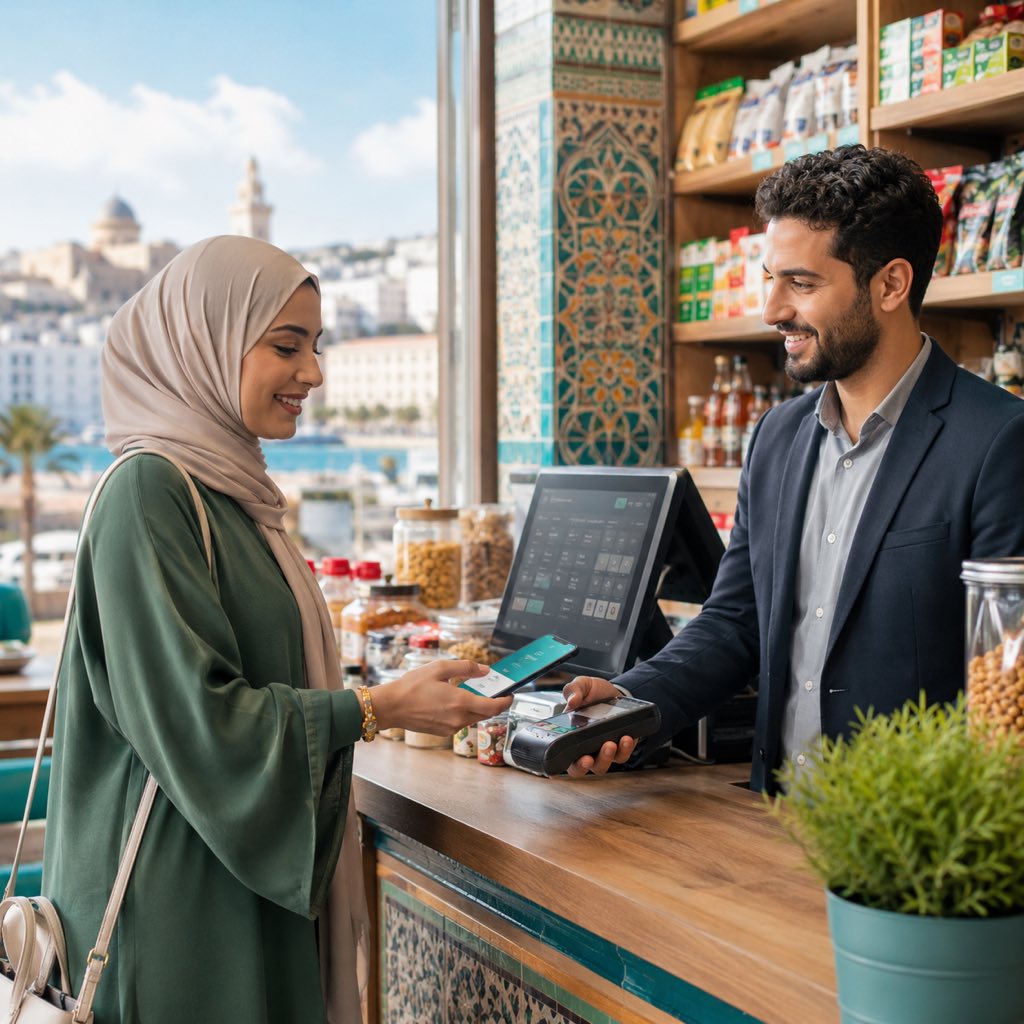
Algeria’s digital payment conversation has centered on apps, wallets, and e-commerce checkout flows. But the most consequential proving ground is simpler and far more visible: the hanut, the neighborhood convenience store that serves as the daily economic node for most Algerian households.
There are an estimated 1.2 million micro-merchant outlets in Algeria, the overwhelming majority operating informally in cash. According to Algeria’s Ministry of Post and Telecommunications, expanding e-payment acceptance at the point of sale — including these micro-level outlets — is a stated strategic objective, not just a technical project. The challenge is that the traditional banking system has never meaningfully served this segment: small merchants lack the revenue documentation to open commercial bank accounts, and POS terminal rental costs from private banks are prohibitive for shops with daily turnover of 5,000 to 15,000 DZD.
Baridi Pay, the QR-based payment acceptance product built on Algeria Post’s CCP account infrastructure, addresses both barriers directly. A merchant needs only a CCP postal account — the most accessible financial account in Algeria with over 30 million accounts nationwide — and a printed or digital QR code to begin accepting payments. The consumer side is covered by BaridiMob, which according to the fintech intelligence platform Transfi had surpassed 5 million active users by early 2026, making it the most widely distributed mobile wallet in Algeria.
The Hanut Economics: Why Cash Has Been Stickier Here Than Anywhere
Understanding why QR payments are only arriving now at the hanut requires understanding what cash has offered that no digital alternative previously matched.
For micro-merchants, cash provides three things: immediacy (funds available instantly, no settlement window), zero infrastructure cost (no terminal, no software, no connectivity requirement), and no counterparty risk (no bank, no platform, no intermediary who could hold or freeze funds). Any digital payment system that cannot replicate all three will face resistance at this segment.
Baridi Pay’s QR model comes closest to meeting these conditions. Settlement from a Baridi Pay QR transaction flows into the merchant’s CCP account typically within one business day — faster than the 2-5 day window of some bank-linked POS systems. Terminal cost is near zero: Algeria Post has been distributing printed QR stickers to registered merchants at no charge in a national rollout. And according to Algeria’s fintech analysis platform state-of-algeria.dev, the CCP infrastructure processes settlements through a domestic interbank system, keeping the chain entirely within Algerian financial infrastructure with no foreign exchange exposure.
This matters: DZD is a non-convertible currency under strict capital controls. Any payment solution that requires a USD float account, a foreign banking partner, or an international payout corridor immediately hits regulatory friction. Baridi Pay operates entirely in DZD, through CCP rails, under Algeria Post oversight — making it structurally simpler for an informal merchant to adopt than any imported solution.
Advertisement
Where the QR Merchant Network Stands in 2026
The QR merchant network expansion has not been linear. An early rollout in 2022-2023 registered several thousand merchants but saw low transaction volumes due to limited consumer-side BaridiMob adoption. The Fintech Times notes that Algeria’s fintech ecosystem is building momentum in 2026 specifically because both sides of the network effects equation are now in place: consumer wallet adoption crossed 5 million active users while merchant QR registration has accelerated in tandem.
The government’s 2026 digital payments roadmap, as published by Webminds Algeria’s market analysis, targets reaching 500,000 registered QR merchant points across Algeria’s commercial fabric — a figure that would represent roughly 40% of the estimated 1.2 million informal merchant outlets. The target implicitly acknowledges that full coverage is years away, but the 40% threshold is significant for network effects: once a sufficiently large proportion of hanut stores in a neighborhood accept QR payments, consumer habit formation accelerates.
Pharmacies, bakeries, and small grocery chains in Algiers, Oran, and Constantine have reported the fastest uptake. These are merchants with slightly higher daily volumes and younger customer demographics already using BaridiMob for person-to-person transfers. The hanut in a peri-urban residential neighborhood, with a 60+ year-old owner and a clientele of mixed age, represents the harder second wave.
What This Means for Algerian Micro-Merchants
The decision to register for Baridi Pay QR is not simply a technology choice — it is a financial and business formalization step that has downstream consequences for access to credit, insurance, and supply chain relationships. Here is what the shift involves for different segments of the micro-merchant base.
1. Register the QR Before the Competition Does — First-Mover Matters in Your Block
In dense urban neighborhoods, the first hanut to accept Baridi Pay QR tends to capture the digitally-active customer base in that catchment. Urban customers who routinely use BaridiMob for transfers will default to stores where they can sweep their wallet balance on daily purchases rather than withdrawing cash at an ATM. Registration requires a CCP account (obtainable at any Algeria Post branch with a national ID) and a simple merchant registration form. Merchants who delay cede this early-adopter customer base to competitors within a 200-meter radius.
2. Use Transaction History as Credit Evidence — Recorded Revenue Is a Lending Asset
This is the highest-value long-term consequence of QR adoption that most micro-merchants underestimate. Every Baridi Pay QR transaction creates a timestamped, auditable record of commercial revenue. Algeria’s nascent PSP ecosystem — shaped by Instruction 06-2025, which established the framework for licensed payment service providers — includes several fintech startups building merchant financing products that use transaction histories as creditworthiness proxies. A merchant with 18 months of consistent QR revenue records is substantially more financeable than an identical merchant with zero digital footprint. The documentation cost of building that record is zero — it is generated automatically.
3. Demand QR Reconciliation Reports from Algeria Post — Accountability Builds Trust
Algeria Post’s merchant portal provides downloadable reconciliation reports of all Baridi Pay QR transactions by day, week, and month. Merchants who use these reports for their own bookkeeping gain two things: first, an internal accounting discipline that reduces end-of-day cash discrepancies; second, a document trail usable for tax declarations or, eventually, loan applications. The portal is accessible via web browser — no dedicated hardware required. Micro-merchants should build a habit of downloading the weekly report every Monday morning, treating it the same way they would count the physical cash drawer.
4. Expect Connectivity Gaps and Have a Fallback Protocol
The primary point of failure in QR payment acceptance is mobile data connectivity, which in peri-urban and rural areas can be unreliable. A customer whose BaridiMob app cannot confirm a payment in 10-15 seconds will default to cash. Merchants should test their QR acceptance during morning hours when data networks are least congested, confirm their phone shows a 4G or strong 3G signal at the counter position, and establish a simple rule: if confirmation takes more than 30 seconds, default to cash and do not retry, to avoid double-charge scenarios. Algeria Post has published a consumer-facing FAQ on contested transactions — merchants should bookmark it for their own reference.
The Structural Lesson: Informal Does Not Mean Undigitalizable
The narrative that Algeria’s informal micro-merchant sector is too atomized, too cash-dependent, or too resistant to change has been consistently overstated. What the sector has historically lacked is not willingness — it is accessible, zero-cost infrastructure that fits within existing business practices.
Baridi Pay QR represents the first payment infrastructure that asks nothing of a micro-merchant beyond a CCP account and a phone with a camera to display the QR. It introduces no new cost center, no new institutional relationship with a private bank, and no foreign-currency exposure. It also asks the consumer to do nothing new — BaridiMob users already use QR scans for transfers between individuals.
The limit on adoption speed is not resistance. It is awareness, and the gradual behavioral shift required for consumers to think of the hanut as a QR-payment destination rather than a cash-only stop. Algeria Post’s merchant outreach program, combined with the organic growth of BaridiMob’s active user base, will drive this shift — but it will take the 2027-2028 period before QR payment acceptance is the expectation rather than the exception at neighborhood level.
For micro-merchants who register now, the asymmetry is favorable: early registration costs nothing, captures early-adopter customers, and builds the transaction record that will eventually matter for access to PSP-enabled merchant credit.
Frequently Asked Questions
Does a hanut owner need a bank account to accept Baridi Pay QR payments?
No. Baridi Pay QR operates through Algeria Post’s CCP (Compte Courant Postal) account system, which is a postal financial account, not a bank account. Any Algerian can open a CCP account at an Algeria Post branch with a national identity card. There is no minimum balance, no monthly fee, and no income documentation requirement. The merchant simply registers their CCP account as a Baridi Pay QR merchant through Algeria Post’s commercial services desk.
How quickly does the merchant receive funds after a QR scan?
Baridi Pay QR transactions settle to the merchant’s CCP account typically within one business day. This means a transaction completed on Monday morning is generally available in the merchant’s CCP balance by Tuesday. This is faster than some bank-linked POS systems (which can take 2-5 days) but slower than cash (which is immediately in hand). Merchants with tight daily cash flow should factor this settlement window into their liquidity planning.
What happens if a customer scans the QR but the payment fails — will the merchant be charged?
No. In a failed or timed-out Baridi Pay QR transaction, no debit occurs on the consumer’s BaridiMob account and no credit occurs on the merchant’s CCP account. The transaction does not exist from a financial standpoint. The merchant should treat the situation the same as a cash transaction that did not complete: ask the customer to retry or accept cash. Algeria Post’s merchant dispute process covers cases where a consumer reports a debit but the merchant did not receive a credit — these are rare but handled through the Algeria Post merchant services helpline.
Sources & Further Reading
- Algeria Ministry of Post and Telecommunications — E-Payment Financial Inclusion
- Transfi — Local Payment Methods and Digital Finance in Algeria
- Algeria E-Payment Solutions Overview — state-of-algeria.dev
- Algeria’s Fintech Ecosystem in 2026: Building Momentum — The Fintech Times
- CIB and Dahabia Online Payment in Algeria — Webminds
🔗 Related Intelligence

Baridi Pay: Algeria’s QR Code Push to Digitize 27.5 Million Accounts

Algeria Payments: The 179% Surge and What Merchants Must Do in 2026
Algeria’s Payment Shift: How Merchants Are Moving from COD to Digital Checkout
Algeria’s Digital Payment Services Law: New Consumer Protections for the Cashless Economy