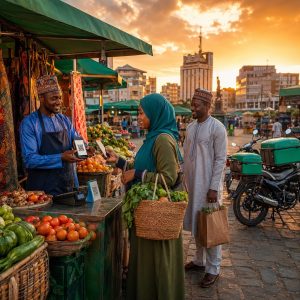
A Pair of Acquisitions Turning Yassir into an Ad Platform
On 13 March 2026, Yassir announced the acquisition of Kawarizmi, a Paris-based programmatic trading desk and ad-tech company. Five days earlier, Yassir had acquired UNO Hypermarché from Cevital, adding physical retail footprint to its already extensive on-demand services. The two moves, read together, describe a clear thesis: turn first-party data from rides, delivery, payments and groceries into a programmatic retail media product for brands.
Wamda’s coverage explains the integration plan — Kawarizmi’s tech stack will be plugged into Yassir’s user base to “build a scalable retail media network across its super-app ecosystem, monetise first-party data through privacy-first programmatic infrastructure, expand international brand partnerships across Europe, MENA and Africa, and develop a regional ad-tech stack with global ambitions.”
What Makes This the First in North Africa
Retail media networks — pioneered by Amazon and scaled by Walmart, Carrefour and Alibaba — combine four ingredients: large first-party audience, transaction-level signals, owned ad inventory, and programmatic infrastructure. In North Africa, no single operator had assembled all four. Glovo, Jumia, and bank apps each have pieces; Yassir is the first to bundle them.
According to Disrupt Africa, the combined business targets the MEA programmatic advertising market valued at $20.05 billion and growing at 7.89 percent CAGR — a market currently served largely by Meta, Google and TikTok because local retailers did not have the technical ability to transact programmatic budgets.
The 10M User Base Is the Real Asset
Yassir’s value proposition to brands rests on the granularity of its data. The same user identity connects a morning ride to work, a lunch order, an evening grocery delivery from UNO, and a bill payment via Yassir Pay. For a brand selling shampoo or cold beverages, that is a behavioral dataset no regional retailer has previously been able to offer outside closed-loop programs.
AllAfrica’s summary describes the ecosystem as “supporting brands and suppliers in MENA” — a positioning that moves Yassir from ride-hailing competitor to media and distribution partner for the region’s FMCG giants. WeeTracker framed it as “a retail media and adtech stack” rather than a ride-hailing expansion.
Advertisement
Privacy-First Programmatic: Why the Structure Matters
The public framing of “privacy-first programmatic infrastructure” is not marketing gloss. Regional regulators are moving on data protection — Algeria’s Law 18-07, Morocco’s CNDP enforcement, UAE’s PDPL — and third-party cookies are being deprecated by Google globally. A retail media network that runs on first-party signals in a consented app environment is structurally more defensible than one depending on external tracking.
This makes Yassir’s ad infrastructure roadmap a direct parallel to Carrefour Links and Walmart Connect in more mature markets: ad sales is a higher-margin adjacency to the core logistics and payment businesses, and the data boundaries are cleaner.
What It Means for Algerian and MENA Brands
For FMCG brands active in Algeria, Morocco, Tunisia and the broader region, the Yassir ad product will offer three things that were not previously combined in a single buy: audience reach through the super-app, basket-level targeting from groceries and delivery, and physical retail uplift measurement through UNO stores. According to Dabafinance’s analysis, the retail media offering is expected to begin taking shape in the second half of 2026.
The implication for smaller Algerian brands is also meaningful: a programmatic retail media surface that operates in dinars with local creative and local targeting signals has not existed. Yassir’s stack makes campaign-level experimentation affordable for a mid-market FMCG or consumer-electronics brand that never had access to Meta-grade targeting in Algerian context.
The Open Questions
Three unknowns will shape execution. First, how Yassir handles competitive tension — grocery brands may hesitate to buy media from a platform that also operates a competing hypermarket. Second, how measurement interoperability works with global media mix modeling — brands will want to tie Yassir ad exposure to outcomes measured outside the Yassir stack. Third, the regulatory response from data protection authorities across the countries Yassir operates in, now that it is a consolidator of cross-service behavioral data.
Frequently Asked Questions
What exactly did Yassir acquire in March 2026?
Yassir completed two acquisitions in a single week: UNO Hypermarché from Cevital on 8 March, adding physical grocery retail, and Paris-based ad-tech firm Kawarizmi on 13 March, adding programmatic trading capability. The two are being integrated into a single retail media network across Yassir’s super-app, rides, delivery, payments, and now physical stores.
How many users does Yassir have across its services?
Yassir reports approximately 10 million users across ride-hailing, delivery, financial services, and now physical retail after the UNO acquisition. This is the largest combined first-party audience for any super-app operating in North Africa.
When will the Yassir retail media network be available to advertisers?
According to public announcements, the retail media offering is expected to take shape in the second half of 2026. Brands and agencies should expect an early-access phase with limited inventory and a gradual expansion to full programmatic buying as the Kawarizmi integration matures.
Sources & Further Reading
- Yassir Acquires France-based Kawarizmi — Disrupt Africa
- Algeria’s Yassir Expands into Adtech with Kawarizmi — Wamda
- Yassir Acquires Paris-Based Kawarizmi to Build Retail Media & Adtech Stack — WeeTracker
- Yassir Acquires Kawarizmi to Build Retail Media and Adtech Platform — AllAfrica
- Yassir Kawarizmi Acquisition Adtech Retail Media Africa EMEA — Dabafinance
- Acquisition Sprint Bridges Pixels to Pavement — MediaPost
- Yassir Buys Kawarizmi to Expand Retail Media and Programmatic — ContentGrip