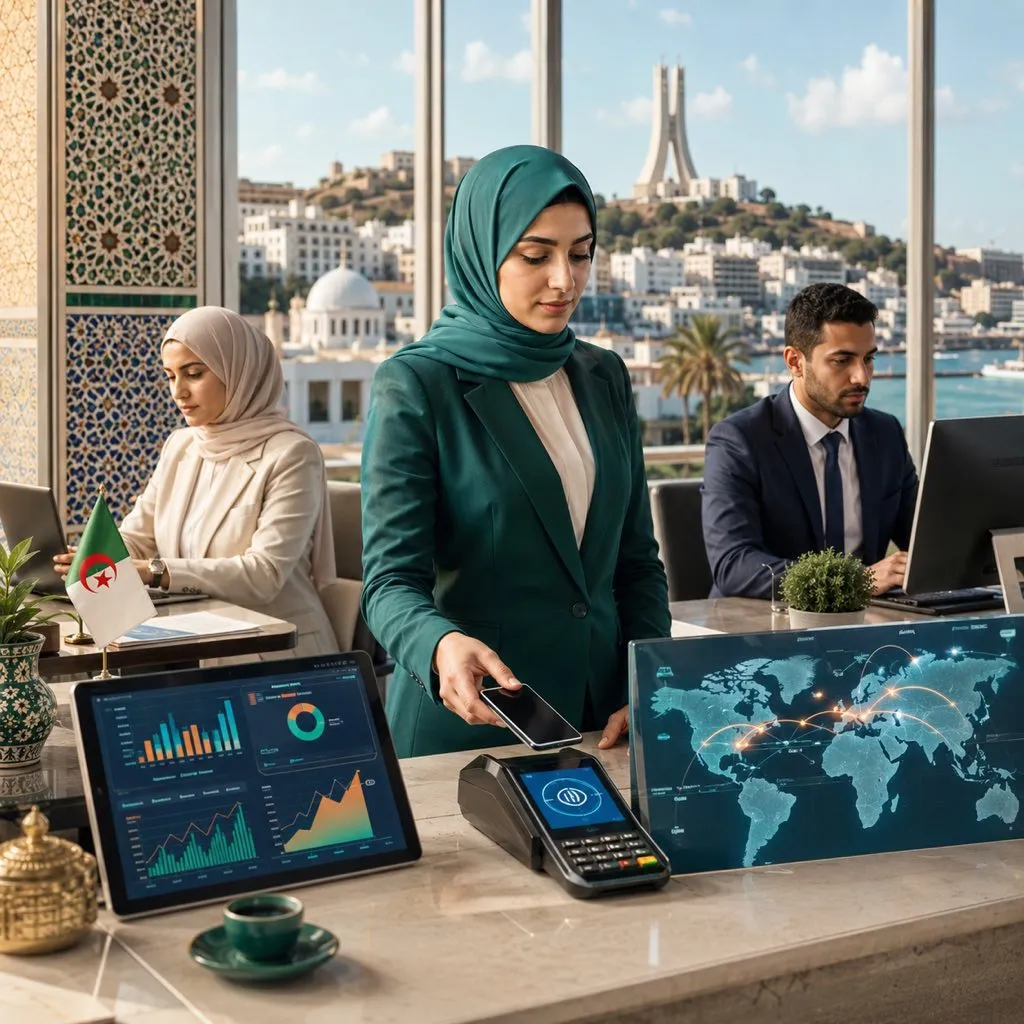
A 2028 Deadline and a Nation That Still Runs on Cash
In June 2025, Algerie Poste officially launched Baridi Pay, enabling QR code-based mobile payments through the BaridiMob application for the millions of Algerians who hold CCP (Compte Chèques Postal) accounts. The mechanism is simple: a merchant displays a QR code, the customer scans it via BaridiMob, confirms the amount, and the transfer settles instantly. The payment never touches cash.
The launch comes against the backdrop of a formal national cashless commitment. The Bank of Algeria’s governor has publicly stated the goal of a cashless society by 2028. The Fintech Strategy 2024-2030, published by the government, sets a more measured but still ambitious milestone: 50% of all transactions to be cashless by 2030. The 2025 Finance Law reinforced both targets with tangible economic incentives — stamp duty exemptions for electronic payments, and VAT and customs waivers on payment terminal assembly kits through December 2027.
What Baridi Pay represents is Algeria’s most accessible bet on closing the distance between those policy targets and ground reality. Algerie Poste holds the largest retail financial network in the country by account count, serving demographics that mainstream commercial banks have historically not reached. BaridiMob has surpassed 5 million downloads on Android, making it one of the most downloaded financial applications in Algeria. The EDAHABIA card base grew from 6 million in early 2020 to more than 14.3 million by end-2024 — a doubling in four years that reflects genuine adoption momentum.
But downloads and card issuance tell only part of the story. The deeper question is activation: how many of those 14.3 million cardholders are making regular digital payments, and how many hold their EDAHABIA card as a cash-withdrawal tool for their CCP balance rather than a point-of-sale instrument?
The Behavioral Gap the Data Reveals
Algeria’s digital payment statistics present a consistent tension between access and use. Internet penetration has crossed 77% nationally. EDAHABIA card issuance has doubled since 2020. Algerie Poste has deployed a functioning QR payment system with millions of potential users already enrolled. Yet cash remains dominant across retail, hospitality, and informal commerce.
The structural reasons are well-documented. Algeria’s e-commerce sector, which is the fastest-growing digital transaction segment, records that over 85% of transactions are settled by cash on delivery. That figure is not purely a trust signal — it also reflects merchant infrastructure: fewer than 5% of merchants operated with card terminals before the EDAHABIA expansion, and QR acceptance has only recently begun to scale beyond pharmacies, which were the initial rollout target for Baridi Pay.
Three friction points define the behavioral gap. First, cash remains the fastest settlement instrument for informal commerce, where roughly 40 to 50% of the Algerian economy operates outside formal invoicing and banking channels. Second, consumer awareness of Baridi Pay and its practical difference from an ATM withdrawal is still nascent; the launch in June 2025 has not yet been accompanied by a mass-market education campaign with measurable reach. Third, merchant incentives remain unclear: without a documented merchant fee schedule, small retailers have limited basis for comparing digital acceptance costs against the operational friction of cash remittance.
The 2025 Finance Law’s stamp duty exemption addresses the merchant cost dimension partly. The VAT and customs waivers on POS terminal kits extend a structural incentive through December 2027, which creates a compressed window for merchants to invest in infrastructure at reduced cost.
Advertisement
What Algerian Fintech Merchants and Operators Should Do Now
The policy and infrastructure foundation is real. The 2028 target is not aspirational decoration — it is backed by a sequence of regulatory and institutional moves that create both incentives and obligations. Merchants, fintech operators, and platform developers who build their payment strategy around that timeline will gain first-mover advantage in a market that is about to re-rate the value of digital acceptance.
1. Register Baridi Pay merchant accounts now, before the 2027 incentive window closes
The combination of stamp duty exemptions and POS terminal duty waivers expires in December 2027. Any merchant who delays past that window will face the full cost of digital infrastructure adoption without the fiscal subsidy. For a small pharmacist or local commerce operator, the terminal cost difference may be marginal — but for mid-sized retailers deploying five to ten POS points, the aggregate savings are meaningful. The Algerie Poste merchant registration process for Baridi Pay QR acceptance is accessible through CCP Business Cashless, the institutional payment service launched in March 2026 targeting companies, entrepreneurs, and merchants. Begin the registration process in Q2 2026 to ensure infrastructure is installed and tested before the 2027 deadline.
2. Build payment flows that treat BaridiMob as a primary channel, not a fallback
Fintech platform developers and digital commerce operators should architect payment UX around BaridiMob as a tier-1 payment method rather than an alternative option. The 5 million download figure suggests a user base that is present but underpowered — meaning the platform has users who are not being given sufficient opportunities to transact digitally. In e-commerce checkout flows, placing BaridiMob / Baridi Pay at the same visual prominence as COD, rather than buried in an “other payment methods” section, measurably increases digital payment take-up according to UX research from similar market transitions in West Africa and Southeast Asia. The same logic applies to B2B invoicing tools: if your platform issues invoices, embed a Baridi Pay QR code on the invoice as the default settlement instruction.
3. Instrument your merchant terminal data for the ARPCE reporting cycle
Algeria’s communications and digital economy regulator ARPCE has begun collecting digital payment penetration data as part of the Fintech Strategy 2024-2030 monitoring framework. Merchants who operate formal digital payment infrastructure will be in a better position during the strategy’s mid-term review in 2027, when the government will assess whether the 50%-by-2030 trajectory is on track. If the data shows structural under-adoption, additional regulatory pressure on merchants to accept digital payments is a likely policy response. Getting ahead of that pressure by formalizing digital acceptance now is both a business and a compliance hedge.
4. Pair payment acceptance with consumer education at the point of sale
The merchant has one of the most powerful consumer education touchpoints: the moment of transaction. Displaying the Baridi Pay QR code prominently, training counter staff to offer the scan option unprompted, and posting the simple three-step “scan, confirm, done” instruction in Arabic and French at the counter are low-cost interventions that convert passive card holders into active digital payers. Markets where QR payment adoption followed this pattern — Morocco’s CIH Bank QR rollout, Senegal’s Wave merchant expansion — saw monthly active digital payer rates increase 15 to 25% within six months of merchant-led education campaigns.
5. Monitor the regulatory sandbox opening for fintech licensing opportunities
The Fintech Strategy 2024-2030 includes a commitment to establish a regulatory sandbox by 2026 for at least 20 fintech startups to test innovations annually. For payment infrastructure operators, digital wallet providers, and buy-now-pay-later pilots, this sandbox is the primary legal pathway to test products in Algeria without the full banking license requirement. The sandbox framework has not yet been formally announced as of May 2026, but its inclusion in the strategy document means the Ministry of Post and Telecommunications and the Bank of Algeria are preparing the regulatory architecture. Companies that engage early — by submitting expression-of-interest letters and building relationships with ARPCE — will be in the first cohort when the sandbox opens.
Where This Fits in Algeria’s 2026 Digital Economy Ecosystem
Baridi Pay is not operating in isolation. Algeria’s Bank of Algeria joined PAPSS in August 2025, connecting Algerian banks to 150+ commercial institutions across Africa for cross-border settlement in local currencies. The Finance Law 2025 extended digital payment incentives through 2027. The e-commerce law (Law 18-05) and its successive amendments have created a legal framework for digital commercial transactions. The government’s digitization strategy — anchored by the High Commissioner for Digitization — targets 20% of GDP from the digital economy by 2030.
What this adds up to is a payment infrastructure moment: the policy stack, the institutional stack, and the user base stack are aligning simultaneously for the first time. Algeria had the CCP account infrastructure for decades without the mobile payment layer. It now has both. The question is whether merchant adoption and consumer habit formation can catch up to the 2028 target before the political cost of missing it becomes a reason to extend the deadline rather than accelerate the program.
The Fintech Strategy 2024-2030’s goal of 30 to 35 active fintech startups growing into a larger ecosystem depends directly on the payment rails being normalized. Banxy, described as Algeria’s first fully mobile banking platform, alongside Digital Finance Algeria (DFA), ESREF Pay, and UbexPay, represent the early cohort of infrastructure builders. Their ability to scale depends on merchants accepting QR codes and consumers being confident enough in the system to leave cash at home. Every pharmacy that activates Baridi Pay, every e-commerce checkout that makes BaridiMob a default, and every invoice that embeds a QR code makes the 2028 target marginally more achievable — and every delay compounds the gap.
Frequently Asked Questions
What is Baridi Pay and how does it differ from the EDAHABIA card?
Baridi Pay is a QR code-based mobile payment service launched by Algerie Poste on June 14, 2025. It runs through the BaridiMob application and allows customers to pay merchants by scanning a QR code, transferring funds directly from their CCP account. The EDAHABIA card is a physical debit card linked to the same CCP account — Baridi Pay adds a contactless, cardless layer on top of the same underlying account infrastructure, enabling payments without the physical card present.
When does the 2025 Finance Law incentive window close for payment terminals?
The VAT and customs duty exemptions on payment terminal assembly kits run through December 2027. Merchants planning to invest in digital payment infrastructure — whether QR display stands, POS terminals, or integrated software — should initiate procurement and registration before that date to benefit from the reduced cost structure.
Is the Bank of Algeria’s 2028 cashless target legally binding?
The 2028 cashless society target was announced by the Bank of Algeria’s governor as a policy objective rather than a regulatory mandate. The binding commitment in the Fintech Strategy 2024-2030 is the 50% cashless transactions target by 2030. The 2028 reference frames the aspiration; the 2030 strategy document sets the measurable milestone. Both create political and regulatory pressure that will shape fintech and payment policy through the rest of the decade.
Sources & Further Reading
- Algeria’s Fintech Ecosystem in 2026: Building Momentum — The Fintech Times
- Algérie Poste Launches Baridi Pay Mobile Payment Service — DzairTube EN
- Algeria’s New Digital Payment Law: 57% Unbanked at Stake — ALGERIATECH
- Algeria’s Fintech 2024-2030 Strategy — Ministry of Post and Telecommunications
- Algeria Joins PAPSS — Fintechnews Africa
- Algeria Digital Economy — US Trade.gov Commercial Guide
🔗 Related Intelligence

Baridi Pay at the Hanut: How Algeria’s Informal Micro-Merchants Are Going Cashless

Algeria’s Cashless 2030 Strategy: Tiered Wallets, Mobile Banking, and the Path to Financial Inclusion

BaridiMob and CCP Business Cashless: The SME Retail Checkout Playbook for 2026

Algeria’s War on Cash: 939 Billion Dinars in E-Payments and the SoftPos Revolution Coming by 2028