
Algeria’s Ecommerce Market Has a $7 Billion Trust Problem
Algeria’s ecommerce market is valued at approximately $7 billion, growing at roughly 25% annually, with a population of 44 million and over 30 million internet users and internet penetration exceeding 77%. By any headline metric, this is a large, growing digital economy. The reality at the checkout screen tells a different story.
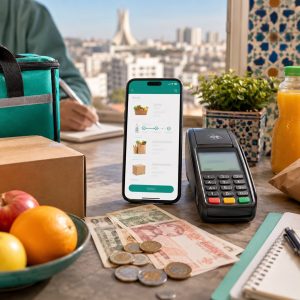
Ninety-five percent of all online transactions in Algeria use cash on delivery. Credit card adoption stands at under 5%. Consumer trust in online payment systems remains structurally low. The result is a market that is, operationally, not ecommerce in the conventional sense — it is a telephone-and-delivery order system with a website layer on top.
This COD dependency matters beyond the inconvenience it creates. Return rates for COD orders in Algeria range from 15% to 25% depending on delivery partner, compared to roughly 8% for prepaid orders across the MENA region. That 17-percentage-point differential is not simply a payment problem. It is a signal that the COD transaction has structurally different consumer intent: a customer who pre-pays has committed to the purchase; a customer who orders COD has an option to refuse delivery, and refusal rates climb sharply for impulse or social-media-driven purchases that dominate the informal commerce segment.
Why COD Persists: Three Structural Causes
Describing COD dominance as a “trust problem” is accurate but incomplete. Three structural causes compound each other to make digital payment adoption difficult even when consumers are willing.
Address infrastructure and last-mile reliability. Algeria’s address system relies on landmark descriptions rather than street numbers in rural and peri-urban areas. This creates last-mile ambiguity that delivery partners resolve by calling ahead — adding friction and reducing the reliability of the estimated delivery window. Outside the three major cities of Algiers, Oran, and Constantine, last-mile delivery typically requires three to seven days rather than the one-to-two day windows that normalize prepaid shopping behavior in markets like Morocco and Egypt. When a customer does not know when exactly their package will arrive, COD becomes a rational insurance mechanism: they pay only when the product is physically in their hands.
Cash remittance cycles that punish merchants. Even when delivery succeeds, cash collected at the door does not immediately reach the merchant. Remittance cycles from Algerian delivery partners range from three to fourteen days after collection, depending on the partner and volume tier. A merchant who sells 100 units per week on COD is effectively extending interest-free credit to their logistics partner for up to two weeks per cycle. Digital payment settlement, by contrast, can reach the merchant account within twenty-four to forty-eight hours. The cash flow advantage of digital payment is substantial, but it requires the consumer to have a digital payment method — which most do not regularly use.
Informal social commerce that bypasses structured checkout. A significant share of Algerian online retail does not happen through structured ecommerce platforms at all. Facebook, Instagram, and TikTok sellers conduct transactions through direct messages, manual bank transfers for trusted repeat customers, and COD for new buyers. This segment operates entirely outside the Baridi Pay / EDAHABIA infrastructure, meaning that even as formal ecommerce platforms introduce digital payment options, a large portion of the market is not subject to those options. The Algerian e-commerce law (Law 18-05) technically requires registered ecommerce operators to provide digital payment options, but enforcement in the informal social commerce segment is limited.
Advertisement
What Algerian Ecommerce Operators Should Do to Break the COD Lock
The COD equilibrium is not permanent — it has been broken in comparable markets within three to five years when the right combination of logistics improvement and payment incentive was deployed simultaneously. The lesson from Morocco, Egypt, and several Southeast Asian markets is that payment-only interventions fail because they do not address the underlying logistical uncertainty that makes COD rational. Logistics-only improvements help but do not capture the full return-rate reduction. The operator playbook that works combines both.
1. Implement prepayment discounts calibrated to the 17-point return-rate differential
The data is clear: prepaid orders return at 8%, COD orders return at up to 25% in Algeria. That differential has a precise financial value. A merchant with an average order value of 5,000 DZD and a 20% COD return rate absorbs the delivery cost, return logistics cost, and often product restocking cost on every fifth order. A 3 to 5% prepayment discount, offered explicitly as a “digital payment benefit” at checkout, shifts the economic equation: the merchant who converts 30% of COD customers to prepaid reduces their blended return rate from 20% to roughly 15%, recovering the discount cost through lower logistics expense alone. Frame the discount as a consumer benefit rather than a penalty for COD; framing matters for take-up rate.
2. Integrate BaridiMob as a first-class checkout option with zero-click payment confirmation
The BaridiMob user base of 5 million downloads represents the largest accessible digital payment population in Algeria. Most ecommerce platforms that integrate digital payment options treat them as a secondary path — a sub-menu under “other payment methods” — while placing COD prominently as the default. Reversing this order and integrating BaridiMob with a one-tap checkout flow (scan QR, confirm, done) converts the payment UX from a multi-step detour into a faster path than COD checkout, which requires counting cash, having correct change, and waiting for the delivery agent to issue a receipt. Speed at the final step of delivery is a genuine consumer convenience argument for digital payment — lead with it in checkout UX copy.
3. Partner with delivery providers on verified tracking and guaranteed delivery windows
The core reason COD is rational for Algerian consumers is delivery uncertainty. An operator who solves delivery certainty — through GPS tracking, two-hour delivery windows, and SMS confirmation — changes the consumer calculus. Three large delivery companies operate with varying API integration capability in Algeria, providing structured tracking data that can be embedded in merchant platforms. Choosing delivery partners based on API tracking quality, not just cost per delivery, is a direct investment in reducing COD rationality. A customer who knows their package arrives between 2 PM and 4 PM tomorrow has much less reason to insist on cash-at-door as the only guarantee of product quality.
4. Use COD data as a conversion optimization tool, not just an operational cost
Every COD return contains actionable data. Category analysis of returned items reveals which product types carry the highest risk (impulse categories, large size-dependent purchases) and which can safely shift to prepayment incentives. Merchant platforms that instrument COD outcomes by product category, delivery zone, and customer segment can build a dynamic prepayment recommendation engine: for customers in Algiers who have ordered twice before, recommend BaridiMob; for first-time customers ordering electronics in rural wilaya, keep COD as default. This segmented approach avoids forcing payment migration on low-trust segments before the infrastructure justifies it, while accelerating conversion where the conditions are favorable.
5. Engage ARPCE and consumer protection frameworks proactively on digital payment guarantees
A key reason for consumer reluctance on prepaid digital purchases is the absence of a clear, enforceable refund guarantee. Law 18-05 gives buyers a right of return within a defined period, but the practical enforcement of that right — particularly for small merchants — is inconsistent. Operators who publish explicit, clear refund policies in Arabic and French and register those policies with ARPCE build a verifiable trust signal that measurably reduces consumer hesitation on prepaid orders. In markets where consumer protection legislation has been actively communicated alongside digital payment infrastructure — Rwanda’s digital payments framework, Kenya’s CGAP-backed consumer disclosure standards — prepaid adoption accelerated significantly faster than in markets with equivalent technical infrastructure but weak consumer protection communication.
The Structural Lesson
The COD problem in Algeria is solvable, but not with payment infrastructure alone. Morocco has shown that a combination of CIH Bank QR expansion, Maroc Telecom wallet integration, and aggressive merchant education reduced COD share from above 90% to around 65% within four years. The enabling factors were not technically superior to what Algerie Poste and BaridiMob already offer in Algeria in 2026. They were operationally superior: cleaner address systems, shorter remittance cycles, and proactive consumer protection communication.
Algeria’s $7 billion ecommerce market has the consumer demand, the internet penetration, and now the payment infrastructure to make the same transition. What remains is the operational layer — reliable last-mile tracking, fast merchant remittance, and consumer-facing guarantees that make a prepaid decision feel as safe as cash at the door. The merchants and platform operators who build that operational layer in 2026 and 2027, ahead of the government’s 2028 cashless target, will be the ones who capture the market share when the transition tips.
Frequently Asked Questions
What is the actual financial cost of Algeria’s 95% COD rate for an average ecommerce merchant?
A merchant with an average order value of 5,000 DZD and a 20% COD return rate absorbs delivery costs (typically 400–600 DZD), return logistics (similar cost), and often restocking costs on every fifth order. That is roughly 1,000–1,200 DZD in direct operational cost per five orders, or around 20–24% of the delivery cost budget. Additionally, cash remittance cycles of 3–14 days from delivery partners create working capital gaps that constrain inventory replenishment.
Can a small merchant realistically shift customers from COD to BaridiMob without a large technology budget?
Yes. The minimum viable integration is displaying a BaridiMob QR code at checkout (a static image linked to the merchant’s CCP account) alongside a 3–5% prepayment discount offer. This requires no API integration and can be implemented within an existing website or social media shop in under an hour. The key step is registering a merchant CCP account through Algerie Poste’s CCP Business Cashless service, which was launched in March 2026 for this purpose.
How does Algeria’s COD rate compare to regional peers?
Algeria at 95% COD is among the highest in the MENA region. Morocco and Egypt, the regional leaders in digital payment adoption, have reduced their COD rates to approximately 65% and 70% respectively through a combination of mobile wallet expansion and consumer protection enforcement. The MENA regional average COD return rate is 19% versus 8% for prepaid — the 11-point gap applies across all markets and represents the minimum financial upside from shifting payment mix toward prepaid.
Sources & Further Reading
- Algeria E-Commerce Research 2026 — Ecommaps Blog
- Algeria E-Commerce COD Complete Guide 2026 — CODRocket
- Algeria E-Commerce — US Trade.gov Commercial Guide
- State of COD E-Commerce in MENA 2026 — eGrow Blog
- Algeria Fintech Ecosystem 2026 — The Fintech Times
- Algeria Digital Payment Services Regulation — ALGERIATECH
🔗 Related Intelligence

The COD Trap: How Cash on Delivery Is Strangling Algeria’s E-Commerce

Algeria E-Commerce Fulfillment: The Warehouse Gap Holding Back a $7 Billion Market
Algeria’s E-Commerce Crossroads: COD Culture, Digital Payments, and Yassir’s Hybrid Commerce Bet

Algeria’s E-Commerce Pivot: From COD Dominance to Digital Payment Adoption