The Account-Opening Friction That Keeps 23 Million Algerians Excluded
Opening a bank account in Algeria today requires, at minimum, a physical branch visit, a copy of the national identity card, and proof of address — a process that excludes anyone more than 20 kilometers from an urban bank branch, anyone who cannot produce formal address documentation, and anyone who finds the process administratively intimidating. The result is structural: 57% of Algerian adults have no bank account, despite 95% mobile penetration and a government-issued biometric identity card that has been mandatory since 2016.
The data tells a clear story. According to trade.gov’s Algeria digital economy guide, only 2.8% of Algerians own a credit card and 22.9% hold a debit card. Mobile banking usage stands at just 11% of adults, despite a 92% mobile phone prevalence. The gap between “has a phone” and “uses mobile banking” is not a technology gap — it is an onboarding gap. Customers cannot get into the banking system in the first place, so mobile banking remains irrelevant.
eKYC — electronic Know Your Customer verification, conducted remotely without a physical branch — is the mechanism that closes this gap. The question for Algeria in 2026 is whether the regulatory framework, the technical infrastructure, and the fintech business models can align quickly enough to make remote onboarding a reality at scale.
What eSIM-Based eKYC Actually Means
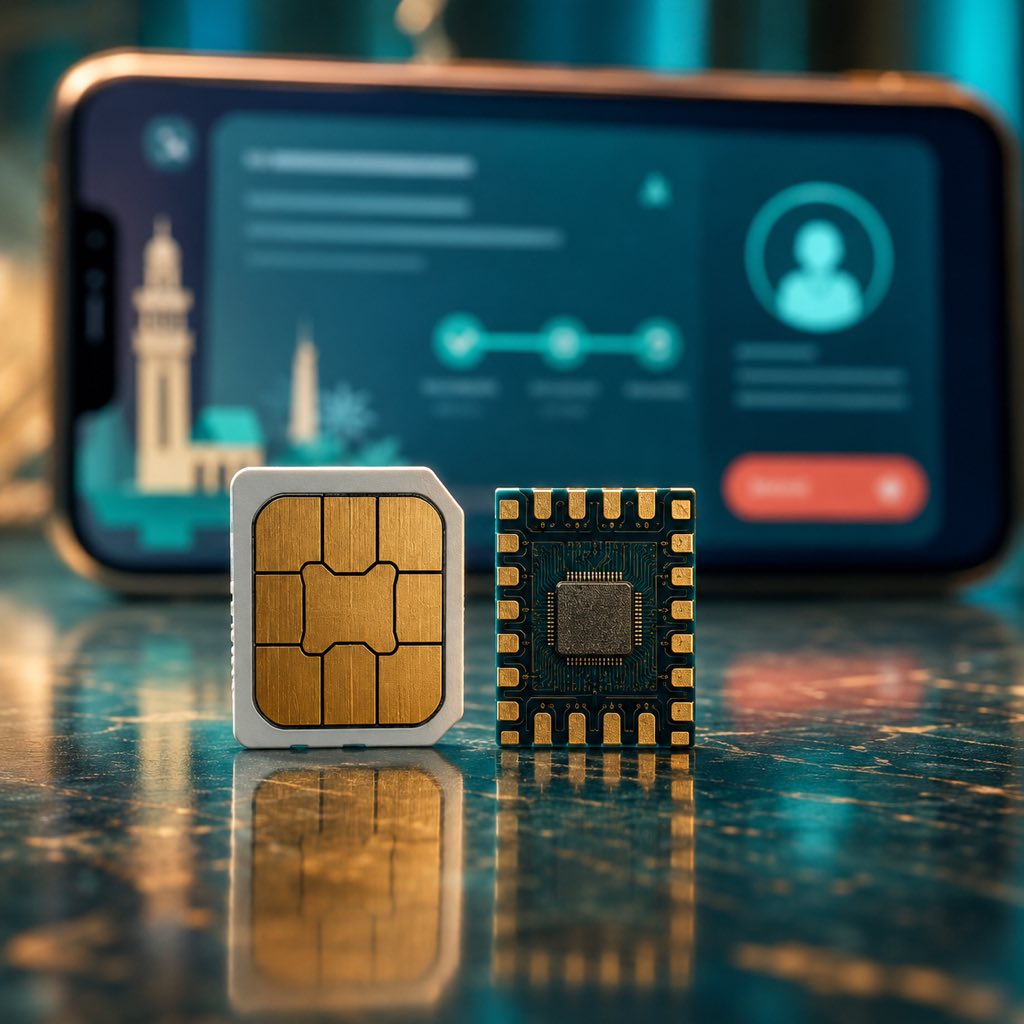
An eSIM is a programmable SIM embedded in a mobile device that stores the subscriber’s identity credentials verified by the mobile network operator (MNO). When an MNO activates an eSIM, it completes a device-level identity check that confirms the subscriber’s biometric national ID matches the device and number. This creates a pre-verified identity layer that financial institutions can reuse for KYC compliance, without repeating the full identity verification process.
As the Mobilise Global analysis of eKYC and eSIM onboarding shows, the combination of eSIM verification and eKYC workflows enables telecoms and fintechs to complete full customer onboarding digitally. Algeria’s three MNOs — Djezzy, Mobilis, and Ooredoo — each completed Know Your Customer checks for 5G eSIM activation. That data could, under a properly regulated data-sharing framework, serve as the identity anchor for bank account opening.
Algeria’s biometric national ID — introduced in 2016 — already provides the government-level identity infrastructure. Unlike countries that lack a universal biometric ID, Algeria has the raw material for eKYC: a uniquely numbered, machine-readable card linked to a centralized biometric database. The technical gap is the API layer that lets authorized fintechs and banks query this database in real time to confirm identity without a physical card scan in a branch.
This is the architecture that regulators in the UAE, Saudi Arabia, and Singapore have built: a national identity API, accessed by licensed financial institutions under strict privacy rules, that converts a government identity record into a verified onboarding credential in seconds. Algeria’s data protection law (Law 18-07, 2018) governs how personal data — including biometric data — can be shared and accessed. The framework exists; what remains is the enabling instruction from the Bank of Algeria that defines which fintech actors can query the national identity system.
Advertisement
The Regulatory Pieces Already in Place
Algeria’s Fintech Strategy 2024-2030 explicitly targets 50% cashless transactions by 2030 and commits to opening a regulatory sandbox for fintech innovation by 2026. The Bank of Algeria’s Instruction No. 06-2025, issued August 2025, created the PSP (Payment Service Provider) licensing framework — the first regulation in Algeria to define who can legally operate digital wallets and agent networks.
According to the Fintech Times’ 2026 Algeria ecosystem overview, the strategy includes plans to license fintech startups to operate within a supervised sandbox. For eKYC specifically, the Bank of Algeria would need to issue a supplementary circular defining the acceptable digital identity verification methods for remote account opening — analogous to the FATF-compliant eKYC frameworks that MENA peers have issued.
The existing infrastructure aligns well with this. SATIM, which manages Algeria’s interbank transaction infrastructure and electronic banking backbone, is the natural technical operator for a national identity API. The “Switch Mobile” interoperability platform — now operational — shows SATIM’s capacity to build and manage shared financial infrastructure at national scale. An eKYC API layer is technically a simpler project than Switch Mobile; the constraint is authorization, not capability.
What Fintech Founders and Banks Should Do About eKYC
1. Build eKYC-Ready Architecture Now, Before the Circular Arrives
The Bank of Algeria has not yet issued the circular that would authorize remote identity verification for account opening. This is no reason to wait. The smart move is to build the technical architecture today so that when the circular arrives, a fintech can be in production within weeks, not months. Specifically: implement an identity verification workflow that accepts biometric national ID numbers as the primary input, pair it with liveness detection (a facial selfie compared against the stored biometric), and design the flow to plug into a national identity API when the endpoint is published. Startups that have this architecture live in sandbox environments before the regulation finalizes will have a first-mover advantage measured in customer cohorts, not just days on a calendar.
2. Partner With MNOs to Access eSIM Verification Data Under a Data-Sharing Agreement
Algeria’s three MNOs each hold verified identity data for their eSIM subscribers. Under Law 18-07, this data cannot be shared without explicit consent and a legal basis. The legal basis to build today — before any national framework exists — is a bilateral data-sharing agreement between a licensed fintech and an MNO, structured as a consent-based identity attribute request. The user initiates the bank account opening, consents to the fintech querying the MNO for their verified ID attributes, and the MNO responds with a confirmation — no raw biometric data transmitted, just a binary match signal. This architecture already operates in Western Europe under GDPR consent frameworks. Replicating it in Algeria requires only a fintech, an MNO, a lawyer, and 6-12 months of negotiation.
3. Address the Address Verification Problem Explicitly
The hardest sub-problem in Algerian eKYC is address verification. A national biometric ID confirms who someone is, but not where they live — and many Algerian citizens in rural areas lack formal address documentation. The workaround used in comparable markets is a combination of telco location data (with consent), utility bill alternatives (rental agreements, commune certificates), and graduated onboarding (a basic wallet with spending limits that upgrades to a full bank account after 90 days of behavioral data). Fintech founders should design their KYC tiers specifically for Algeria’s address verification gap, not import a European or North American KYC checklist that assumes universal postal infrastructure.
4. Engage the ANPDCP to Define eKYC Compliance Standards Pre-Launch
The National Authority for Protection of Personal Data (ANPDCP) is the body that will ultimately determine whether a fintech’s eKYC implementation is compliant with Law 18-07. Engaging ANPDCP before product launch — through a regulatory consultation or sandbox participation — is not optional risk management, it is the only way to avoid a post-launch compliance order that forces a product redesign. The ANPDCP has signaled openness to fintech innovation; the barrier is that most Algerian fintechs have not formally engaged the authority. Those that do will find they can co-design the compliance standards, not just react to them.
The Structural Lesson from Regional Peers
The fastest eKYC rollouts in the MENA region — in the UAE, Morocco, and Egypt — shared one common feature: a single regulatory authorization event that explicitly permitted remote identity verification for financial account opening. In the UAE, the Central Bank’s KYC Utilities Framework, issued in 2020, unlocked an entire generation of digital banking products. In Morocco, Bank Al-Maghrib’s Payment Institution Framework had a similar effect. In each case, the framework did not create eKYC technology — it created the legal permission that allowed existing technology to be deployed commercially.
Algeria has the technology (biometric national IDs since 2016), the infrastructure (SATIM, Switch Mobile), the demand (57% unbanked with 92% mobile penetration), and the strategic intent (Fintech Strategy 2024-2030). The next regulatory unlock is a single circular from the Bank of Algeria — expected in 2026 or 2027 under the sandbox commitment — that confirms: “Remote identity verification using biometric national ID plus liveness check is a valid KYC method for account opening in Algeria.” When that circular arrives, the market will move in months. The fintechs that are architecturally ready on day one will capture the first wave of account openings. The rest will spend 12 months catching up.
Frequently Asked Questions
What is the difference between eKYC and traditional KYC in Algeria?
Traditional KYC in Algeria requires an in-person branch visit where a bank employee physically inspects the customer’s national identity card and supporting documents. eKYC is a fully remote process: the customer submits their national ID number and a live selfie through an app, the system compares the selfie against the biometric stored in the national ID database, and the match result becomes the identity confirmation. The key advantage for Algeria is that eKYC removes the physical branch visit — the single largest barrier for the 57% of adults who live more than 20 kilometers from an urban bank branch.
Does Algeria’s data protection law (Law 18-07) prevent eKYC implementation?
Law 18-07 regulates how personal and biometric data can be used, shared, and stored, but it does not prohibit eKYC. It requires explicit user consent, a defined legal basis for processing, and data minimization — principles that are compatible with eKYC architectures used globally. The constraint is not the law; it is the absence of a Bank of Algeria circular that explicitly designates biometric national ID verification as an acceptable account-opening method for remote channels. Once that circular is issued, Law 18-07 compliance becomes a design requirement, not a barrier.
Why is eSIM specifically important for eKYC in Algeria?
eSIM onboarding by MNOs already includes an identity verification step — the operator confirms the subscriber’s biometric national ID before activating the embedded SIM. This creates a pre-verified identity record held by Djezzy, Mobilis, or Ooredoo that represents the same level of confidence as a branch-based ID check. If fintechs can access this verification signal — with user consent and under a bilateral data-sharing agreement — they inherit the MNO’s verification work rather than repeating it from scratch. For Algeria’s 5G rollout, which is driving eSIM adoption, this creates an accelerating effect: every new 5G eSIM subscriber becomes a pre-verified identity that fintechs can onboard remotely.
Sources & Further Reading
- Algeria’s Fintech Ecosystem in 2026: Building Momentum — The Fintech Times
- Algeria Digital Economy Guide — U.S. Commercial Service / trade.gov
- eKYC and eSIM as Key Enablers for Digital Customer Onboarding — Mobilise Global
- Algeria’s Payment Rails & Path to Digital Banking — Transfi
- Algeria’s New Digital Payment Law: 57% Unbanked at Stake — AlgeriaTech
🔗 Related Intelligence

Algeria’s Digital Banking Infrastructure: How Neobank Licensing Is Reshaping Enterprise IT

Algeria’s Digital Identity Infrastructure: The National Biometric ID, e-Signature

Algeria Digital Identity Law: How the New Trust Services Framework Enables Secure e-Services in 2026

11 Mobile Banks, One Winner: Algeria’s Neobank Race Is On