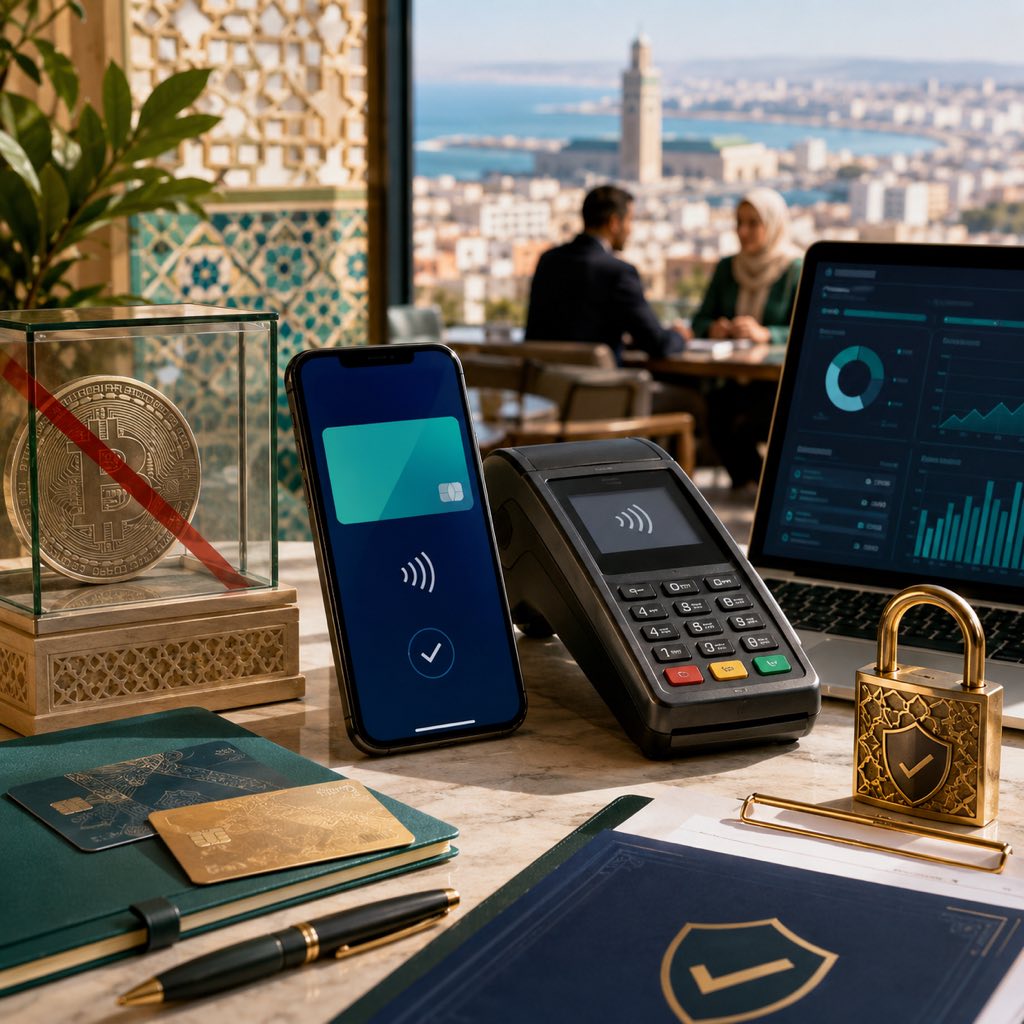
What Law 25-10 Actually Criminalises — and Why Clarity Matters
Algeria has held a restrictive stance toward cryptocurrency since the 2018 Finance Law introduced a vague prohibition on virtual currency purchase, sale, and use. That early ban was loosely enforced. Law No. 25-10, enacted in July 2025, changed the nature of the restriction entirely. The new law is not a regulatory framework for crypto — it is a comprehensive criminalisation covering every point of contact with digital assets:
- Issuance, purchase, and sale of any digital asset
- Ownership and possession of cryptocurrency
- Mining operations
- Operating digital wallets linked to decentralised networks
- Running or using crypto exchanges
Penalties reach one year of imprisonment and fines of up to approximately $7,700 USD. Enforcement falls to a broad coalition of authorities: the Bank of Algeria, the Banking Commission, judicial authorities, financial authorities, and security authorities.
The law eliminates the ambiguity that allowed some operators to claim grey-market tolerance. For fintech builders, this clarity — while restrictive — is operationally useful: it removes the risk of investing in a product line that could be shut down mid-build. The regulated channels that remain open are now unambiguously the viable paths.
The Regulated Digital Finance Infrastructure That Remains Open
1. Mobile Payments and Electronic Wallets Through Licensed Banks
The Algerian banking sector comprises 19 banks — six state-run — supported by two key payment infrastructure entities: GIE Monétique and SATIM (Société d’Automatisation des Transactions Interbancaires et de Monétique), which facilitates electronic payments and interbank transactions. This infrastructure supports compliant mobile banking and digital wallet products when deployed through or in partnership with licensed banking institutions.
Mobile banking adoption remains low: only 8.2% of Algeria’s population made internet or mobile purchases in 2023, and just 4.7% sent money digitally. These figures represent both the structural constraint and the market opportunity. A licensed fintech that integrates with SATIM’s interbank network to deliver a user-friendly mobile payment experience is addressing a real gap — and doing so within the Bank of Algeria’s approved framework.
The key compliance parameter: digital wallets and payment apps must be anchored to a licensed bank and operate within the approved electronic payment regulations. Standalone, peer-to-peer digital asset transfers outside this framework fall under Law 25-10’s prohibitions.
2. B2B Payment Automation and Treasury Technology
Algeria’s business-to-business payment infrastructure is underdeveloped relative to the size of its formal economy. Companies managing supplier payments, payroll disbursements, and inter-entity transfers rely heavily on paper-based or branch-based processes. B2B payment automation — invoice processing, payment scheduling, reconciliation tooling — is fully within the regulated banking perimeter and does not require any contact with digital assets.
This vertical is particularly attractive because Algeria’s startup ecosystem now exceeds 2,000 certified companies, with 7% of those focusing on fintech. Enterprise treasury and payment automation represents a lower-regulatory-friction opportunity than consumer-facing digital wallets, with higher contract values and longer retention.
Builders should note that Algeria’s 2022 public procurement law enables direct negotiation with certified startups — meaning a B2B treasury tech product can be sold to public enterprises as well as private ones, widening the total addressable market.
3. International Remittance Products Through Regulated Channels
Algeria has approximately 1.5 million citizens in France alone, with significant diaspora communities across Europe. International remittance flows into Algeria run through formal banking channels — a requirement that Law 25-10 reinforces by eliminating crypto-based remittance as an alternative. The Bank of Algeria and the Banking Commission regulate cross-border money transfers.
Within this regulated space, there is room for product innovation: faster digital onboarding for remittance senders abroad, mobile-first disbursement for recipients in Algeria, and reduced-friction identification using Algeria’s national biometric ID system. None of these require digital assets — they require good UX on top of the existing regulated infrastructure.
The comparison point is instructive. Morocco’s regulated fintech sector has seen Wave, CIH Bank’s digital offerings, and international players expand precisely because the regulatory perimeter is clear. Algeria’s Law 25-10, by drawing an equally clear line, enables the same kind of bounded innovation — as long as builders stay within the licensed banking perimeter.
Advertisement
What Algerian Fintech Builders Should Do
1. Anchor Every Product to a Licensed Bank Partner
The single most important structural decision for any Algerian fintech is choosing a licensed banking partner before writing the first line of product code. The Bank of Algeria does not license fintech companies directly — products reach consumers and businesses through the banking network. Establish a partnership or white-label agreement with one of Algeria’s 19 banks as the foundation, not as an afterthought. State-run banks (BNA, BEA, CPA, BADR, BDL, CNEP) have the largest distribution networks; international banks (HSBC, Citibank) may offer more flexibility on product design.
2. Build on the SATIM Interbank Network
SATIM’s interbank transaction network is the payment infrastructure backbone of Algeria. Products that integrate with SATIM’s APIs (where available) or work through SATIM-connected banks get access to the full Algerian banking ecosystem rather than being limited to a single institution’s customer base. Engage with SATIM’s technical team early to understand current integration pathways and forthcoming open banking capabilities — the digital strategy Algeria is developing through 2029 includes plans to modernise payment infrastructure.
3. Target the 91.8% of the Population Not Yet Using Digital Payments
The adoption gap is the market. With only 8.2% of Algerians making mobile or internet purchases as of 2023, the entire digital payments market is effectively still to be built. The demographic profile is favourable: Algeria has 50.65 million active mobile connections representing 95.2% of the population, and 33.49 million internet users. Mobile penetration exists; payment behaviour has not yet digitised. A product that converts mobile users to digital payment users — starting with a specific high-frequency use case like utility bill payment or transport ticketing — can capture this transition without competing with any established digital incumbent.
Where This Fits in Algeria’s Digital Finance Trajectory
Law 25-10 is the regulatory equivalent of a construction permit being denied for one building while the adjacent plot is cleared and graded. The crypto channel is closed. The regulated payment and banking channel is the one Algeria is actively investing in developing, as evidenced by its national digital strategy through 2029, 5G deployment, and fibre expansion.
Fintech builders who treat this as a constraint rather than a definition of the viable space will struggle to find product-market fit. Those who treat the regulated banking perimeter as the design brief — building the most compelling user experience possible within that perimeter — are positioned to own the digital payments category in a market of 47 million people that has barely begun to digitise.
The most actionable near-term move is to complete due diligence on a banking partner, file for startup certification with the Ministry of Knowledge Economy, and begin product scoping with the SATIM network in mind. The window for establishing market position in Algerian digital finance is open — and it is open specifically because the law has defined the boundaries clearly enough to build within.
Frequently Asked Questions
What exactly does Law 25-10 ban, and are there any exceptions for businesses?
Law 25-10 criminalises all cryptocurrency activities without exception: ownership, purchase, sale, issuance, mining, and operating digital wallets connected to decentralised networks. There are no licensed or registered categories of crypto businesses permitted in Algeria. The only digital finance activities that are legal are those conducted through Bank of Algeria-regulated banks and payment operators like SATIM.
Can Algerian startups still build blockchain-based products under Law 25-10?
Law 25-10 targets digital assets and cryptocurrency specifically. Permissioned blockchain technology used for supply chain tracking, document verification, or internal enterprise record-keeping — where no digital asset or cryptocurrency is issued or transferred — is not explicitly prohibited. However, any product involving the creation, transfer, or storage of value in a digital asset format falls under the ban. Builders should obtain legal counsel before launching any blockchain product in Algeria.
What is SATIM and why is it important for Algerian fintech products?
SATIM (Société d’Automatisation des Transactions Interbancaires et de Monétique) is Algeria’s interbank payment and electronic money infrastructure operator. Products that integrate through SATIM-connected banks can process electronic payments across the entire Algerian banking network rather than being limited to a single institution. It is the backbone of any compliant digital payments product in Algeria.
Sources & Further Reading
🔗 Related Intelligence

Algeria’s Crypto Ban: How Law 25-10 Reshapes Fintech Product Strategy in 2026

What the Law Actually Says: Algeria’s Cryptocurrency Ban Explained

Algeria’s Crypto Ban: What Law 25-10 Means for Blockchain, Fintech, and Innovation

Algeria’s Crypto Ban and the Blockchain Lane It Opens: A Builder’s Pivot Guide