Algeria’s Water Crisis Is an AI Opportunity
Algeria is one of the most water-stressed countries in the Mediterranean basin. Annual renewable freshwater resources per capita have declined steadily for decades, and climate projections consistently place the Maghreb region among the highest-risk areas for rainfall reduction through 2050. Agriculture consumes an estimated 65% of Algeria’s total water withdrawals — yet conventional flood and furrow irrigation, still dominant across most Algerian farmland, wastes a significant portion of every cubic meter applied.
Agricultural water management under water scarcity in Algeria has reached an inflection point: without technological intervention, the combination of population growth (Algeria’s population reached 47.4 million in 2025), expanding cultivated area, and decreasing rainfall will push the agricultural sector into structural water deficit within a decade. The Ministry of Agriculture and the Ministry of Knowledge Economy and Startups have both identified smart farming as a priority — not as a future option but as an immediate operational necessity.
The scale of the opportunity matches the scale of the problem. Algeria has approximately 8.5 million hectares of arable land, but much of it is underproductive relative to comparable agroclimatic zones in the Mediterranean. Precision agriculture AI studies consistently show that AI-optimized irrigation — matched to real-time soil moisture, crop water stress indices, and localized weather forecasting — not only reduces water use but increases yields by eliminating both underwatering and overwatering stress. In a country where food import dependence remains a strategic vulnerability, that yield improvement is a national security concern as much as an agricultural one.
Three Algerian Innovation Profiles Already in the Field
The FarmAI Model: Drone-Based Disease Detection as the Entry Point
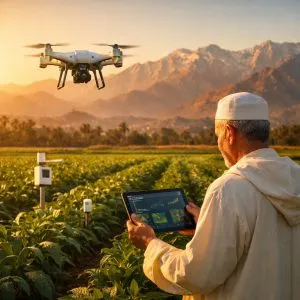
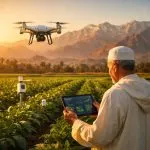
FarmAI, an Algerian agritech startup, built its initial product around drone-based crop disease detection using AI vision systems. The system’s core capability is wheat rust detection — a fungal disease that can devastate entire harvests if not caught in the early-infection window when targeted fungicide intervention is still effective. FarmAI’s Huawei Tech4Good competition win — second prize globally and the People’s Choice Award, with a USD 100,000 investment — validated the approach: AI-driven aerial monitoring at the field level, feeding into treatment recommendations that reduce chemical use and preserve yield. The irrigation optimization layer is the natural product extension: drone-based moisture mapping feeds AI scheduling models that determine precisely when and where water should be applied.
The Sakai Project: Autonomous Robots at Hectare Scale
The Sakai Project, developed by Algerian researchers Nasser Bouziani and Mourad Bouzit, represents a different architectural bet: autonomous ground robots rather than aerial drones. The Sakai system uses solar-powered autonomous robots to perform precision irrigation and deep root fertilization across approximately 120 hectares per unit — a scale that matches the typical Algerian commercial farm without requiring constant human oversight. The system has attracted interest from NASA and Chinese research institutions, suggesting it has crossed the validation threshold from local prototype to internationally recognized technology. The Union for the Mediterranean featured the project as a model for Mediterranean climate resilience precisely because it operates without reliable power grid access — a critical requirement for semi-remote Algerian agricultural zones.
Gardens of Babylon: Vertical Farming and Closed-Loop Water Management
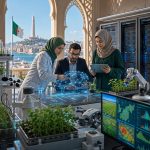
Gardens of Babylon operates at the opposite end of the spectrum from field-scale robots: highly controlled vertical farming environments where AI manages every input variable — irrigation volume, climate control, nutrient delivery, light cycling — to maximize yield-per-liter-of-water. The system uses AI-analyzed sensor data to generate planting and irrigation recommendations at each growth stage, producing more precise decision-making and dramatically reduced water consumption compared to conventional open-field agriculture. While vertical farming is not a solution for Algeria’s broad-acre grain production, it is directly applicable to high-value horticultural crops — cherry tomatoes, leafy greens, herbs — that Algeria currently imports at significant foreign currency cost.
Advertisement
What Algerian Farmers, Founders, and Agritech Teams Should Do
1. Adopt IoT Soil Moisture Sensors as the First Digital Step — Cost Has Collapsed
The prerequisite for any AI irrigation system is real-time field data. Soil moisture sensors, once prohibitively expensive for smallholder farmers, have dropped dramatically in cost: commercial-grade IoT sensors now cost USD 50–150 per unit and can be deployed on a 5–10 hectare plot for under USD 1,000. Smart irrigation studies from IoT-enabled deployments confirm that even simple rule-based systems built on soil moisture data reduce water application by 15–30% compared to calendar-based irrigation scheduling. Algerian farmers should treat sensor deployment as the essential first step — not as an expense but as the data infrastructure that makes every subsequent AI tool functional. The Ministry of Agriculture’s smart farming pilot programs provide subsidy pathways worth investigating before self-funding sensor networks.
2. Target the Drip Irrigation + AI Combination — Algeria’s Most Underdeployed Stack
Drip irrigation is already recognized by the Algerian government as a priority technology — subsidy programs exist through the Ministry of Agriculture. The next investment frontier is the AI scheduling layer that makes drip irrigation adaptive rather than fixed-schedule. A fixed-schedule drip system wastes water during rainy periods and underirrigates during heat spikes; an AI-scheduled drip system responds to real-time weather, soil data, and crop growth stage to deliver exactly the right volume at the right moment. Algerian agritech startups have a genuine product opportunity here: build the AI scheduling middleware that connects existing drip irrigation infrastructure to IoT sensor networks. The hardware is already in the field for many commercial farms; the intelligence layer is the next piece to add on top.
3. Pursue International Validation First — Then Domestic Scale
FarmAI’s Huawei Tech4Good win and the Sakai Project’s NASA engagement demonstrate a repeatable pattern: Algerian agritech founders get faster commercial traction by winning international validation competitions before attempting domestic institutional sales. The Algerian procurement ecosystem for agritech is still nascent, and Ministry-level contracts are long-cycle. International competitions — Huawei Tech4Good, Seedstars Africa, MIT Climate CoLab — provide both funding (USD 50,000–250,000 in typical prize tiers) and the credibility signal that Algerian institutional buyers respond to. Founders should allocate resources to competition preparation as a primary go-to-market channel, not as a distraction from product development.
The Structural Lesson
Algeria’s agritech AI trajectory is not primarily constrained by technology — the tools exist, Algerian researchers have built internationally validated versions, and the cost of deployment has fallen to within reach of commercial farming budgets. The constraint is adoption infrastructure: technical extension services that can train farmers to use these tools, connectivity that makes IoT sensors viable across semi-remote farmland, and financial products (agri-loans, insurance) that give farmers the capital to invest before the harvest that pays them back.
The Ministry of Knowledge Economy and Startups’ support for agritech startups — alongside the National Chamber of Agriculture’s endorsement of precision farming initiatives — creates a policy window that did not exist five years ago. But policy windows close. The 2026–2028 period, when Ministry-level smart farming contracts will be awarded for the first large-scale national deployments, is the window in which early movers can establish the reference implementations that shape every subsequent procurement decision.
For Algerian farmers, the calculation is straightforward: a 25% yield improvement and 30% water savings on a 100-hectare farm represent hundreds of thousands of dinars in annual cash flow improvement. At that return-on-investment profile, AI-powered precision irrigation is not a technology gamble — it is the most economically rational investment available in Algeria’s agricultural sector today.
Frequently Asked Questions
How much water can AI-powered irrigation actually save in Algerian field conditions?
Global precision irrigation studies consistently show 15–30% water savings compared to calendar-based or flood irrigation methods. AI-driven systems that respond to real-time soil moisture, crop growth stage, and weather data achieve the higher end of that range. In Algeria’s semi-arid conditions — where water application is often excessive in cooler periods and insufficient during heat waves — the savings from AI scheduling are likely to be at the upper bound of published estimates.
What did FarmAI win at the Huawei Tech4Good competition?
FarmAI, an Algerian agritech startup specializing in drone-based crop disease detection using AI vision systems, won second prize globally and the People’s Choice Award at Huawei’s Tech4Good international competition. The prize included a USD 100,000 investment. The system’s core application is wheat rust detection — identifying early fungal infection before it can spread across a field, enabling targeted treatment that preserves yield.
What support does the Algerian government provide for precision farming adoption?
The Ministry of Agriculture operates subsidy programs for drip irrigation hardware deployment. The Ministry of Knowledge Economy and Startups has backed agritech initiatives through its startup support frameworks, and the National Chamber of Agriculture has endorsed precision farming programs. For specific subsidy applications and eligibility criteria, farmers should contact their regional agricultural development office (DRDPA) or the national agricultural extension service.
—
Sources & Further Reading
- Agricultural Water Management under Water Scarcity in Algeria — ScienceDirect
- Algeria Promising Prospects for Precision Farming Using AI — AL24 News
- Farming in an Age of Drought: Algerian Innovation — Union for the Mediterranean
- Intelligent Irrigation: How Agro-AI Helps Farmers Manage Water Resources — AgTech Navigator
- IoT-Driven Smart Irrigation System to Improve Water Use Efficiency — Nature Scientific Reports
- Algeria Agriculture AI Trends 2025 — Farmonaut
🔗 Related Intelligence
Algeria’s AI Agri-Tech Bet: Beating Drought Before It Beats the Harvest
AI-Powered Water Management in Algeria: Desalination, Dam Monitoring

Algeria AI in Agriculture: Precision Farming Startups Target a 12% GDP Sector
Algerian Water Sector Deploys AI for Leakage Detection and Desalination