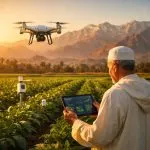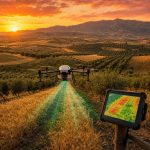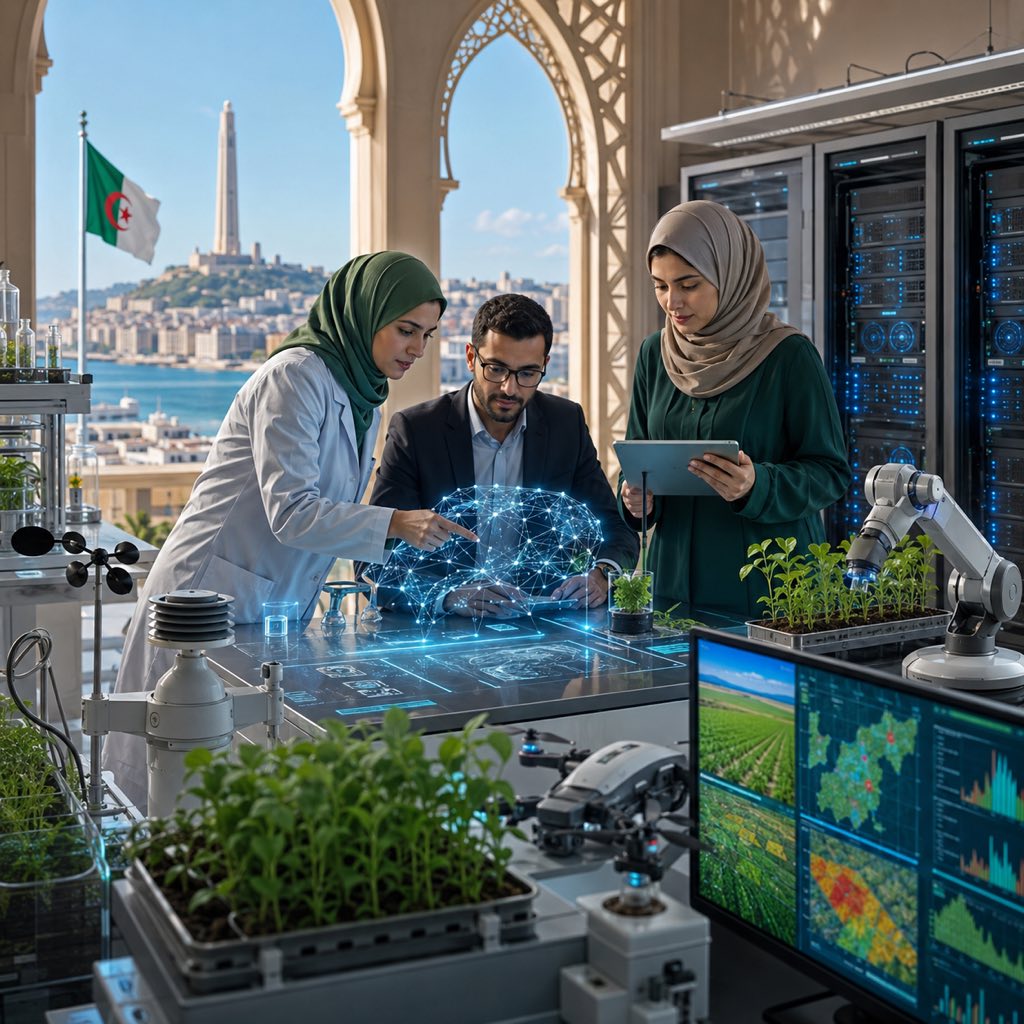
Water Scarcity Is Not a Future Risk — It Is the Current Constraint
Algeria sits at the intersection of two intensifying forces: a fast-growing population that demands more agricultural output, and a water table that is retreating faster than official projections anticipated. Agriculture is already the largest single consumer of water in a country where groundwater reserves have been under continuous stress. The Mediterranean basin, which encompasses Algeria’s most productive farming zones, has warmed approximately 1.5°C above pre-industrial levels. Research compiled by the Union for the Mediterranean Secretariat documents that summer rainfall in some Algerian regions is projected to decline by as much as 30% in the near term, and that approximately 180 million people across the Mediterranean region already experience water scarcity conditions.
For an Algerian farmer, this is not a climate abstraction. It is a production constraint that arrives every season, expressed as higher irrigation costs, shorter growing windows, and increased crop failure risk. The government’s strategic response has been to position precision agriculture — AI-driven irrigation and yield management — as the core technological intervention. Algeria’s ecofinagency-covered AI strategy for agriculture frames precision farming as a food security imperative, not merely an efficiency gain.
The sector research supports the ambition. AI-based precision irrigation is documented to conserve approximately 30% of water consumption relative to conventional methods, while improving crop yields by 21–28%. With $80–110 million allocated for agricultural technology investment and an estimated 30–40 AI startups and projects currently active in the sector, Algeria has the building blocks. The question is whether those building blocks are being assembled into a coherent system or remaining fragmented pilots.
Three Algerian Ventures That Prove the Model
The practical evidence that AI precision farming works in Algeria comes from a small cluster of ventures operating at field scale rather than in laboratory conditions.
Gardens of Babylon. Mokhtar Bouazza, a 31-year-old entrepreneur from Mascara, built a vertical farming system that uses AI software and sensors to manage closed farming environments with automated irrigation and climate control. The system analyses seed type, soil conditions, climate variations, water quality, and plant growth stages simultaneously, delivering water and nutrients precisely when needed. The UFM Secretariat’s profile of the initiative emphasises that Bouazza’s insight was not inventing vertical farming itself — the technology exists globally — but making it accessible to ordinary Algerian farmers who cannot afford enterprise-grade systems. The project has trained over 100 farmers and entrepreneurs, with a deliberate focus on youth and women, and won the 2025 ARLEM Award for Young Local Entrepreneurship in the Mediterranean, with institutional backing from Algeria’s Ministry of Knowledge Economy, Ministry of Agriculture, and Germany’s GIZ.
The Sakai Robotic Irrigation Project. Researchers Nasser Bouziani and Mourad Bouzit developed autonomous solar-powered robots capable of irrigation and deep-root fertilisation across large-scale field agriculture. A single Sakai unit can service approximately 120 hectares. The al24news reporting on Algeria’s precision farming prospects notes that the deep fertilisation approach alone could reduce tree early mortality rates from 45% to 15% — a transformation in orchard economics. The project has attracted interest from NASA and Chinese research institutions, which positions it as internationally validated technology developed in Algeria rather than imported from it.
Farm AI. This Algerian startup developed drone-based plant disease detection that achieved second place in China’s international Tech 4 Good competition in 2023. The drone surveillance approach addresses one of the highest-cost failure modes in Algerian agriculture: late-stage crop disease that is undetected until after the economic damage is done. Drone-based early detection typically identifies disease three to four weeks earlier than ground-level observation, which at Algerian production costs represents a meaningful reduction in yield loss per hectare.
Advertisement
What Holds Adoption Back — and Why It Matters for the $800M Opportunity
The $800 million–$1.2 billion agricultural value unlock cited in the sector hook requires mass adoption, not showcase pilots. Three barriers consistently appear in the Farmonaut analysis of Algeria’s AI agriculture trends as the factors preventing Gardens of Babylon-style models from scaling across Algeria’s hundreds of thousands of smallholder farms.
Rural connectivity gaps. Precision irrigation systems require real-time data transmission — soil temperature readings, satellite imagery, weather feeds — and most of Algeria’s agricultural zones still lack the 4G or fixed-broadband coverage needed to support uninterrupted data flows. The AI works; the telecommunications infrastructure beneath it does not yet exist at agricultural scale.
Digital literacy deficits. Farmers who spent decades managing irrigation by eye and experience cannot be converted to AI-platform users by distributing an app. The training requirement is substantial. Gardens of Babylon’s 100-person training programme is commendable in the context of a single startup but represents approximately 0.02% of Algeria’s active farming population. Scaling digital literacy is a multi-year, multi-institution undertaking that no single agri-tech venture can finance alone.
Initial capital barriers. A precision irrigation sensor array for a typical Algerian smallholder farm costs significantly more than the farmer’s seasonal credit capacity. Without accessible financing instruments — subsidised loan programmes, government co-investment, or pay-as-you-save revenue models tied to water savings — adoption will remain concentrated among larger commercial farms that need the efficiency gains least urgently.
What Algerian Agri-Tech Founders and Policymakers Should Do
Solving the adoption problem is not primarily a technology challenge — it is a distribution and financing challenge. The right interventions operate on three fronts.
1. Founders Should Build Revenue Models Around Water Savings, Not Upfront Hardware Sales
The most durable route to smallholder adoption is a pay-as-you-save model where the farmer’s payment is structured as a percentage of the documented water saving delivered by the AI system. This eliminates the upfront capital barrier and aligns the vendor’s incentive with the farmer’s outcome. The UFM’s case study on Mediterranean agri-tech scaling identifies this revenue model as the common thread among agri-tech ventures that reached 1,000+ farm users in comparable water-stressed markets. Founders who insist on hardware-sales-first models will stall at the showcase-pilot phase indefinitely. The technology is proven; the business model is what needs engineering.
2. Policymakers Should Create a National Precision Agriculture Financing Instrument Through ANGEM or ANADE
Algeria already has government-backed financing vehicles for micro-enterprises in the ANADE and ANGEM programmes. A dedicated precision agriculture track within these instruments — offering subsidised loans specifically for AI irrigation equipment, with repayment schedules tied to harvest cycles rather than calendar months — would convert the existing startup cluster from isolated pilots into a financeable market. The Ministry of Agriculture should co-design this instrument with agri-tech founders who have already deployed at field scale, because the repayment structure needs to reflect actual agricultural cash flow, not generic business lending calendars.
3. Universities Should Embed Agricultural AI Modules in Agronomy and Engineering Curricula
Algeria has 57,702 students enrolled in AI master’s programmes, and a separate agronomy university system producing agronomists with deep soil science training. Connecting those two tracks — so engineers understand both precision sensing and soil science — is where the most valuable talent will emerge. The University of Mascara’s support for the Gardens of Babylon project is a working model: a business incubator that bridges agronomic and technology expertise within a single support structure. Replicating this interdisciplinary model at the five largest agricultural universities would begin to produce graduates capable of designing, deploying, and maintaining AI farming systems rather than simply using imported toolkits.
The Structural Lesson
Algeria’s agri-tech AI story is, at its core, a story about where a $30–$60 hardware and connectivity investment unlocks $300–$500 of annual water savings and yield improvement per hectare. That economics is compelling. It is not, however, self-executing. The Gardens of Babylon model works in Mascara because Mokhtar Bouazza spent four years on farmer education, institutional relationship-building with two ministries and GIZ, and iterative product simplification. That same four-year runway is not available for the 500 farms that need the solution by 2027.
The government’s $80–110 million digital agriculture investment creates a window. If that capital flows toward farmer financing instruments and rural connectivity infrastructure — the two structural barriers — rather than toward additional pilot programmes in cities with adequate 4G coverage, the $800 million value unlock becomes a planning target rather than an aspiration. If the capital flows toward more showcase projects without the distribution infrastructure beneath them, Algeria will have the world’s most documented agricultural AI pilots and one of its least-adopted.
The right decision is not to choose between technology investment and distribution investment. It is to treat distribution as the technology problem — the harder, more important one.
Frequently Asked Questions
How much water can AI precision irrigation actually save in Algeria’s conditions?
Global research consistently documents water savings of approximately 30% from AI-based precision irrigation relative to conventional methods, with yield improvements of 21–28%. In Algeria’s semi-arid agricultural zones, where groundwater tables are already under stress, the 30% water saving figure is particularly significant — it directly extends the productive lifespan of depleted aquifers and reduces seasonal irrigation costs. The Sakai robotic project’s deep fertilisation approach adds a complementary benefit: reducing tree early mortality from 45% to 15%, which improves long-term orchard productivity without additional water inputs.
What is Gardens of Babylon and how does it work?
Gardens of Babylon is an Algerian vertical farming venture founded by Mokhtar Bouazza in Mascara. The system uses AI software combined with sensors to manage closed farming environments, automatically controlling irrigation and climate. The AI analyses soil conditions, seed type, water quality, and growth stages simultaneously, delivering inputs precisely when needed. The project has trained over 100 farmers and entrepreneurs and won the 2025 ARLEM Award for Young Local Entrepreneurship in the Mediterranean. It is backed by Algeria’s Ministry of Knowledge Economy, Ministry of Agriculture, the University of Mascara, and Germany’s GIZ.
Why are Algerian smallholders slow to adopt AI farming tools despite proven benefits?
Three structural barriers combine to slow adoption: rural connectivity gaps that prevent real-time data transmission, digital literacy deficits among farmers trained on conventional methods, and upfront capital costs that exceed typical smallholder credit capacity. The technology is proven and accessible in price-point terms for commercial farms, but smallholders — who make up the majority of Algeria’s agricultural base — cannot absorb the initial investment without financing instruments that match their seasonal cash-flow patterns. This is a distribution and financing problem, not a technology problem.
—
Sources & Further Reading
- Farming in an Age of Drought: Algerian Innovation — UFM Secretariat
- Algeria’s Promising Prospects for Precision Farming Using AI — Al24news
- Algeria Agriculture AI Trends 2025 — Farmonaut
- Why Algeria Is Positioned to Become North Africa’s AI Leader — New Lines Institute
- Algeria Unveils AI Strategy to Boost Digital Transformation — EcofinAgency
🔗 Related Intelligence

AI-Powered Precision Irrigation: How Algerian Farms Are Cutting Water Use
Smart Agriculture in Algeria: Can AI Feed 47 Million People More Efficiently?

AI in Algerian Fields: Smart Farming and Oil & Gas Operations Lead First Wave
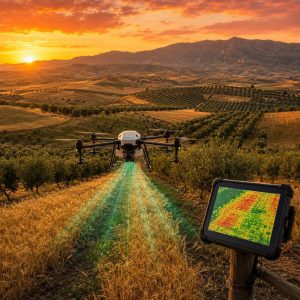
Smart Farming in Algeria: How AI Startups Are Modernising a 12% GDP Sector