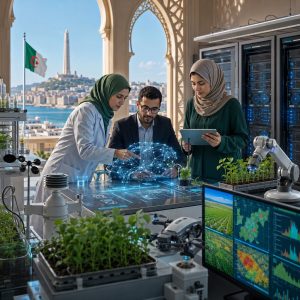
Why Algerian Agriculture Is a Structural AI Opportunity
Algeria’s agricultural sector is simultaneously one of the country’s most important economic assets and one of its most under-optimized systems. The sector contributes roughly 12% of GDP, employs approximately 20% of the workforce, and faces persistent structural pressures: water scarcity across semi-arid regions, recurring drought cycles, fragmented smallholder land tenure, and rural connectivity gaps that limit technology adoption.
These are not new problems. What is new is that AI-based agricultural intelligence — including precision irrigation, satellite-enabled soil monitoring, and drone-based disease detection — has matured to the point where deployment does not require advanced research infrastructure. The core components (sensors, drones, satellite APIs, edge inference models) are now commercially available at price points that Algerian agritech ventures can realistically work with.
According to data compiled by Farmonaut’s Africa agriculture AI trends analysis, Algeria’s projected digital investment in agricultural AI runs between $80 and $110 million, with 30–40 active AI projects or startups operating in the space as of 2025. The same source estimates that AI implementation could increase Algerian agricultural yields by 21–28% — a figure that, applied to a sector this size, represents billions of dirhams in potential economic output.
The Ventures Defining the Space
Three Algerian initiatives illustrate different entry points into agricultural AI deployment.
The Sakai Project, developed by Algerian roboticists Nasser Bouziani and Mourad Bouzit, uses solar-powered autonomous robots for irrigation and deep-root fertilization. Al24news reports that a single Sakai unit can service approximately 120 hectares — and the system’s irrigation precision has been linked to reducing tree early mortality from 45% to 15% in pilot conditions. The project has attracted international interest from NASA and Chinese research institutions, suggesting technical validation beyond the domestic context.
Souakri Group Modern Farms represents a more commercialized entry point. The farm operates a fully automated cherry tomato production system for export, in partnership with a Turkish collaborator. The AI-controlled production environment manages all stages — from climate regulation to disease detection to packaging sequencing. As an export-oriented operation, Souakri demonstrates that Algerian agricultural AI can meet international quality and consistency standards, which is the threshold that justifies infrastructure investment.
A third, unnamed startup won second place in China’s Tech 4 Good competition in 2023 with a drone-based plant disease detection system. The win demonstrates that Algerian agritech developers are competitive at international benchmarks — not merely building locally-oriented products.
Agricultural economist Brahim Lekfal has cited successful horticulture experiments achieving four-to-five times the yield of conventional cultivation through AI-enabled disease prevention and remote irrigation management. That multiplier, even discounted for ideal conditions, indicates a commercially viable efficiency case.
Advertisement
What Agritech Founders and Investors Should Do About It
1. Enter through water optimization — it solves the most politically visible problem
Algeria’s water stress is acute and politically salient. Semi-arid and arid zones cover significant portions of the agricultural interior, and water-intensive cereal crops (wheat, barley) face recurring yield shortfalls. AI-based precision irrigation, which can reduce water consumption by approximately 30% globally according to current benchmarks, addresses a state priority — not just a market opportunity. Ventures that can demonstrate measurable water savings in Algerian field conditions will find alignment with national planning objectives, public procurement appetite, and international development finance that is unlikely to attach to, say, a drone aesthetic startup.
The Sakai project’s irrigation precision model is the benchmark. Founders entering this vertical should target deployable precision irrigation for plots under 50 hectares (the most common smallholder scale) and design for low-bandwidth operation, since rural connectivity remains a constraint.
2. Build for the export corridor, not just domestic production
Souakri Group’s focus on export-quality automated tomato production reveals a neglected strategic insight: international market access requirements actually accelerate AI adoption. Export buyers demand traceability, consistency, and food safety documentation that manual farming cannot efficiently produce. AI automation — with sensor logs, AI-verified quality checks, and blockchain-linked supply chain data — satisfies these requirements as a byproduct of its core function.
Algerian agritech startups targeting the EU or Gulf export corridors have a stronger commercial case than those targeting only the domestic market, because international buyers fund the premium that makes AI infrastructure economically self-sustaining. Founders should identify a specific crop with active Algerian export demand (cherry tomatoes, dates, olives), find the quality certification requirement that is currently limiting export volumes, and design their AI product to solve that specific bottleneck.
3. Partner with the national agricultural research institutions before pitching private capital
Algeria’s Institut National de la Recherche Agronomique d’Algérie (INRAA) and related research bodies hold decades of soil composition, rainfall, and crop yield data that no private startup can replicate quickly. Partnerships with these institutions — even informal data-sharing agreements — provide the training data foundation that makes domain-specific agricultural AI models meaningfully better than imported general-purpose tools. Investors evaluating Algerian agritech ventures should treat the existence of institutional research partnerships as a signal of both data access and regulatory goodwill. Founders should therefore initiate INRAA relationships before seeking private capital, because those relationships meaningfully change the risk profile of the investment.
4. Design for the 60%-farmer-adoption threshold identified in current projections
Current estimates project that over 60% of Algerian farmers will adopt digital platforms in the medium term. The gap between 38–45% current AI penetration and that 60% target represents the scale-up window. Products that require smartphone sophistication, consistent internet connectivity, or agronomist-level expertise to operate will not reach the smallholder farmer who represents the majority of that gap. The design constraint is not technical capability — it is interface simplicity and offline-first operation. Drone-based systems that provide SMS or basic-screen crop health alerts, or irrigation sensors that operate on GSM with no smartphone required, unlock the farmer cohort that current products are leaving behind.
Where This Fits in Algeria’s 2026 Agricultural Strategy
The broader context is Algeria’s national food security agenda. Algeria imports substantial quantities of durum wheat and refined cereals — reducing that import dependency is a stated government objective. AI-enabled precision agriculture is one of the mechanisms through which the productivity gap in domestic cereal production could be narrowed, assuming technology adoption accelerates at the pace projected by current investment signals.
The $80–110 million digital investment projection for agricultural AI is meaningful but not transformative at national scale. Algeria’s agricultural sector would require sustained investment across multiple cycles — including rural connectivity infrastructure, training programs for farmers, and calibrated government procurement — to move from demonstration projects to sector-wide deployment.
What 2026 provides is the existence of a viable commercial pathway: the Sakai project has international validation, Souakri demonstrates export readiness, and the drone startup win in an international competition proves Algerian technical competitiveness. The ingredients for a productive agritech cluster exist. The question is whether the capital environment, both public and private, allocates at the speed the deployment window requires.
Frequently Asked Questions
What is the current state of AI adoption in Algerian agriculture?
AI penetration in Algerian commercial farming is estimated at 38–45% as of 2025, with 30–40 active AI projects or startups operating in the agricultural sector. Active ventures range from the Sakai solar-powered irrigation robot — which can service 120 hectares and has attracted NASA attention — to drone-based disease detection systems that competed successfully in international tech competitions. The sector received an estimated $80–110 million in digital investment, though infrastructure gaps in rural connectivity and training remain the primary adoption barriers.
How much can AI improve crop yields in Algeria specifically?
Domain-specific projections for Algeria estimate a 21–28% yield increase from AI implementation across precision irrigation, soil monitoring, and disease detection applications. Agricultural economist Brahim Lekfal has cited pilot experiments demonstrating four-to-five times yield multiples in specific horticultural conditions. The Sakai irrigation project reduced tree early mortality from 45% to 15% in pilot conditions. These figures represent demonstration-scale results and require broader deployment to validate at national production scale.
Why is export market alignment a key strategy for Algerian agritech startups?
International export buyers — particularly EU and Gulf purchasers — require traceability, quality consistency, and food safety documentation that manual farming processes struggle to provide efficiently. AI automation systems generate these records as a byproduct of their core operational function. This means export-oriented Algerian farms have a stronger financial case for AI adoption than domestic-market operations, since export premiums can fund the infrastructure cost. Souakri Group’s automated cherry tomato operation is the current reference model for this approach.
—
Sources & Further Reading
🔗 Related Intelligence
Smart Farming in Algeria: How AI Startups Are Modernising a 12% GDP Sector
Algeria’s AgriTech Awakening: Smart Farming and AI Startups Driving Precision Agriculture
Precision Agriculture Meets AI: How Smart Farming Boosts Crop Yields in North Africa

Smart Farming in Algeria: AI Agritech Startups Target Wheat & Crop Security