The Gap Between Agricultural Weight and Digital Depth
Algeria feeds roughly 47 million people from a semi-arid landscape where water scarcity is endemic, wheat rust recurs every season, and the gap between what the land produces and what it could produce under optimal conditions is enormous. Agriculture’s contribution to GDP sits between 12% and 13% — similar in scale to sectors that attract ten times the venture investment. The reason is not lack of need; it is lack of proven market mechanisms to capture the value that AI-driven productivity gains would unlock.
That is beginning to change. According to the New Lines Institute’s analysis of Algeria’s AI positioning, precision farming technologies applied at scale could yield 20-25% productivity increases in Algeria’s agricultural sector, representing $800 million to $1.2 billion in additional agricultural value by 2030. This is not a speculative projection — it is based on yield-gain evidence from comparable semi-arid geographies where precision irrigation, soil sensing, and drone monitoring have already been deployed.
The structural challenge is that most Algerian farms are small-scale, connectivity is uneven in rural regions, and initial hardware costs create adoption barriers that only coordinated public-private investment can address. What the current startup cohort is demonstrating is that the software layer — the AI models for disease detection, irrigation scheduling, and yield prediction — can be built cheaply and with high accuracy using locally collected training data.
FarmAI and the Wheat Rust Problem
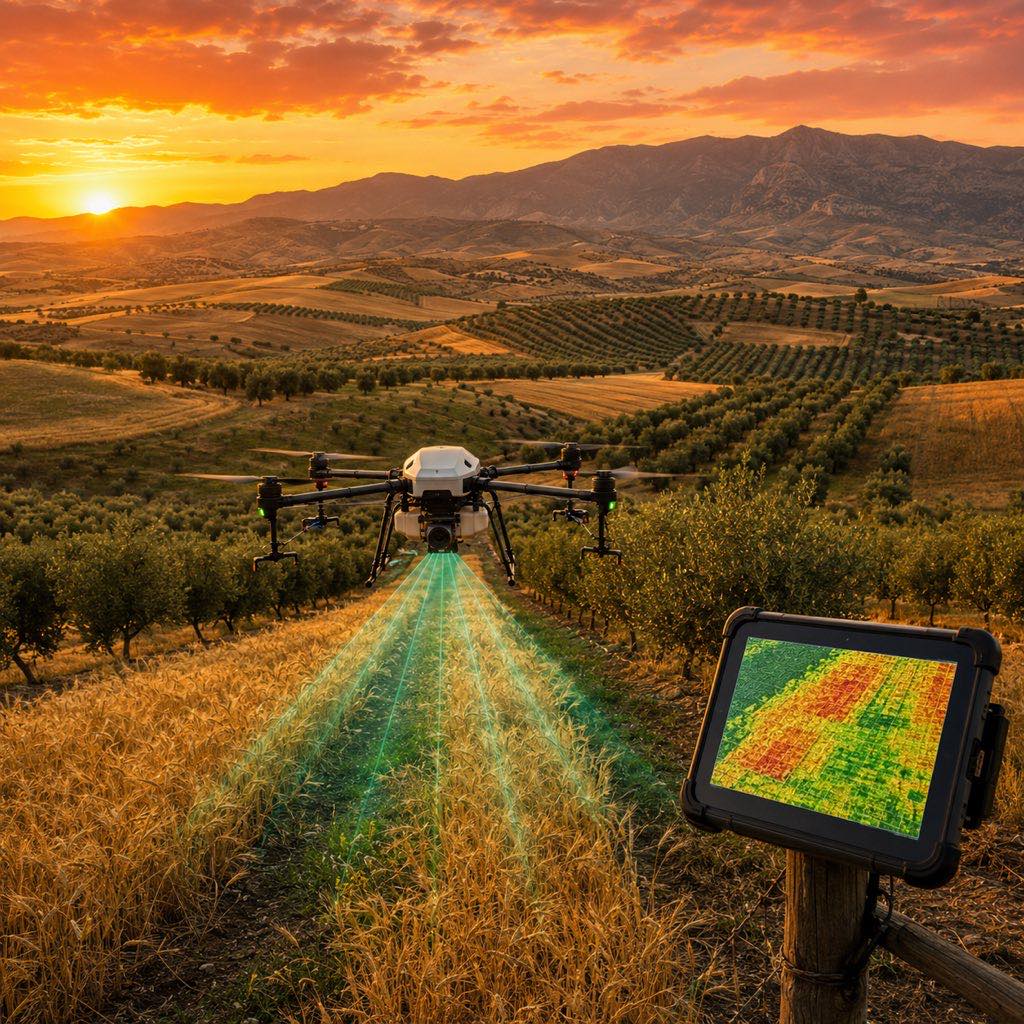
The most concrete proof of concept is FarmAI, an Algerian agritech startup that won second prize globally and the People’s Choice Award at Huawei’s “Tech4Good” competition final in January 2023, taking home roughly $15,000 and qualifying for a $100,000 Huawei sponsorship round to automate wheat rust detection using drones and computer vision. Wheat rust is a fungal disease that can destroy up to 70% of an infected crop in a single season. In Algeria, where wheat is a food security staple and import substitution is a national policy objective, early detection is not an agricultural amenity — it is a sovereignty issue.
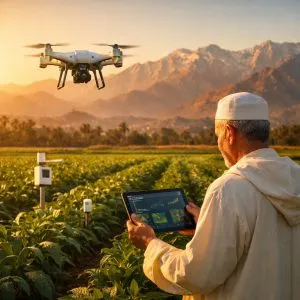
FarmAI’s approach — deploying drones over fields, capturing multispectral imagery, and running the images through a trained classification model that identifies rust infection at the leaf level — is technically replicable across a range of crop diseases. The Huawei award both validates the approach and provides the capital needed to expand from proof-of-concept field trials to commercial deployments. It also establishes a template: competitive, award-backed Algerian agritech is legible to international investors in a way that domestic-market-only narratives are not.
The farmonaut.com analysis of AI in Algerian agriculture estimates 30-40 active AI agritech startups or projects operating in Algeria, with AI adoption projected to reach 38-45% of farms by 2025. Whether or not the adoption projection has materialized, the 30-40 active projects number suggests a growing innovation density — more than enough to form a sector cluster. Agritech-AI startups can qualify for the Sidi Abdellah cluster — Algeria’s first cluster dedicated to AI and cybersecurity — via its broad AI mandate.
Advertisement
What Algerian Agritech Founders and Investors Should Do Now
1. Build for Algeria’s Specific Crop Diseases and Water Profile First
Global precision agriculture platforms (most built for North American or European large-scale monoculture) do not transfer cleanly to Algeria’s crop mix — durum wheat, barley, dates, olives, tomatoes — or to its water scarcity profile. Founders who build disease-detection models trained on Algerian field imagery and irrigation scheduling algorithms calibrated to Algeria’s rainfall and aquifer patterns create products with a structural moat that international incumbents cannot easily replicate. The training data is the barrier, and it can only be gathered locally, season by season, in Algerian fields. Building it now is a three-to-four-year head start.
2. Secure the Startup Label and Target the Algérie Télécom AI Fund Agritech Sub-category
Agricultural modeling is explicitly listed as an eligible sub-category within the Algérie Télécom AI fund’s AI domain. The fund, announced at the CTO Forum Algeria in early 2025, targets $11 million across 15-25 portfolio companies with seed tickets of $150,000–$300,000 and Series A tickets up to $1.5 million. The mandatory prerequisite is the Startup Label (only ~2,300 of 7,800 registered companies on startup.dz hold it). The AlgeriaTech ecosystem overview notes the Algeria Startup Fund (ASF) at 2.4 billion dinars has already funded 100+ startups across 20 sectors — agritech with a clear AI component has a compelling case. Move to label acquisition in Q3 2026.
3. Design a Technology Layer That Works on 2G Connectivity
Rural Algeria’s internet infrastructure varies dramatically between wilaya (province) and remote commune. Any smart farming solution that requires a smartphone with 4G connectivity to function will fail to reach the farmers who need it most — those in the arid south and Hauts Plateaux where most cereal farming occurs. The farmonaut analysis explicitly identifies “rural connectivity gaps” as a primary adoption barrier. Architectures that process AI inference at the edge (on-device or on the drone itself), sync to the cloud only when connectivity is available, and deliver actionable alerts via SMS rather than app notifications eliminate this barrier. The additional engineering investment to support offline-first operation typically pays back within the first growing season through higher adoption rates.
4. Partner with the Ministry of Agriculture on Pilot Contracts as Anchors
The Algerian government’s food security imperative — reducing agricultural import dependency — creates a natural alignment with agritech startups that can demonstrate measurable yield improvements. A pilot contract with a Ministry of Agriculture regional directorate, even unpaid, provides the institutional credibility and real-field data that both the Algérie Télécom AI fund and international accelerators require. The Sidi Abdellah cluster — Algeria’s first cluster dedicated to AI and cybersecurity — admits agritech-AI startups via its broad AI mandate; being physically present in the cluster positions startups for the first-mover advantage in government procurement conversations. The 2025 government target of 500 digitalization projects across all sectors creates contract opportunities that do not require entering a highly competitive commercial market to access.
The Bigger Picture: From Subsistence to Sovereignty Tech
The strategic logic behind Algerian AI agritech is not purely economic. Algeria currently imports significant quantities of wheat, vegetable oils, and sugar — commodities where domestic AI-driven productivity improvements would directly reduce import bills and improve trade balance. A precision-farming ecosystem that makes Algerian agriculture 20-25% more productive within a decade would have macroeconomic effects that extend well beyond the agritech sector’s own market size.
The New Lines Institute report situates Algeria’s AI strategy within a broader economic sovereignty narrative — reducing dependence on hydrocarbon revenues by building productive capacity in sectors like agriculture, healthcare, and energy. For agritech specifically, the oil and gas efficiency angle also applies: AI-optimized water management for irrigation reduces energy costs in regions where groundwater pumping is a major operational expense.
The 30-40 active agritech AI projects today are a base, not a ceiling. FarmAI’s global recognition demonstrates that Algerian startups can compete internationally on agricultural AI. The $800 million to $1.2 billion value creation opportunity by 2030 is large enough to sustain a healthy competitive ecosystem. The question for founders, investors, and the Ministry of Knowledge Economy is whether the enabling conditions — label pathways, pilot access, connectivity infrastructure — scale fast enough to capture it.
Frequently Asked Questions
What did FarmAI win at Huawei’s Tech4Good competition?
FarmAI, an Algerian agritech startup, won second prize globally and the People’s Choice Award at Huawei’s “Tech4Good” competition final in January 2023, taking home roughly $15,000 and qualifying for a $100,000 Huawei sponsorship round. The startup focuses on automating wheat rust detection using drones equipped with computer vision systems. Wheat rust is a fungal disease that can destroy up to 70% of infected crops, making early AI-powered detection critical for Algeria’s food security objectives. The award validates that globally competitive agricultural AI is being developed by Algerian startups.
What is the potential economic impact of AI precision farming in Algeria?
According to the New Lines Institute’s analysis of Algeria’s AI positioning, precision farming technologies applied at scale could yield 20-25% productivity increases in Algeria’s agricultural sector. This translates to $800 million to $1.2 billion in additional agricultural value by 2030. Oil and gas operational efficiency from AI-optimized water management for irrigation could deliver an additional $200-300 million annually. The combined economic case makes agriculture one of the highest-ROI sectors for AI deployment in Algeria.
What are the main barriers to AI smart farming adoption in Algeria?
Three structural barriers are most commonly cited: rural connectivity gaps (many farming regions lack reliable 4G coverage, requiring offline-first architectures), initial hardware costs for drones and sensors (which require public subsidy programs or pay-per-use models to overcome), and training deficits in digital technologies among the rural farming population. Successful Algerian agritech startups are addressing these by building SMS-based alert systems, designing edge-computing architectures that process AI inference locally on the drone, and partnering with the Ministry of Agriculture for training and deployment programs.
Sources & Further Reading
- Why Algeria Is Positioned to Become North Africa’s AI Leader — New Lines Institute
- Algeria Tech and AI Startup Ecosystem in 2026 — AlgeriaTech News
- Algeria Agriculture AI Trends 2026 — Farmonaut
- Algeria Launches First AI and Cybersecurity Startup Cluster — TechInAfrica
- Algérie Télécom $11M AI Fund: How to Qualify — AlgeriaTech News
- Algeria Unveils AI Strategy to Boost Digital Transformation — EcoFinAgency
🔗 Related Intelligence

Algeria AI in Agriculture: Precision Farming Startups Target a 12% GDP Sector
Algeria’s AgriTech Awakening: Smart Farming and AI Startups Driving Precision Agriculture

Smart Farming in Algeria: AI Agritech Startups Target Wheat & Crop Security
Smart Agriculture in Algeria: Can AI Feed 47 Million People More Efficiently?