Algeria’s Food Security Gap and the AI Window
Algeria imports between 6 and 7 million tonnes of wheat annually, making it one of the world’s largest wheat importers relative to its population. The country’s cereal production — covering wheat, barley, and durum varieties — is highly vulnerable to wheat rust, a fungal disease that can destroy 70% of a crop if not detected and treated within a narrow window. Traditional detection methods require agronomists walking fields manually, a labor-intensive process that misses early-stage infections in large farms and remote areas.
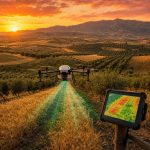
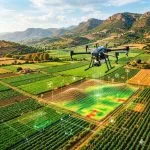
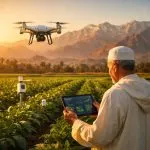
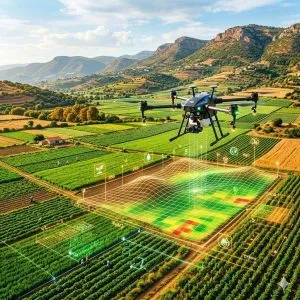
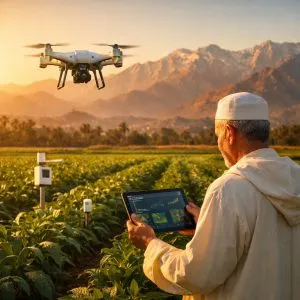
This is the problem FarmAI was built to solve. The Algerian startup, developed by a five-person team operating under the company SevenG, combines drone automation with AI-powered computer vision to detect wheat rust infections from aerial imagery. The system is designed for non-specialist use: farmers interact only with a smartphone app to receive reports; the drone calibration, launch, flight path, data collection, and image classification are fully automated. The underlying AI classifies crop images against disease signatures and flags infection zones with geographic precision, enabling targeted treatment rather than blanket pesticide application.
The FarmAI team — led by CEO Ouassim Hamdani alongside co-founders Ahlam Boumezrag, Mohamed Aimen Benkoua, Abderrahmane Herizi, and Mohamed Riadh Ziane — won Huawei’s Seeds for the Future global startup competition and earned the People’s Choice Award for their submission. The competition drew entries from teams across more than 170 countries; the People’s Choice Award reflects broad peer recognition of both the technical approach and the social relevance of tackling food security through accessible AI tools.
Algerian agritech startups collectively raised $180 million in 2024, with AI applications in agriculture representing a growing share. The government’s AgriTech DZ initiative — a program under the Ministry of Knowledge Economy — explicitly targets disease control, water management, and traceability as national agritech priorities. FarmAI sits at the center of that agenda.
The Technology Layer: What Drone-AI Systems Actually Do
Understanding what FarmAI’s system does — and what it does not do — is essential for both investors and policymakers evaluating agritech claims. The core technology is a pipeline: drone hardware executing a pre-planned flight path, onboard or ground-based imaging, AI classification of the resulting imagery, and report delivery to the farmer’s smartphone.
The AI component performs image classification against trained disease models. In the case of wheat rust, the visual signature — orange or brown pustules on leaf surfaces — is distinctive enough that computer vision models trained on sufficient labeled imagery can detect it with high accuracy. What makes FarmAI’s approach commercially relevant is the automation of the upstream steps: most drone-based crop monitoring systems require a skilled drone operator and a GIS specialist to process imagery. FarmAI removes both dependencies.
The water efficiency dimension is a secondary but significant benefit. Algeria’s agriculture sector is the country’s largest consumer of water, in a context of severe water stress and declining groundwater reserves. Precise disease detection enables targeted fungicide application, which reduces water use compared to preventive broadcast spraying. The Gardens of Babylon project in northwestern Algeria’s Mascara region — a separate agritech initiative led by Mokhtar Bouazza using automated irrigation in vertical farming environments — illustrates the same principle: precise data application reduces per-output resource consumption, a critical metric in Algeria’s water-constrained agricultural reality.
Advertisement
What Algerian Agritech Founders and Agricultural Stakeholders Should Do
The FarmAI case is instructive not just as a product success but as a model for how Algerian agritech startups can reach international credibility while remaining anchored to domestic food security needs. The path involves three overlapping moves.
1. Build around verifiable disease detection datasets specific to Algerian crop varieties
FarmAI’s success depended on training AI models on crop disease imagery relevant to Algerian field conditions — durum wheat varieties grown in the Tell Atlas region behave differently under rust attack than Canadian or French varieties. Generic agricultural AI models trained on North American or European datasets perform poorly on Algerian crops. Founders building in agritech AI should invest early in proprietary, Algeria-specific training datasets — even if that means manually labeling imagery from actual Algerian farms across multiple growing seasons. This dataset moat is more defensible than any algorithm, because it is both expensive to replicate and directly tied to local agronomic knowledge. The AgriTech DZ program and the national agricultural research centers (INRAA, ITGC) are natural data collection partners and should be approached as co-investors in dataset creation.
2. Design for non-specialist farmers first, specialist operators second
One of FarmAI’s key design decisions was eliminating the need for a skilled drone operator. This is not a marginal product choice — it is the primary driver of commercial viability in Algeria’s agricultural market. The country’s 1.1 million agricultural holdings are predominantly small farms (under 10 hectares) managed by owners with limited formal agricultural education. Any agritech solution that requires specialist operators to deploy is structurally excluded from this majority market. The correct design target is a system that a farmer with a smartphone and a mid-range data connection can use within 20 minutes of receiving the device — zero GIS training, zero drone piloting skill required. Founders who design for this constraint will find addressable markets 10–15 times larger than those who design for the 5% of farms with professional agronomy staff.
3. Target the wheat-barley-durum cluster as the highest-ROI entry point for AI pilots
Algeria’s agricultural strengths center on cereal production: wheat, barley, and durum varieties make up the majority of cultivated area in the northern plains. These crops share common disease profiles (rust, smut, blight) that AI computer vision can detect, and they are directly linked to the national food security budget — meaning that even modest yield improvement generates measurable government savings in import costs. A 5% reduction in post-disease wheat losses across the Tell Atlas growing region would reduce import expenditures by hundreds of millions of dinars annually. This quantifiable fiscal impact is the argument for public procurement of agritech AI tools — and founders who can demonstrate that link in a pilot study gain access to a procurement pipeline that purely commercial channels cannot reach. Pilot sites in the wilayates of Tiaret, Sétif, and El Bayadh represent the most productive entry points, given their combination of cereal density and historical rust exposure.
4. Use international competition wins as an export credentialing mechanism
FarmAI’s Huawei Seeds for the Future win functions as an international quality signal in markets where AlgerIan startups are unknown. The People’s Choice Award, in particular, reflects broad peer recognition across 170+ country teams — a credentialing asset that reduces the trust deficit Algerian agritech startups face when approaching buyers in francophone West Africa, the Gulf, or European development finance institutions. Founders should treat international competition wins not as vanity metrics but as specific instruments for opening specific doors: Huawei partner network access, AfDB/USAID agricultural innovation funding conversations, and EU-Africa agritech partnership programs. Each win should be followed immediately by targeted outreach to the stakeholders for whom that particular competition signal is most legible.
Where This Fits in Algeria’s 2026 Food Security Strategy
Algeria’s agricultural AI moment is not happening in isolation. Globally, the World Economic Forum identifies AI-driven agricultural intelligence as one of the five technologies most likely to reduce food insecurity by 2030, with precision disease detection cited as the highest near-term ROI application. Algerian startups like FarmAI and the Gardens of Babylon project are reaching this technology frontier not from the center of global agritech — which remains in the US, Netherlands, and Singapore — but from the edge, driven by specific local constraints.
That peripheral origin is, paradoxically, a structural advantage. Algerian agritech founders are not building solutions for the hypothetical ideal Algerian farmer. They are building for the actual one: semi-arid conditions, irregular connectivity, small holdings, minimal specialist staff, and a government that has a direct fiscal interest in reducing wheat imports. The specificity of those constraints produces more durable solutions than technology transferred wholesale from contexts with fundamentally different agricultural structures.
The open question for 2026 is whether Algeria’s supporting ecosystem — seed funding, data infrastructure, regulatory clarity for commercial drone operations in agricultural zones — can scale at the pace the technology warrants. FarmAI’s international competition win demonstrates that the talent exists. The next test is whether the institutional infrastructure can match it.
Frequently Asked Questions
What did FarmAI win at Huawei’s Seeds for the Future competition?
FarmAI, developed by the Algerian startup SevenG and its five co-founders, won the global Seeds for the Future startup competition organized by Huawei and received the People’s Choice Award — a peer-voted recognition from competition participants across more than 170 countries. The team won a $100,000 investment for their AI-powered, drone-based wheat rust detection solution. The win provided both funding and international visibility, with FarmAI’s system recognized specifically for combining genuine technical innovation with direct social relevance to food security.
Why is wheat rust detection particularly important for Algeria?
Wheat rust is a fungal disease that can destroy up to 70% of a cereal crop if not detected and treated within a narrow window after infection onset. Algeria’s cereal sector — covering wheat, barley, and durum varieties — is both a food security priority and a major water consumer. Traditional manual field inspections miss early-stage infections across large or remote farms. AI-powered drone detection identifies infections earlier, enables targeted (rather than broadcast) fungicide application, and reduces the water and chemical inputs required for disease management. Given that Algeria imports 6–7 million tonnes of wheat annually, even a modest improvement in domestic yield protection has direct fiscal value.
How does the Algerian government support agritech AI startups?
The Ministry of Knowledge Economy operates the AgriTech DZ program, which targets innovation in disease control, water management, product traceability, and soilless farming. Agritech startups can apply for the national startup label (granting access to ANADE financing and tax benefits), pursue partnerships with national agricultural research institutions (INRAA, ITGC), and submit pilot projects to the AgriTech DZ program for co-development support. Algerian agritech startups collectively raised $180 million in 2024, reflecting growing investor and institutional confidence in the sector.
Sources & Further Reading
- FarmAI’s Journey: Tackling Crop Disease with Innovation and Resilience — PIM Global
- SevenG Advocates for Smart, Dynamic, and Efficient Farming with FarmAI — We Are Tech Africa
- Algeria Startup Ecosystem in 2025: A Year of Resilience and Transformation — Stats and Market Insights
- AI Agricultural Intelligence: How It Can Revolutionize Farming — World Economic Forum
- Farming in an Age of Drought: An Algerian Innovation — Union for the Mediterranean
- AgriTech DZ — Startup Algeria
🔗 Related Intelligence
Smart Farming in Algeria: How AI Startups Are Modernising a 12% GDP Sector
Algeria’s AgriTech Awakening: Smart Farming and AI Startups Driving Precision Agriculture
Smart Agriculture in Algeria: Can AI Feed 47 Million People More Efficiently?

Algeria AI in Agriculture: Precision Farming Startups Target a 12% GDP Sector