What the National AI Strategy Actually Prioritises
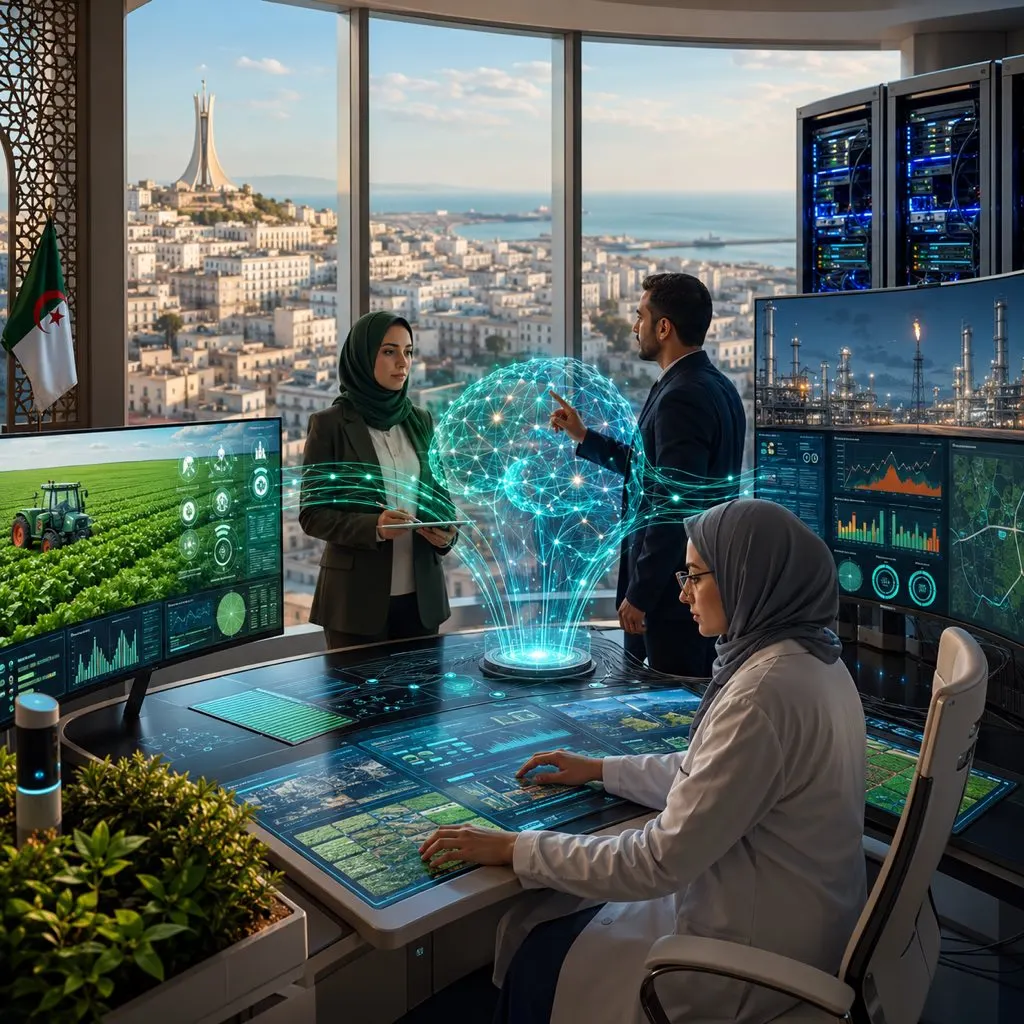
Algeria’s AI action plan, formalised through the AI Council established in June 2023 and anchored at the National Artificial Intelligence Strategy Conference in December 2024, does not distribute its ambitions evenly across sectors. It concentrates resources on two verticals where Algeria has both existing infrastructure and urgent efficiency needs: agriculture and hydrocarbons.
This prioritisation reflects economic logic. Agriculture contributes approximately 12.4% of Algeria’s GDP and employs nearly one-quarter of the working population, yet yields remain well below regional benchmarks due to water scarcity, soil degradation, and limited access to precision input management. The oil and gas sector, anchored by Sonatrach, is Algeria’s primary foreign currency earner — yet ageing field infrastructure and manual operational processes leave significant efficiency and cost reduction on the table.
The strategy’s six pillars — scientific research, talent development, hardware investment, investment promotion, data protection, and sector-specific applications — are sequenced so that sector-specific applications arrive last, after infrastructure and talent pipelines are in place. What is notable about the 2026 moment is that the first two pillars are now operational enough to enable real pilot deployments in the field.
Algérie Télécom invested approximately $11 million in February 2025 to fund AI, cybersecurity, and robotics startups — a direct injection into the ecosystem that services the agriculture and energy verticals. The Algeria Digital Strategy 2030 meanwhile targets over 500 digitisation projects by 2026, creating a procurement pipeline that AI-focused companies can bid into.
Agriculture: The Pilot Results
The agricultural pilots are the most concrete demonstration that Algeria’s AI ambitions are moving beyond conference declarations. According to research from the New Lines Institute, trained agricultural engineers implementing AI-powered precision horticulture delivered four- to five-fold increases in vegetable yields in early deployments. The national strategy projects that scaling precision agriculture could drive 20–25% yield increases sector-wide, creating between $800 million and $1.2 billion in economic value by 2030.
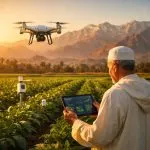
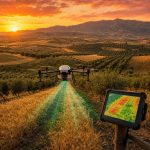
What does precision horticulture look like in the Algerian context? It involves sensor networks that monitor soil moisture, temperature, and nutrient levels in real time, with AI models that recommend targeted irrigation and fertilisation rather than blanket application. In water-scarce northern regions — where agricultural land is concentrated — this approach can cut water use by 30–40% while simultaneously raising output. The AI model is not replacing the farmer; it is giving the farmer information that was previously inaccessible without expensive laboratory testing.
FarmAI, an Algerian agritech startup, represents the local ecosystem’s entry into this space. It secured $100,000 in funding for a drone-based wheat rust detection system — a specific, high-value application because wheat rust can destroy 70% of a crop if not detected early. This model — targeted AI for a specific crop disease, using drone imagery — is replicable across Algeria’s northern agricultural belt at relatively low hardware cost. The fact that FarmAI won competitive funding through Algeria’s startup ecosystem signals that the market is beginning to price AI agricultural tools, not just discuss them.
Advertisement
Oil & Gas: The Efficiency Opportunity
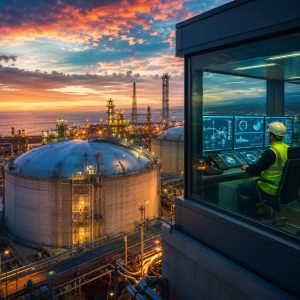
The hydrocarbons sector presents a different challenge and a larger financial opportunity. Sonatrach operates fields of varying ages across the Sahara, with some infrastructure dating to the 1970s. Ageing equipment generates high maintenance costs and unplanned downtime — both of which AI-based predictive maintenance can directly address.
The projected annual cost reductions from AI-optimised oil and gas operations are $200–300 million per year, according to projections cited by the New Lines Institute. These gains come from three sources: predictive maintenance that replaces reactive repairs with scheduled interventions, reservoir modelling that optimises extraction rates without over-pressurising formations, and logistics optimisation across long supply chains in the Saharan basin.
The Algerian context adds an urgency that pure efficiency calculations understate. Algeria’s foreign currency reserves declined from $193.6 billion to $63.6 billion over the past decade — a drop driven partly by oil price cycles and partly by rising import costs. Improving operational efficiency in the sector that generates most of Algeria’s export revenue has a multiplier effect on the national balance sheet that domestic AI deployments in other sectors do not.
Regional precedent confirms this is achievable. Abu Dhabi National Oil Company (ADNOC) has implemented AI-based reservoir modelling and predictive maintenance across its operations, reporting double-digit percentage reductions in unplanned downtime within three years. Algeria’s infrastructure is older and less digitised than ADNOC’s baseline, which means the initial efficiency gains are potentially larger — but also that the data collection and sensor installation phase requires its own investment before AI can be applied.
What Algerian Operators and Startups Should Do Now
1. Treat Data Collection as the AI Prerequisite, Not the Afterthought
Neither precision agriculture nor oilfield AI can function without clean, structured sensor data. For agricultural operators, this means deploying soil and weather monitoring networks before selecting an AI platform. For oilfield teams, it means auditing existing SCADA systems for data quality and completeness. The single most common reason that AI pilots fail to reach production in emerging markets is poor data infrastructure — not a shortage of models. Algeria’s AI Readiness Index score of 35.99 out of 100 partly reflects this gap. Allocate the first quarter of any AI initiative to data architecture, not model selection.
2. Partner with FarmAI, TuraLabs, and the Incubator at Sidi Abdallah
The Algerian ecosystem already has operational players. FarmAI has a proven drone-based detection model with competitive funding behind it. TuraLabs is an active AI development agency with sector-specific experience. The incubator at the Centre of Excellence in Digital Economy, Sidi Abdallah — launched April 2026 — is the government’s designated pathway for taking pilot projects to commercial scale. Agricultural cooperatives and oil service companies should engage these players rather than waiting for international vendors who will price solutions at international rates. The $11M Algérie Télécom fund has an explicit mandate for AI applications in strategic sectors — which both agriculture and hydrocarbons qualify as.
3. Use the $800M–$1.2B Agriculture Value Projection as an Investor Pitch, Not Just Policy Language
The government’s $800M–$1.2B agricultural AI value projection by 2030 is not a planning estimate — it is the basis of a business case. Any startup building agricultural AI tools for the Algerian market can anchor their investor pitch to this figure, provided they can demonstrate a plausible share of the value and a go-to-market path that does not depend on a single government contract. Build for the cooperative and large commercial farm market first — these are buyers who can make procurement decisions without a ministerial signature.
4. Map the Oilfield AI Opportunity to Specific Sonatrach Procurement Channels
Sonatrach runs a formal supplier qualification process for technology vendors. AI companies targeting oilfield applications should begin qualification processes now — the typical timeline runs 12–18 months from first contact to first purchase order. The key procurement entry points are predictive maintenance for surface equipment (compressors, pumps, separators) and reservoir data analytics — both of which have defined budget lines within Sonatrach’s operational expenditure. Companies that wait until a large-scale digitisation tender is announced will face intense competition from international vendors who began qualification years earlier.
Where This Fits in Algeria’s 2026 Ecosystem
The agriculture and oil & gas prioritisation is not arbitrary. These are the two sectors where AI can produce verifiable economic output in a timeframe that fits Algeria’s political and fiscal cycles. A startup that delivers measurable yield improvement or documented cost reduction in hydrocarbons has a reference case that opens every door in the Algerian market.
The broader AI market trajectory — $498.9 million in 2025 growing to $1.69 billion by 2030 — will be shaped disproportionately by what happens in these two sectors over the next 24 months. If the precision agriculture pilots scale and the oilfield optimisation programmes move from projection to contract, Algeria will have a sector-specific AI deployment record that is difficult for competitors in North Africa to replicate quickly. Egypt and Morocco are investing in AI infrastructure, but neither has Algeria’s combination of hydrocarbons revenue, agricultural scale, and government willingness to concentrate resources on specific sector applications.
The risk is the one that has shadowed every Algerian technology initiative: execution velocity. The pilots exist. The funding exists. The projected returns are compelling. What determines whether 2030 looks like $1.69 billion or $498.9 million is whether the data infrastructure, procurement channels, and inter-agency coordination mature fast enough to keep pace with the 27.67% market growth rate.
Frequently Asked Questions
What AI applications are already in pilot phase in Algeria’s agriculture sector?
AI-powered precision horticulture initiatives have delivered four- to five-fold increases in vegetable yields in early trials, according to the New Lines Institute. FarmAI, an Algerian agritech startup, has deployed a drone-based wheat rust detection system funded with $100,000 in competitive startup capital. The national strategy targets 20–25% sector-wide yield increases by 2030, equivalent to $800 million to $1.2 billion in agricultural value creation.
What are the projected cost savings from AI in Algeria’s oil and gas sector?
The New Lines Institute projects annual cost reductions of $200–300 million from AI-optimised operations in Algeria’s oil and gas sector. These savings come primarily from predictive maintenance (replacing reactive repairs with scheduled interventions), reservoir modelling, and logistics optimisation across Saharan supply chains. Sonatrach operates ageing infrastructure where unplanned downtime is a significant cost driver — the profile where AI-based maintenance produces the largest returns.
How can Algerian startups access funding to build AI solutions for these sectors?
The primary near-term funding source is Algérie Télécom’s 1.5 billion DZD fund (approximately $11 million), launched in February 2025, explicitly targeting AI, cybersecurity, and robotics startups with applications in strategic sectors including agriculture and energy. The National Venture Studio Programme — a $600 million public-private initiative — is a second pathway for startups that have a validated pilot. The incubator at the Centre of Excellence in Digital Economy, Sidi Abdallah, provides the pre-funding structure for converting pilots into fundable companies.
—
Sources & Further Reading
- Why Algeria Is Positioned to Become North Africa’s AI Leader — New Lines Institute
- Deep Dive: AI in Algeria — TechaHub
- The Role of Artificial Intelligence Within the Algerian Economy — Economic Research Forum
- Algeria Unveils AI Strategy to Boost Digital Transformation — Ecofin Agency
- Algeria Tech and AI Startup Ecosystem in 2026 — ALGERIATECH
- Algérie Télécom’s $11M AI Fund: How to Qualify — ALGERIATECH
🔗 Related Intelligence

AI Adoption Across Algeria’s Energy Sector: Oil, Gas, and Utilities Playbook 2026
Smart Agriculture in Algeria: Can AI Feed 47 Million People More Efficiently?
Smart Farming in Algeria: How AI Startups Are Modernising a 12% GDP Sector

AI in Algeria’s Oil and Gas Sector: How Sonatrach Is Betting on Machine Intelligence