A Quiet Imaging Revolution Inside the CHU Network
Walk into any of Algeria’s 15 University Hospital Centres — from CHU Mustapha Pacha in Algiers to CHU Issaad Hassani in Beni Messous, CHU Frantz Fanon in Blida, or CHU Oran — and you will find the same scene: queues of patients waiting for chest CTs, mammograms or brain MRIs, and a small number of radiologists trying to read hundreds of studies per day. According to Algeria’s Ministry of Health overview compiled on Wikipedia, the country operates 586 public health facilities, including 15 CHUs and 83 specialised hospitals (EHS) that together carry the bulk of advanced diagnostic imaging volume. That asymmetric load — high volume, scarce specialists — is exactly the workflow shape that AI radiology was designed to support.
What is genuinely new in 2026 is that the algorithms doing this support are increasingly designed and validated in Algeria itself. The CDTA (Centre de Développement des Technologies Avancées) in Algiers has a BIOSMC team that has worked on automatic lung segmentation and measurement on CT-scan images, originally for COVID-19 triage and now adaptable to broader pulmonary radiology. CERIST’s “Information Systems and Multimedia Systems” division, led by Dr. Abdelkrim Meziane, runs the DIAG project — an AI plus virtual reality tool that, according to public statements by the team, can flag affected lung areas in under 30 seconds, developed jointly with the Faculty of Medicine at Université d’Alger 1.
These are not imports. They are locally trained, locally maintainable models — and they sit one administrative decision away from being deployed at the bedside.
Why 2026 Is the Inflection Point
Three things have shifted in the last twelve months that make this the right moment to scale. First, the national policy frame is now explicit. At a government meeting on 25 May 2026 chaired by Prime Minister Sifi Ghrieb, the executive reviewed the six-pillar National AI Strategy — research, skills, infrastructure, ecosystem, regulation, and sectoral applications — and reaffirmed health as a priority sector alongside agriculture and energy. The strategy is now in active implementation under High Commissioner for Digitalisation Meriem Benmouloud, with an AI Council advising on cross-sectoral policy.
Second, the funding curve has turned. The Algerian AI market is projected to grow from $498.9 million in 2025 to $1.69 billion by 2030, a compound annual growth rate of 27.67% according to techahub’s deepdive on AI in Algeria. Healthcare is consistently named as a top capture vertical because the public-payer model removes the patient-billing complexity that has slowed AI radiology adoption in fragmented private markets.
Third, the global radiology playbook has matured. According to Satmed Health’s 2026 industry review, the FDA has now cleared more than 1,000 AI/ML medical devices, of which roughly 75% are in radiology, and the architectural patterns have converged on “zero-click” background processing via HL7 ORU messages, DICOMweb routing, and FHIR-based APIs. That convergence means Algerian teams no longer need to invent integration patterns; they can adopt them.
The combination — explicit policy mandate, expanding market, mature integration patterns — is what creates the 2027 window.
Advertisement
The Local Research Bench Is Already Producing
The pieces of a national AI radiology platform exist. They are just not yet connected. A short, non-exhaustive map of what is already running in Algerian labs:
- CDTA (Algiers) — BIOSMC team on CT segmentation; IRVA team (under researcher Kahina Amara) on brain tumor detection using 3D modelling with virtual and augmented reality overlays for surgical planning.
- CERIST (Algiers) — DIAG project for pulmonary disease detection, led by Saïd Yahiaoui in collaboration with Université d’Alger 1’s Faculty of Medicine. Reported sub-30-second inference on CT studies.
- Université Oran 1 — Ahmed Ben Bella — Hosts an “AI House” within its NTIC initiatives; ran the JESIA 2025 study day on AI in Healthcare on 3 June 2025 in partnership with its Pharmacovigilance Laboratory, drawing radiologists, pharmacists and computer scientists into one room.
- ENSIA + Tsinghua AIR (Beijing) — The China-Algeria Joint Laboratory for Artificial Intelligence, signed in 2023, gives Algerian PhD students access to one of Asia’s largest medical-imaging compute environments.
- ANSSP (National Agency for Health Safety) — Under President Pr. Kamel Sanhadji, working on a national health data centre and exchange platform — the missing data layer that AI radiology models need for training and audit.
Each of these is funded, staffed, and producing peer-reviewed work. None of them, today, has a contract to read live CT studies inside a CHU radiology PACS. Closing that gap is the work of the next 18 months.
What Clinical Teams and Health-Tech Startups Should Do
The opportunity is not to invent new algorithms — it is to industrialise the ones already validated. Here is how the different stakeholders can move from pilot to platform.
1. Stand up an “AI-ready” PACS profile inside each CHU before procuring any algorithm
Every CHU radiology service should publish, by Q4 2026, a short technical profile describing how AI vendors plug in: DICOMweb endpoint, HL7 ORU outbound, study volume per modality (CT chest, mammography, head CT, MRI brain), and the de-identification rules that apply before any pixel leaves the institution. This is administrative work, not engineering. It does not require new procurement. But without it, every algorithm integration is bespoke — and bespoke kills scale. The reference Satmed framework calls this “zero-click integration” and treats it as a precondition for everything else. CHU CIOs can write the first draft in a week if they coordinate through the Ministry of Health’s hospital reform unit.
2. Start with three high-volume use cases that already have strong local algorithms
Pick the three radiology workflows where Algerian teams have proven local algorithms and where reader fatigue is the binding constraint: chest CT triage (CDTA + CERIST work directly applies), mammography screening (national breast cancer programme already routes through CHUs), and head CT for stroke/haemorrhage triage in emergency rooms. Each of these has hundreds of studies per day per CHU, clear ground-truth labels, and an obvious clinical KPI (turnaround time, sensitivity for critical findings). Pilot two CHUs per use case for six months, publish blinded reader-comparison data, then expand to the rest of the network. This is the same staged path that produced the FDA’s 1,000+ cleared devices.
3. Wire health-tech startups into the CHU procurement track from day one
Algeria’s health-tech startup layer is thin compared to fintech or e-commerce, but it exists, and it cannot survive on grant funding alone. The Algerie Telecom AI investment fund of approximately $11 million announced in 2025 is one source, but the durable signal is paid pilots inside CHUs. Hospital CIOs should reserve a small annual procurement envelope — even $50K-$100K per CHU — for locally-developed AI radiology tools with a clear performance gate. This converts grants into revenue, gives founders the reference customers they need to raise a Series A, and keeps the IP and the talent in Algeria rather than exporting both to Paris or Dubai.
4. Use ANSSP’s emerging health data platform as the validation backbone
The national health data centre being built under ANSSP is the highest-leverage piece of infrastructure for AI radiology in the country. It is where federated training data, de-identified validation cohorts, and post-deployment drift monitoring will eventually live. Health-tech founders and CHU research directors should engage now — not after the platform launches — to shape the data schemas, the access tiers, and the audit logs. The single biggest reason AI radiology models fail in production globally is data drift between training and deployment populations. A purpose-built Algerian data layer with proper cohort representation is the prevention.
Where This Fits in Algeria’s 2027 Health-AI Roadmap
The path from today’s promising lab demos to a national AI radiology backbone by 2027 is shorter than it looks, but only if three things happen in sequence rather than in parallel. The first is the technical bridge — CHU radiology services adopting a common AI-integration profile so the same algorithm can be deployed in Algiers, Oran, Constantine and Blida without three separate engineering projects. The second is the clinical bridge — published reader-comparison studies from at least two CHUs per use case, giving Algerian radiologists the evidence base to trust and adopt these tools. The third is the commercial bridge — converting CDTA, CERIST and university-incubated algorithms into operating health-tech companies with paid CHU contracts, not perpetual grant cycles.
What makes Algeria’s setup unusually well-positioned is that the same Ministry of Higher Education that funds CDTA and CERIST also accredits the medical faculties that train the radiologists, and the same Ministry of Health that runs the CHUs sets the clinical guidelines. Other middle-income markets fight regulatory fragmentation across private payers, hospital chains and standalone imaging centres. Algeria has fewer institutional layers — which means fewer veto points and a faster path to a coordinated national platform. The work between now and end-2027 is not to invent the technology. It is to wire the institutions that already exist.
Frequently Asked Questions
How many university hospitals in Algeria could realistically host AI radiology deployments?
According to Algeria’s Ministry of Health public-sector overview, the country operates 15 University Hospital Centres (CHUs) and 83 specialised hospitals (EHS) within a broader network of 586 public health facilities. The CHUs in Algiers (Mustapha Pacha, Beni Messous, Bab El Oued), Oran, Constantine, Annaba, Blida, Tizi Ouzou, Sétif, Batna, Tlemcen and Sidi Bel Abbès are the natural first wave because they combine high study volumes, attached medical faculties for research, and the IT capacity to support PACS-integrated AI tools. The 83 EHS sites become second-wave deployment targets once the CHU integration profile and clinical evidence are in place.
What is the role of the National AI Strategy in scaling these pilots?
Algeria’s six-pillar National AI Strategy, reaffirmed at the 25 May 2026 government meeting chaired by Prime Minister Sifi Ghrieb, explicitly names health as a priority sector alongside agriculture and energy. The strategy is implemented under High Commissioner for Digitalisation Meriem Benmouloud, with an AI Council guiding cross-sectoral policy. For AI radiology specifically, the strategy unlocks coordinated funding, training pipelines through the 74 master’s programmes across 52 universities, and policy clarity on data governance — all preconditions for moving from a single CHU pilot to a national platform.
Which Algerian research teams are already producing usable AI radiology algorithms?
The most visible groups are CDTA (Centre de Développement des Technologies Avancées) in Algiers — whose BIOSMC team has worked on CT lung segmentation and whose IRVA team has built brain tumor detection with 3D imaging — and CERIST, where the Information Systems and Multimedia Systems division led by Dr. Abdelkrim Meziane runs the DIAG project for pulmonary disease detection in collaboration with Université d’Alger 1’s Faculty of Medicine. Université Oran 1’s AI House and the ENSIA-Tsinghua China-Algeria Joint Laboratory for AI add further capacity. The next step for each is to move from peer-reviewed prototypes to live CHU deployments under a shared integration profile.
Sources & Further Reading
- Algeria Reviews National AI Strategy Progress and Approves Launch of Dzair Digital Services Portal — iAfrica
- Deepdive: AI in Algeria — TechAhub
- Scaling Radiology AI 2026: From Pilots to Core Infrastructure — Satmed Health
- Healthcare in Algeria — Public Health System Overview (Wikipedia)
- Automatic COVID-19 Lung Infected Region Segmentation on CT Scans — PMC
- JESIA 2025: AI at the Service of Healthcare in Algeria — Université Oran 1 Ahmed Ben Bella
- Why Algeria Is Positioned to Become North Africa’s AI Leader — New Lines Institute
🔗 Related Intelligence
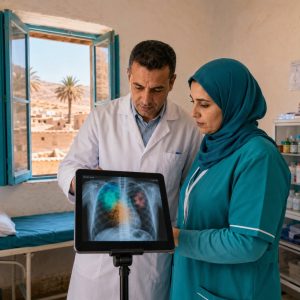
AI Reads X-Rays in Algeria’s Rural Clinics: Closing the Diagnostic Gap
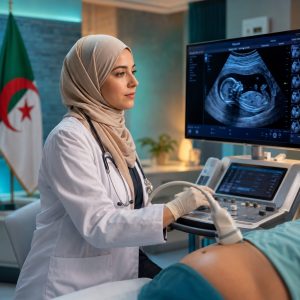
Algeria’s Medical AI Moment: Fetal Ultrasound Models Trained on Local Datasets

Alsat-3A and Alsat-3B: The New Data Pipeline for Algerian AI

Computer Vision in Algeria: From Manufacturing Quality Control to Smart Surveillance