The Grid Cannot Keep Up with AI
When xAI needed power for its Memphis supercluster in 2024, it didn’t wait for a utility interconnection. It drove in semitrucks carrying natural gas generators. That improvised solution captured global attention not because it was elegant, but because it worked — and because it revealed, in unmistakable terms, how badly the traditional grid model has broken down for AI-scale infrastructure.
The mismatch is structural. An AI data center campus can be permitted, constructed, and operationally ready in 18 months. Grid interconnection for a large industrial load now takes substantially longer, with a March 2026 Bloom Energy survey finding that the wait had grown 1.5 to 2 years beyond previous expectations. In some markets — Northern Virginia and Dallas-Fort Worth most visibly — this gap is already suppressing under-construction capacity, as developers who cannot secure power commitments simply cannot break ground.
The economic stakes make delay intolerable. An AI data center generates an estimated $10–12 million per MW annually, or $10–12 billion per GW. Accelerating deployment by even one or two years against a competitor can represent tens of billions in cumulative revenue. For hyperscalers racing to capture enterprise AI workloads, waiting years in an interconnection queue is not a constraint to manage — it is an existential risk.
The result has been a rapid, large-scale pivot to on-site generation. A study published by the American Public Power Association identified 46 data centers planning behind-the-meter power generation with a combined capacity of 56 GW — approximately 30% of all planned U.S. data center capacity. Roughly 90% of those projects, representing around 50 GW, were announced in 2025 alone. The industry crossed a threshold last year, and the momentum is not reversing.
Why Behind-the-Meter Changes Everything
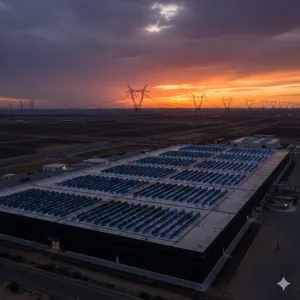
“Behind the meter” refers to power generation installed on a customer’s own site, physically disconnected from the utility grid, and dedicated entirely to that customer’s load. It is the industrial equivalent of going off-grid — except that these facilities are drawing tens or hundreds of megawatts from their own turbines rather than a few kilowatts from rooftop solar.
Approximately 75% of the generation equipment in identified projects — roughly 23 GW out of 56 GW — is natural gas-powered. The appeal is straightforward: gas-fired generation can be deployed faster than grid interconnection, runs continuously unlike intermittent renewables, and carries a well-understood engineering and regulatory footprint. Natural gas also has its own supply chain advantages: dedicated pipelines can be routed directly to a campus, bypassing grid topology entirely.
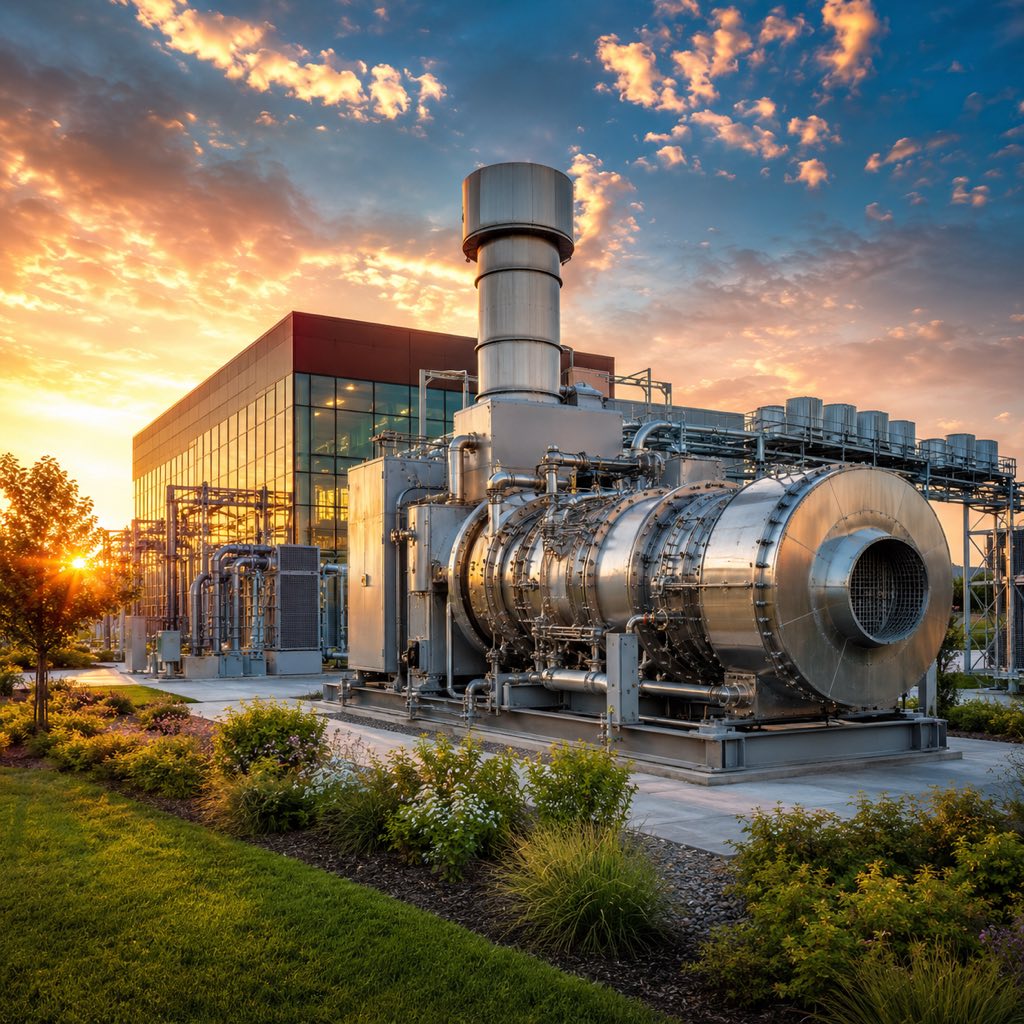
The most technically sophisticated option within the gas turbine category is the aeroderivative turbine, a design adapted directly from aircraft and naval propulsion engines. These units trade raw efficiency for exceptional speed-to-deploy, compact footprint, and rapid start capability. Reporting by Data Center Frontier documents the current hardware landscape: the GE Vernova LM6000 (derived from the CF6-80C2 aircraft engine), the Mitsubishi Power FT8 MOBILEPAC, ProEnergy’s retrofitted CF6-80C2 cores delivering approximately 50 MW per unit, and the Boom Superpower unit at 42 MW. These are not provisional backup generators — they are primary power infrastructure.
The scale of orders underscores the urgency. Crusoe Energy, positioning itself as an “energy-first AI infrastructure developer,” has ordered 29 Boom Superpower units — enough to deliver 1.21 GW of onsite generation across its data center portfolio, with Baker Hughes supplying 25 BRUSH Power Generation DAX 7 generators and deliveries scheduled from mid-2026 through 2028. Exxon Mobil has assembled a pipeline of over 2.7 GW in data center power projects. Boom Supersonic, whose primary business is supersonic commercial flight, received a $1.25 billion order for power generation equipment — its first such deal — signaling that even non-traditional manufacturers are being pulled into the vacuum left by turbine backlog.
That backlog is severe. Wood Mackenzie tracked gas turbine lead times reaching 243 weeks — nearly five years — for certain turbine classes as of Q2 2025. The wait for the equipment needed to bypass grid delays has itself become a constraint, compressing the very time advantage that behind-the-meter strategy was supposed to deliver.
Meta’s approach in Ohio illustrates the full architecture at scale. The Socrates South Power Generation Project, approved by Ohio’s Power Siting Board in June 2025, is a 200 MW natural gas facility built by Williams Companies for Meta’s 740-acre New Albany Business Park campus. The plant combines three Solar Turbines Titan 250 turbines, nine Solar Turbines PGM 130 turbines, three Siemens Energy SGT400 turbines, and 15 Caterpillar 3520 reciprocating engines. It is explicitly dedicated to a single customer’s load and not physically connected to the electric grid. A second 200 MW phase is already planned. The total Williams investment in the project — branded Project Socrates — is $1.6 billion, with service commencement targeted before the end of 2026.
AI-driven natural gas demand across the sector is projected to reach up to 6 billion cubic feet per day by 2030. A Bloom Energy survey conducted in 2025 found that data center leaders expect approximately 30% of all data center sites to use onsite power by 2030 — a figure 2.3 times higher than the same survey seven months earlier. The shift is accelerating faster than the industry’s own forecasts.
Advertisement
What Infrastructure Teams Should Do
The behind-the-meter transition is not a temporary workaround. It is a structural reorganization of how data center power is sourced, owned, and operated. Infrastructure teams that treat it as a procurement footnote will find themselves locked out of capacity timelines that their competitors have already secured. Four specific actions define the difference between teams that will be ready and those that won’t.
1. Model Your Power Gap Before You Break Ground — Not After
The most common planning failure is treating power as a late-stage site selection input. In today’s environment, the power availability timeline must anchor the entire project schedule. Before committing to a site, infrastructure teams should map grid interconnection queue position (request the utility’s published queue and look up your substation’s wait position), identify whether behind-the-meter capacity can be sited within the parcel, and model the full cost delta between grid power at interconnection versus gas generation at today’s turbine lead times.
For a 100 MW campus, the difference between a grid interconnection delivered in 18 months versus 48 months is not just schedule risk — at $10–12 million per MW per year in revenue potential, it is $1.2–1.4 billion in cumulative delay cost. Treated as an investment analysis problem rather than a facilities problem, behind-the-meter gas generation often pencils out decisively even before accounting for turbine availability. Run this calculation before signing a land lease, not after.
2. Lock in Turbine Commitments Two to Three Years Ahead
With lead times for certain turbine classes hitting 243 weeks, teams that begin procurement when they need capacity will not receive it in time. The procurement decision for turbines that will power a 2028 or 2029 campus needs to happen now, in 2026. This is not familiar territory for infrastructure teams accustomed to ordering servers on 8–16 week lead times or provisioning cloud capacity instantaneously.
The practical implication is a shift toward speculative capacity reservation: ordering turbine units before the site is fully designed, before all permits are in hand, and sometimes before the customer contract is signed. Some operators are placing portfolio-level orders — as Crusoe Energy did with its 29-unit Boom Superpower commitment — to secure a block of capacity that gets allocated to specific sites as they mature. If your organization does not have a turbine order in place or a framework agreement with a manufacturer, you are already behind.
3. Build Environmental Compliance into the Power Architecture, Not as an Afterthought
The regulatory environment around behind-the-meter gas generation is tightening. The EPA has begun scrutinizing whether extended turbine operation — originally classified as “bridging” capacity while awaiting grid interconnection — should require full stationary source air quality permits rather than the temporary emergency generator classifications operators have sometimes relied on. APR Energy markets its turbine solutions explicitly for “behind-the-meter capacity while awaiting utility build-out,” but the regulatory framing of that waiting period is in flux.
Infrastructure teams should assume that any behind-the-meter gas asset running as primary power for more than 12 months will be subject to the same permitting expectations as a permanent facility. Building the emissions monitoring, reporting, and offset programs into the original project design — rather than retrofitting them under regulatory pressure — avoids the scenario that has derailed several projects: a facility that is mechanically operational but legally unable to run at full capacity. Engage environmental counsel at the turbine procurement stage, not at the certificate of occupancy stage.
4. Design for Hybrid Architecture From the First Schematic
Behind-the-meter gas generation is increasingly being paired with battery storage in hybrid architectures designed for long-duration support. The battery layer handles short-duration demand spikes and provides a buffer for turbine start cycles; the gas layer provides sustained baseload capacity. This combination matters for AI workloads specifically because GPU clusters have notoriously spiky power demand profiles — sudden ramp-ups to full load during training runs, sustained high load during inference, and partial load during maintenance windows.
A gas-only architecture sized for peak demand will operate significantly below capacity for much of its runtime, which affects fuel efficiency and equipment wear rates. A hybrid system can size the gas capacity for sustained average load, use battery storage to absorb the peaks, and recover turbine efficiency across the cycle. Emerging frameworks like EPRI’s Flex MOSAIC classification are beginning to formalize how behind-the-meter hybrid assets can also participate in grid flexibility programs, creating potential revenue offsets against the capital cost of the battery layer. Design teams that ignore this possibility are leaving money on the table.
The Bigger Picture: Infrastructure Ownership Is Shifting
The behind-the-meter trend is doing something more significant than solving a short-term power gap — it is fundamentally rewriting the ownership model of digital infrastructure. For most of the data center industry’s history, power was a utility input: someone else built it, maintained it, priced it, and bore the capital risk. Hyperscalers showed up, signed a power purchase agreement, and focused on what they knew: servers, networking, cooling.
That model is over at the frontier of AI infrastructure. Meta is now a natural gas operator. Crusoe Energy is effectively an energy company that happens to run data centers. Exxon Mobil — an oil and gas company — has assembled a 2.7 GW data center power pipeline. The skills required to plan, permit, construct, and operate a 200 MW combined-cycle gas facility are not skills that a typical data center infrastructure team possesses. They belong to power plant engineers, energy traders, environmental compliance attorneys, and fuel supply chain managers.
The hyperscalers moving fastest in 2026 are the ones who recognized this competency gap early and either hired into it or partnered around it. The Williams–Meta relationship is instructive: Meta did not build Project Socrates itself. It structured a dedicated-supply arrangement with a pipeline and midstream company that already had the EPC expertise, the regulatory relationships, and the operational track record. That deal structure — hyperscaler as customer, energy company as builder-operator — is the emerging template.
For infrastructure leaders, the strategic question is no longer “do we need our own power?” The answer to that is settling toward yes for any campus above 100 MW in a constrained grid market. The question is now “who is our energy partner, what is their capacity, and do they have the turbine order slots to deliver on the timeline our AI buildout requires?” That is a different conversation than the one infrastructure teams were having two years ago — and organizations that have not yet started it are already late.
Frequently Asked Questions
What is behind-the-meter power generation for data centers?
Behind-the-meter (BTM) generation means a data center builds and operates its own power plant on-site, physically disconnected from the utility grid. The facility generates all or most of its electricity from its own gas turbines, reciprocating engines, or fuel cells, eliminating dependence on grid interconnection. This approach avoids multi-year utility queue delays and gives operators full control over their power supply and capacity timeline.
Why are aeroderivative turbines preferred over conventional industrial turbines?
Aeroderivative turbines, adapted from aircraft and naval propulsion engines, offer three advantages critical for data center deployment: faster installation (weeks versus months for heavy-frame industrial turbines), compact physical footprint suited to campus siting, and rapid start capability that matches the variable load profiles of GPU clusters. Their main trade-off versus heavy-frame turbines is slightly lower thermal efficiency at sustained baseload, which hybrid battery pairing partially offsets. GE Vernova’s LM6000 and the Boom Superpower unit are the leading platforms in current data center deployments.
How does the behind-the-meter shift affect grid operators and public ratepayers?
When large industrial loads — some in the hundreds of megawatts — exit the grid or never connect to it, utilities lose load that would otherwise help spread fixed infrastructure costs across a broader base. In March 2026, leading hyperscalers signed a White House Ratepayer Protection Pledge committing to shoulder their own electricity generation costs rather than pass new infrastructure charges to existing ratepayers. Grid operators are also beginning to explore frameworks under which BTM assets could provide grid flexibility services during off-peak periods, creating a partial offset against the lost-load concern.
Sources & Further Reading
- Study Details How Data Centers Are Building Their Own Power Plants — American Public Power Association
- Aeroderivative Turbines Move to the Center of AI Data Center Power Strategy — Data Center Frontier
- Onsite Gas Turbines and Reciprocating Engines to Power Meta Data Center — Power Engineering
- Gas to Power Boom: AI Drives 2026 On-Site Energy Shift — Enki AI
- Why Data Centers Are Turning to Behind-the-Meter Power — Data Center Knowledge
- Hyperscalers in 2026: What’s Next for the World’s Largest Data Center Operators — Data Center Knowledge
🔗 Related Intelligence
The $700B Hyperscaler Bet: Why Power and Cooling Are Now the AI Infrastructure Ceiling
Bloom Energy and Oracle’s 2.8 GW Fuel Cell Deal: The On-Site Power Revolution for AI Data Centers
The 49GW Shortfall: How Cloud Operators Are Solving the AI Power Grid Bottleneck
Power Before Chips: The $80B Azure Backlog That Reveals Hyperscalers’ Real Constraint