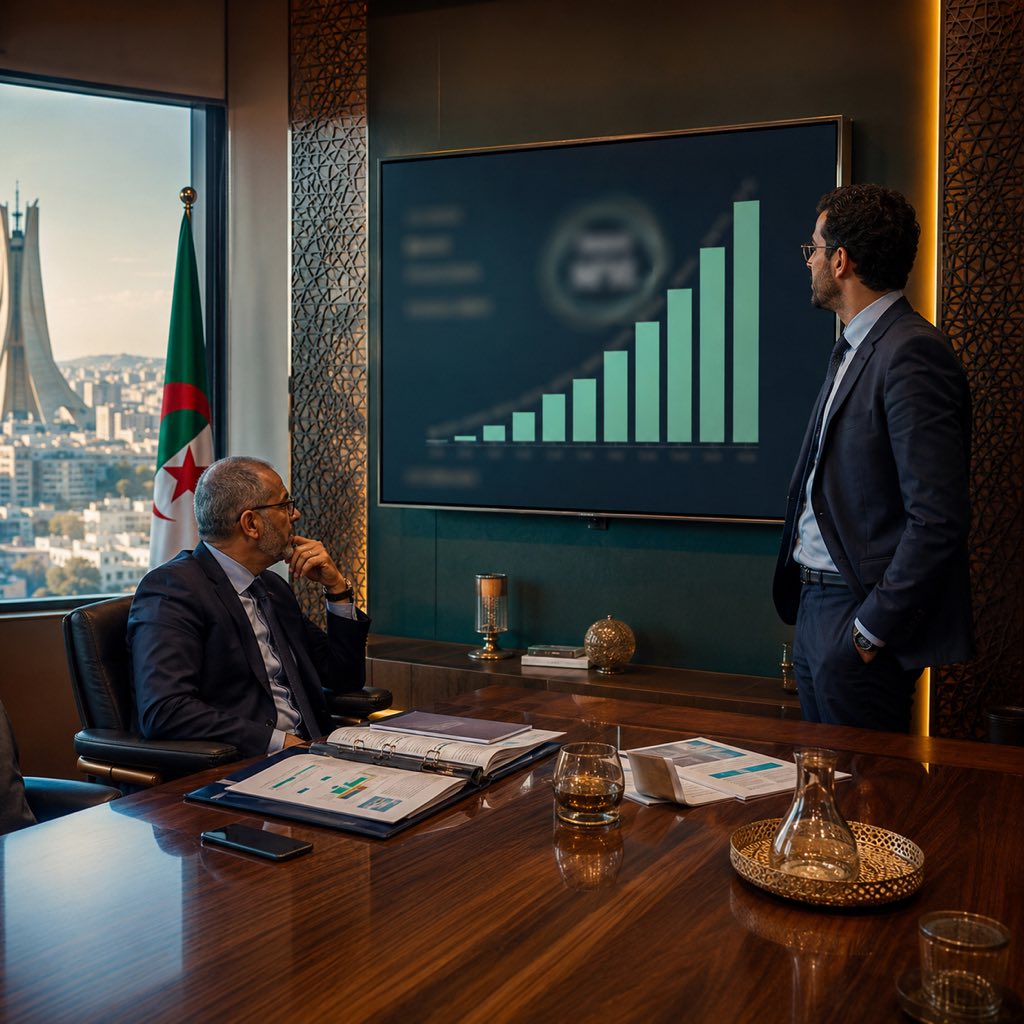
A Single Exit That Reframes Four Years of Capital Allocation
When Völz CEO Mohamed Abdelhadi Mezi announced the closing of his $5 million Series A at the African Startup Conference in Algiers in December 2025, two things happened simultaneously. The country recorded its largest publicly disclosed startup round ever priced in local currency, and the Algerian Startup Fund (ASF) — the state-backed vehicle created in October 2020 to seed early-stage venture investing — booked its first reported exit at a 3.35x return on initial investment. The buyers were Tell Group, a regional investment firm, with participation from Groupe Industriel Babahoum Algérie (GIBA), the Biskra-based industrial group behind the Guedila mineral water brand.
For four years, ASF defenders argued that the fund’s value should be measured in ecosystem terms — applications processed, wilayas covered, founders trained — rather than in returns. Critics argued the opposite: without a single liquidity event, the public VC thesis remained unproven. The Völz transaction settles that debate. As Wamda’s coverage noted, the deal demonstrated that “the state-backed model can generate returns and, crucially, that secondary markets or private equity players are willing to buy out early-stage public positions.” The 3.35x multiple is not Sequoia-grade, but it is real, dinar-denominated, and bookable.
What the Völz Math Actually Looks Like
The headline number — 3.35x — describes ASF’s return on its initial ticket, not the fund-wide multiple. ASF does not publish individual deal sizes, but its public mandate caps tickets at DZD 150 million per project, with most pre-seed and seed allocations falling well below that ceiling. If ASF deployed a typical 40-80 million DZD ticket into Völz at seed in 2022-2023, a 3.35x exit would return roughly 134-268 million DZD on that single position. Against a 2.4 billion DZD total fund capitalization, that is between 5.6% and 11.2% of the entire fund recouped from one exit.
That ratio matters because it sets a baseline. A textbook seed portfolio expects roughly one in ten companies to return the fund. ASF, with over 100 funded startups across 22 wilayas, needs maybe three to five more Völz-grade exits over the next 36 months for cohort 1 to be considered a viable proof-of-concept rather than a pilot. The fund’s general manager Anys Rahabi has not published a TVPI target, but the public arithmetic implies one: cohort 1 needs to clear 1.5x net by 2028 to justify the political capital tied up in cohort 2.
Advertisement
Why Cohort 2 Should Not Look Like Cohort 1
Cohort 1’s sector-agnostic mandate made sense in 2020. Algeria had no startup census, no functioning angel layer, and no reference exits. Spraying small tickets across Industry 4.0, health, agri-tech, fintech, education, and green-tech built data, not returns. Cohort 2 inherits that data — and the question is whether ASF’s second vehicle keeps the same horizontal mandate or concentrates capital where cohort 1 has shown signal.
Three signals are clear from the cohort 1 record. First, travel-tech and consumer marketplaces that solve Algerian-specific friction (currency controls, cash-on-delivery, unbanked checkout) produce the deepest moats — Völz is the proof point, not the exception. Second, B2B SaaS in agri-tech and logistics has consistently attracted follow-on interest from groups like Tell Group and GIBA, suggesting the buy-side exists for industrial-adjacent verticals. Third, the wilayas outside Algiers, Oran, and Constantine have generated fewer than 15% of funded deals — meaning cohort 1’s regional spread was real but shallow, and cohort 2 should pick four or five secondary cities to build genuine density rather than 22-wilaya tokenism.
What Algerian founders and investors should do
1. Stop pitching ASF as a grant — pitch it as the first check that unlocks Tell Group, GIBA, and FCPR follow-on capital
The Völz exit revealed the actual product ASF sells: not capital, but legitimacy that local industrial groups recognize. Tell Group and GIBA did not lead the Völz round because they read a pitch deck cold; they led because ASF had been on the cap table for two years, which signaled that the company had cleared the Startup Label process, undergone an investment-committee diligence, and reported quarterly KPIs to a state-backed vehicle. Founders pitching ASF in 2026 should optimize their materials for that downstream buyer — explicitly model the Series A bridge from ASF seed to a Tell Group, GIBA, or FCPR follow-on, name the industrial group most likely to acquire the company, and time the ASF ticket to land 18-24 months before that conversation. ASF is the runway to private capital, not the destination.
2. Concentrate cohort 2 on three sectors with proven private-market exit demand — and publish the thesis
Cohort 1’s horizontal mandate was the right call when no exits existed. With one exit booked and the private FCPR framework operational since 2025, ASF’s second cohort should publish an explicit thesis concentrating 60-70% of capital in three sectors where private buyers have already shown up: consumer marketplaces solving currency-control friction (the Völz template), agri-tech and logistics SaaS targeting the industrial conglomerate buyer class, and fintech infrastructure aligned with the post-Instruction 06-2025 PSP framework. The remaining 30-40% should keep optionality on green-tech and health, but as a hedge, not the headline. A published thesis lets founders self-select, lets co-investors plan, and lets cohort 2 be evaluated against an explicit benchmark rather than a generic “support startups” mandate.
3. Move from 41-wilaya tokenism to four-city density
Cohort 1’s expansion to 41 of 58 wilayas was politically necessary but financially diffuse. A founder in Tamanrasset receiving a 30 million DZD ticket has no local angel layer, no co-working anchor, no follow-on investor, and no acquihire buyer within 1,500 km. Cohort 2 should pick four secondary cities — candidates include Annaba, Sétif, Béjaïa, and Ouargla — and concentrate 80% of regional deployment there, paired with regional FCPR commitments and university spinout programs. Tell Group and GIBA invested in Völz partly because the company had a coherent operating footprint, not a wilaya-distributed team. Density compounds; tokenism does not.
4. Build the secondary-market plumbing before the next exit, not after
Völz’s exit worked because Tell Group and GIBA were willing to buy out ASF’s position at a 3.35x clip. There is no public market in Algeria where ASF can sell positions on a clock, which means every future exit depends on a strategic acquirer showing up at the right moment. Cohort 2 should pre-wire that plumbing by signing memoranda of understanding with three to five industrial groups for right-of-first-look on portfolio companies above defined revenue thresholds, formalizing co-investment agreements with the first wave of FCPRs (Afiya and successors), and publishing a standardized term sheet that maps secondary-sale mechanics. Founders should not have to discover at the Series A stage that the cap table has no exit ramp.
5. Set a public TVPI target for cohort 2 and report against it semi-annually
ASF’s cohort 1 reporting has been process-based: applications received, files reviewed, wilayas covered, dinars introduced to partners. Cohort 2 needs financial reporting — a published TVPI target (a 2x net floor by year five is the entry-level expectation for emerging-market public VC), DPI tracking once exits begin, and semi-annual portfolio mark updates against named comparables. Founders, co-investors, and the National People’s Assembly all benefit from the discipline. The 3.35x Völz print is the moment to switch the metrics from ecosystem language to portfolio language, while goodwill is at its peak.
The Compounding Question
The risk for cohort 2 is not failure — it is mediocrity. A second 2.4 billion DZD vehicle deployed across 100 more startups in 22 more wilayas would produce another Völz-grade exit in three to five years, and the cycle would repeat without compounding. The opportunity sitting on Anys Rahabi’s desk is different: use the Völz print to argue for a 5-7 billion DZD cohort 2 with concentrated bets, a published thesis, and explicit DPI targets, paired with the FCPR ecosystem maturing in parallel. That combination — a focused public vehicle and a growing private layer — is how Singapore’s early ecosystem moved from pilot scheme to flywheel between 2008 and 2015. Algeria’s window to do the same is open while the Völz narrative is fresh. If cohort 2 launches as a cohort-1 sequel, the political momentum dissipates and the next exit will not arrive with the same news cycle behind it. The Völz 3.35x is not a victory lap. It is the budget cycle’s most expensive argument waiting to be made.
Frequently Asked Questions
What was ASF’s actual return on Völz, and how does it compare to global VC benchmarks?
ASF reported a 3.35x return on its initial investment in Völz when the travel-tech startup closed its 600 million DZD Series A in December 2025. Global pre-seed and seed multiples on individual exits typically range from 5x to 25x for top-decile deals, so 3.35x is below top-tier benchmarks but well above the median for emerging-market public venture vehicles, where most pilot funds never record a positive exit at all. For a fund less than five years old in a market with no prior reference exits, it is a credible first print.
Has ASF officially announced a second cohort or fund?
ASF has not, as of May 2026, published an official second-cohort prospectus, target size, or sector thesis. Industry conversation following the Völz exit has centered on the case for a larger, more concentrated second vehicle, but the formal structure, capital base, and governance changes remain to be confirmed by ASF leadership and the Ministry of Knowledge Economy. Founders and co-investors should monitor announcements from ASF general manager Anys Rahabi and the Council of Ministers for formal updates.
How does the FCPR framework change ASF’s role going forward?
The 2025 FCPR (Fonds Commun de Placement à Risque) framework allows private venture capital funds to operate in Algeria with minimums as low as 50 million DZD and just two unitholders, with Afiya Investments approved as the first FCPR. This creates a private layer that did not exist when ASF launched in 2020 — meaning ASF no longer needs to be the entire pipeline. Cohort 2’s strategic question is how to position ASF as the legitimacy and Startup Label gatekeeper at pre-seed, while explicitly handing off Series A and growth-stage capital to the FCPR layer and industrial groups like Tell Group and GIBA.
Sources & Further Reading
- Algeria’s Public Startup Fund Scores First Exit as Travel-Tech Völz Raises $5M — Launch Base Africa
- Algeria’s VOLZ raises $5 million in landmark funding round — Wamda
- VOLZ closes $5m Series A round, the largest funding raised by an Algerian startup — Technext
- VOLZ raises Algeria’s largest startup funding round in local currency — TechCabal
- ASF — Algerian Startup Fund official site
- Algerian Startup Fund — Crunchbase profile
- Start-up : les FCPR, un nouveau levier pour attirer les financements étrangers — Algérie Patriotique
🔗 Related Intelligence

ASF + FCPR Co-Investment: Bridging Algeria’s Series A Funding Gap in 2026

ASF and the 58 Billion Dinars Wilaya Funds: How Algerian Startups Can Access Regional Capital in 2026

ASF’s First Exit: How Algeria’s Startup Fund Is Building a Series A Pipeline

Algeria’s Startup Fund: 100+ Investments and the Case for a Second, Larger Vehicle