The 4.6× Trust Leap: What the Numbers Actually Say
Five years ago, an Algerian consumer making an online payment was most likely paying 1,180 DZD to recharge an Algérie Telecom or Djezzy line. In 2025, that same digital transaction averaged 5,400 DZD — not a telecom top-up but a utility installment, an insurance premium, or the first payment on an AADL 3 housing unit.
This is not merely inflation at work. According to GIE Monétique’s 2025 annual report, online payments grew 179% in a single year, reaching 145 billion DZD across more than 27 million transactions. December 2025 alone set a monthly record: 3.6 million transactions totalling 65.27 billion DZD — fuelled primarily by the first instalment of the AADL 3 social housing programme, which was conducted exclusively through digital channels. When consumers trust a payment platform enough to send a housing down payment through it, the psychology of the market has fundamentally changed.
The broader picture reinforces this maturation. Total electronic payments — spanning point-of-sale terminals, online transactions, and mobile applications — reached 939 billion DZD in 2025, up 46% from 643.8 billion DZD in 2024. According to We Are Tech Africa’s coverage of the GIE Monétique figures, the number of interbank cards in circulation crossed 22 million. The POS terminal network expanded from 68,140 devices to 78,774, a 15.61% increase. Meanwhile, the number of certified web merchants reached 644 — up 26.27% year-on-year — after GIE Monétique streamlined the technical integration process for new operators.
The sector breakdown inside online payments is revealing: telecommunications dominated with over 12 million transactions, but administrative services (7.6 million), service providers (3.6 million), and utility payments (1.8 million) collectively account for nearly half the volume. Algerian consumers are now comfortable completing multi-step, high-stakes payments digitally. That comfort is the commercial opportunity merchants have been waiting for.
Where the Growth Is Actually Coming From
Telecom top-ups remain the single largest category by transaction count, but the value story sits elsewhere. The average POS terminal transaction climbed from 6,000 DZD in 2020 to over 9,000 DZD in 2025 — consistent with higher-ticket retail categories, including electronics and household goods, migrating from cash to card. Mobile peer-to-peer (P2P) transfers via BaridiMob and Wimpay averaged between 13,000 and 14,000 DZD per transfer in 2025, suggesting that when consumers choose digital for discretionary spending, they move significant sums.
The AADL 3 effect deserves its own paragraph. A government housing programme choosing to process its payments exclusively online injected 65 billion DZD into the digital payment ecosystem in a single month. This demonstrated to millions of Algerian households — many for the first time — that a four- or five-digit DZD transaction could be completed safely, instantly, and without a branch visit. The behavioural shift does not reverse after December: those households now carry the lived experience of high-value digital payment.
BaridiMob’s P2P expansion also signals structural depth. Transfers grew from 17.8 million operations in 2023 to 36.2 million in 2024 — a 103% surge — and reached 47.5 million in 2025, totalling 647.4 billion DZD. As Transfi’s analysis of Algeria’s payment rails notes, consumers who use P2P transfers routinely are the same cohort most likely to pay merchants digitally, because the friction barrier has already been cleared in personal use.
Advertisement
What Algerian Merchants Should Do About It
The payment data tells a clear commercial story: consumers are ready to spend more per transaction online than at any point in Algerian history. The constraint is not consumer willingness — it is merchant readiness. Fewer than 10% of Algerian merchants currently operate an electronic payment terminal, according to industry estimates. The gap between consumer appetite and merchant infrastructure is the addressable opportunity. These three prescriptions are ordered by return on effort.
1. Add Online Payment to Your High-Ticket SKUs First — Not Your Full Catalogue
The 5,400 DZD average online transaction signals that buyers paying digitally are comfortable with mid-range purchases. Merchants who accept digital payment only on low-margin consumables (under 2,000 DZD) are leaving the highest-value customer segment unserved. The strategic move is to identify your top 20% of products by unit price — electronics, appliances, premium clothing, furniture accessories — and ensure those SKUs are the first to carry a “Pay by CIB or Edahabia” option on your website or order form.
The rationale: a customer who has chosen to pay 5,400+ DZD digitally has already cleared the psychological friction barrier. They are not comparison-shopping your checkout process; they are ready to commit. The 12 million telecom transactions in 2025 prove that low-value digital payments will happen regardless of merchant effort. The incremental gain is at the upper end of the ticket range — where margins are higher and where COD returns (which routinely reach 40–60% in Algerian e-commerce) are less likely because the customer has already committed funds.
2. Negotiate Per-Transaction Fee Structures with Your PSP — Not Flat Annual Rates
As Algeria’s PSP landscape evolves under Bank of Algeria Instruction 06-2025 — the country’s first formal fintech regulatory framework — merchants now have more negotiating leverage than they did in the SATIM-monopoly era. The 160 million DZD minimum capital requirement for licensed PSPs means that operators competing for merchant accounts are capitalized enough to offer competitive terms.
Merchants processing high-ticket items should negotiate on a per-transaction-percentage basis rather than accepting flat annual licensing fees. At 5,400 DZD per transaction, a 1% fee is 54 DZD per sale — a number that should be benchmarked against the actual COD cost (logistics fee + return risk + cash handling time) for the same transaction. According to Ecommaps’ 2026 Algeria e-commerce research, over 85% of Algerian e-commerce transactions still rely on Cash-on-Delivery, and return rates routinely reach 40–60% — making fully-loaded COD cost far higher than 2–3%. Digital payment, even at PSP rates, is the cheaper fulfilment path for merchants who do the honest accounting. Request itemised fee schedules from at least two certified PSPs — SATIM’s gateway and Chargily Pay are both active in the merchant market — and model the break-even at your average order value before signing.
3. Train Front-Line Staff on QR and Contactless Conversion — Treat It as a Revenue Skill
The 78,774 POS terminals deployed across Algeria by end-2025 are vastly underutilised relative to their merchant base. The barrier is rarely technical: GIE Monétique has streamlined integration, and the hardware cost of a POS terminal has fallen with the network expansion. The barrier is human: sales staff who default to “do you have cash?” before presenting the payment terminal are converting digital-capable customers back to COD.
The new DZ Mob Pay interbank service — which registered 95,014 personal accounts and 14,283 merchant accounts in its inaugural year — shows that QR-code-based collection is operationally viable for merchants without dedicated POS hardware. Train staff to offer QR payment actively at the point of sale, not passively after the customer asks. Practical script: “You can pay by Edahabia or CIB card — here or by QR code.” Track conversion rates by staff member for one month. Shops that have done this in comparable markets see digital payment rates improve 15–25 percentage points without any infrastructure change. The conversion script costs nothing; the lost margin from COD returns costs real money.
Where This Fits in Algeria’s 2026 Ecosystem
The 5,400 DZD average transaction milestone is not an isolated statistic — it is a marker inside a compressing window. Algeria has set a target of 50% cashless transactions by 2030, and the 2025 Finance Law introduced tax incentives for electronic payment adoption. The regulatory sandbox that Bank of Algeria Instruction 06-2025 enabled is scheduled to activate in 2026, which means new PSP entrants and new product formats — instalment payments, buy-now-pay-later for higher-value goods, embedded checkout in delivery apps — will enter the market within the next 12 to 18 months.
Merchants who build their digital payment infrastructure now will carry a compounding advantage into that window. Consumers who experienced AADL 3 digital payments in December 2025 are the same households that will use those same credentials to pay for appliances, school fees, and health services in 2026 and beyond. The commercial question for every Algerian merchant is no longer “should we accept digital payment?” The evidence from GIE Monétique settles that debate. The live question is how quickly a given business can configure its checkout, train its staff, and price its high-ticket SKUs to match the trust level consumers have already reached.
Frequently Asked Questions
What drove Algeria’s 179% surge in online payments in 2025?
The single largest factor was the AADL 3 social housing programme, which processed its first instalment exclusively online — generating 3.6 million transactions worth 65.27 billion DZD in December 2025 alone. Structural factors include the expansion of the certified web merchant network to 644 operators (+26.27%), the continued growth of BaridiMob P2P transfers (47.5 million operations), and streamlined GIE Monétique integration procedures that lowered the barrier for new merchants.
How does the 5,400 DZD online average compare to other payment channels?
The 5,400 DZD figure covers online (internet) payments specifically. POS terminal transactions averaged over 9,000 DZD in 2025 — reflecting higher-ticket in-store retail. Mobile P2P transfers via BaridiMob averaged 13,000–14,000 DZD per transaction. Mobile QR-code merchant payments averaged approximately 825 DZD — the lowest channel, dominated by daily consumables. Online payments sit in the mid-range but have grown the fastest (from 1,180 DZD in 2020), signalling the most rapid trust accumulation.
What is the minimum a merchant needs to start accepting digital payments in Algeria?
The lowest-friction entry point is DZ Mob Pay, the interbank QR-code service that reached 14,283 merchant accounts in 2025, which requires no dedicated POS hardware. For online acceptance, merchants apply through GIE Monétique for certification, integrate the SATIM gateway or a certified PSP such as Chargily Pay, and display CIB and Edahabia card acceptance — Algeria’s two main interbank card standards — at checkout.
Sources & Further Reading
- Electronic Payments in Algeria Surge by 46% in 2025 — DzairTube EN
- Algeria: Le paiement électronique franchit le cap des 22 millions de cartes — We Are Tech Africa
- Algeria’s New Digital Payment Law: 57% Unbanked at Stake — AlgeriaTech
- Algeria’s Payment Rails & How They Work — SATIM, E-Payments & the Path to Digital Banking — Transfi
- The Digitization of E-Commerce in Algeria: Challenges and the Ecommaps Ecosystem — Ecommaps
🔗 Related Intelligence

Algeria Payments: The 179% Surge and What Merchants Must Do in 2026
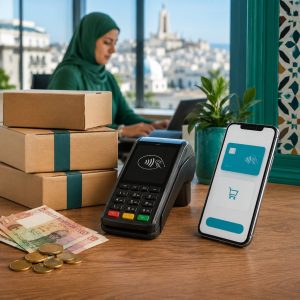
Algeria’s Payment Shift: How Merchants Are Moving from COD to Digital Checkout
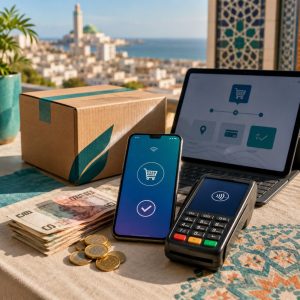
Algeria’s E-Commerce Pivot: From COD Dominance to Digital Payment Adoption
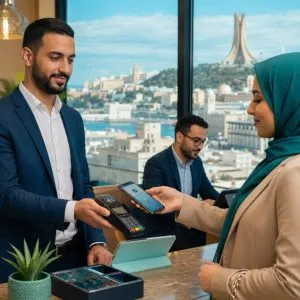
Algeria’s Digital Payment Infrastructure: 78K Terminals, 644 Online Merchants, and a 46% Surge