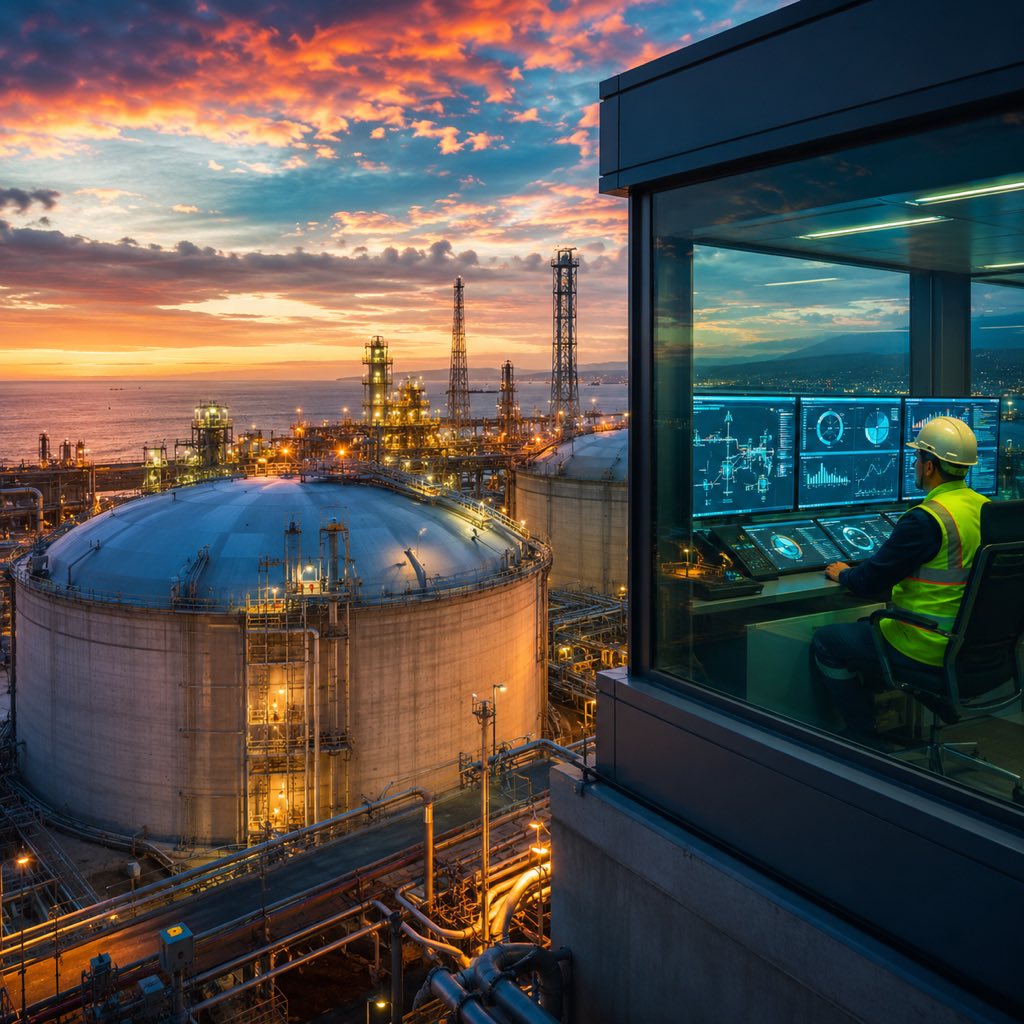
Algeria’s LNG Revenue and the Quality Problem
Algeria is Europe’s third-largest gas supplier, with Sonatrach exporting to France, Italy, Spain, Turkey, and several other European markets. In the first eight months of 2025, Algeria recorded nearly $31 billion in hydrocarbon export revenue, with European demand remaining robust despite continent-wide efforts to diversify away from Russian pipeline gas. LNG — liquefied natural gas chilled to -162°C for tanker transport — forms a significant part of that export portfolio, running through Algeria’s two major liquefaction complexes at Skikda and Arzew.
LNG trade runs on strict contractual quality specifications. Buyers — utilities, regasification terminals, and industrial consumers in Europe — have precise requirements for energy content (expressed as British Thermal Units per cubic foot), methane purity, and the composition of heavier hydrocarbons like ethane, propane, and butane. A cargo that arrives outside specification can trigger price adjustments, cargo rejection, or contractual penalties. In an industry where a single LNG tanker carries 60,000 to 265,000 cubic meters of gas, the financial stakes per cargo are substantial.
The quality variability problem at Algerian liquefaction plants has multiple sources: feedstock gas composition shifts as reservoir production profiles mature; liquefaction train temperatures vary with ambient conditions and maintenance cycles; and blending decisions between different gas streams introduce batch-to-batch inconsistency. Managing this manually — through periodic laboratory sampling and operator judgment — works when feedstocks are consistent and plant conditions are stable. As Algeria’s gas fields mature and plant utilization intensifies, manual QC increasingly becomes a reactive rather than a predictive tool.
Sonatrach’s Existing Digital Footprint
Sonatrach is not starting from zero on digitalization. According to Sonatrach’s 2024 Annual Report, digital well models have already cut workover downtime by 12% in pilot wells, and digital drilling tools have reduced average well completion times by approximately one third. The company’s joint ventures — with TotalEnergies at Timimoun, PTTEP at Touat, and Occidental in Berkine — have introduced 4D seismic, AI-based production optimization, and advanced reservoir modeling to upstream operations.
In early 2024, Sonatrach and Huawei announced a joint innovation initiative for smart pipeline monitoring using fiber optic sensing technology — a system that generates continuous acoustic and thermal data along pipeline routes and uses ML models to detect leaks, stress points, and anomalous flow patterns before they become failures. The partnership was unveiled at Mobile World Congress 2024 and represents a concrete, already-deployed example of Sonatrach integrating real-time ML into operational infrastructure.
The Skikda liquefaction complex — Algeria’s oldest and one of its largest, with a capacity of 4.5 million tonnes per year — underwent a major modernization between 2023 and October 2025, when Sonatrach restarted its key liquefaction train following extended scheduled maintenance. The restart, which directly affects Algeria’s LNG export capacity, coincided with Sonatrach’s broader plan to invest $50 billion in upstream and downstream operations over 2024-2028. A plant that has just undergone modernization is the ideal moment to deploy ML quality monitoring — instrumentation has been refreshed, sensor density is high, and process parameters are well-documented.
Advertisement
What Sonatrach’s AI QC Team Should Do About It
1. Deploy Continuous Online Analyzers Linked to ML Prediction Models
The first infrastructure requirement for AI-powered LNG quality control is continuous online gas chromatography — instruments that sample the gas stream every few minutes and transmit composition data digitally, rather than waiting for laboratory batch results. Most modern liquefaction plants use periodic sampling; the Skikda modernization provides an opportunity to upgrade to continuous analyzers as part of the instrumentation refresh.
Once continuous composition data is flowing, ML regression models can be trained to predict the final cargo specification 30 to 90 minutes before a loading operation completes. This prediction window is commercially significant: it gives operators time to make blending adjustments, pause loading pending correction, or notify the buyer of expected specification, rather than discovering a deviation after the tanker has departed. Sonatrach’s existing data science teams — which already work on reservoir modeling and production optimization — have the skills to develop and validate these models. The training data exists in historical process logs; the main investment is in instrumentation and data pipeline infrastructure.
2. Build a Digital Twin of the Liquefaction Train for Predictive Maintenance
LNG quality is inseparable from equipment condition. A liquefaction train running with a degraded heat exchanger, a compressor operating outside its efficiency curve, or a refrigerant circuit with trace contamination will produce gas with shifted composition profiles even when the feedstock is identical. The current maintenance model — scheduled overhaul plus reactive response to alarms — cannot catch gradual degradation before it affects product quality.
A digital twin of the liquefaction train — a continuously updated computational model that mirrors real-time sensor data from vibration sensors, temperature probes, flow meters, and pressure transducers — enables predictive maintenance at a level manual monitoring cannot achieve. Sonatrach’s partnership with GNPC on upstream R&D, announced in January 2026, includes advanced seismic and AI-enabled interpretation techniques; the same engineering capability applies to downstream process digital twins. Sonatrach should commission a digital twin pilot for one Arzew or Skikda liquefaction train in 2026, benchmarking equipment runtime improvement against the existing 12% workover reduction already achieved in upstream wells.
3. Integrate Quality Prediction Into Export Documentation Workflows
The final AI capability layer is automated quality documentation. Each LNG cargo requires a Certificate of Quality issued at loading, specifying the measured composition, calorific value, and any deviations from contract specification. Currently this document is assembled manually from laboratory results and operator logs after the loading is complete. An AI-assisted documentation system that pulls live analyzer data, cross-references contract specifications, flags any deviations in real time, and pre-populates the Certificate of Quality template would reduce documentation cycle time from hours to minutes.
This is not an exotic capability — it is a straightforward integration of process data with document management software, already standard in LNG terminals in Qatar, Australia, and the United States. Sonatrach’s IT infrastructure, which supports the Huawei smart pipeline monitoring system and Sonatrach’s existing SCADA networks, is capable of hosting this integration. The constraint is internal process standardization: each liquefaction train currently has its own data format and documentation workflow. The 2024-2028 investment program provides the budget and organizational momentum to unify these into a single digital QC platform.
Where This Fits in Algeria’s 2026 Energy Digitalization Strategy
Sonatrach’s AI quality control initiative cannot be evaluated in isolation. It sits within Algeria’s broader ambition to grow non-hydrocarbon exports from their current $5.1 billion baseline while simultaneously protecting the hydrocarbon revenues that fund the national budget. The National AI Strategy’s energy sector pillar, which projects $200-300 million in annual oil and gas efficiency gains from AI deployment, explicitly names LNG and upstream production optimization as priority application areas.
The Skikda modernization, the Huawei smart pipeline partnership, and the GNPC R&D agreement are all convergent signals that Sonatrach is building the infrastructure and partnerships to support serious AI deployment at the process level. What has been slower to develop is the quality control application specifically — the ML layer that connects real-time process data to export contract specifications and buyer relationships. Closing that gap is both technically feasible with Sonatrach’s current capabilities and commercially justified by the revenue protection at stake. For a company exporting billions in LNG annually, even a 1% reduction in cargo specification deviations translates to meaningful revenue protection.
Frequently Asked Questions
Why does LNG quality control matter commercially for Algeria?
LNG buyers — European utilities and regasification terminals — have strict contractual specifications for energy content and gas composition. A cargo outside specification can trigger price reductions, rejection, or penalties. With Algeria exporting tens of millions of tonnes of LNG annually, even a small improvement in specification consistency protects significant revenue and maintains Algeria’s reputation as a reliable supplier in a competitive market.
What AI technology does Sonatrach already use?
Sonatrach has deployed AI-based production optimization and 4D seismic analysis through joint ventures with TotalEnergies, PTTEP, and Occidental. Digital well models have already reduced workover downtime by 12% in pilot wells. The Huawei smart pipeline monitoring partnership, unveiled at Mobile World Congress 2024, uses ML-based fiber optic sensing for real-time leak and anomaly detection across pipeline infrastructure.
How much would ML quality control cost to deploy at a liquefaction plant?
Instrumentation costs for continuous online gas chromatography at a single liquefaction train range from $2-5 million depending on analyzer density and integration complexity. ML model development, using existing process log data, can be handled internally by Sonatrach’s data science teams or with a specialized technology partner. Full deployment including digital twin infrastructure typically runs $10-20 million per train — a fraction of the value at risk from a single cargo rejection or contract penalty.
Sources & Further Reading
- Energy Revenues Rise in Algeria in 2025 — CapMad
- Sonatrach Annual Report 2024 — Sonatrach
- Sonatrach Restarts Key Skikda Gas Unit — Ecofin Agency
- Sonatrach, GNPC Expand Upstream Innovation Through New R&D Agreement — World Oil
- Why Algeria Is Positioned to Become North Africa’s AI Leader — New Lines Institute
- Algeria Unveils AI Strategy — Ecofin Agency
🔗 Related Intelligence
Sonatrach’s AI Predictive Maintenance: The Highest-Value AI Use Case in Algeria’s Economy
AI in Algeria’s Oil and Gas Sector: How Sonatrach Is Betting on Machine Intelligence
Sonatrach and Baker Hughes: AI-Powered Predictive Maintenance Reshapes Algeria’s Oilfields

AI Adoption Across Algeria’s Energy Sector: Oil, Gas, and Utilities Playbook 2026