Why Predictive Maintenance Beats Every Other Algerian AI Use Case on ROI
Every Algerian government white paper on AI lists health, education, and public services as priority use cases. They are important. But none of them compare to predictive maintenance at Sonatrach on raw economic value. Sonatrach’s hydrocarbon exports drive the national budget, and the Algeria Oil and Gas Market was valued at roughly USD 9.36 billion in 2025, projected to grow toward USD 11.58 billion by 2031 at a 3.61% CAGR according to Mordor Intelligence.
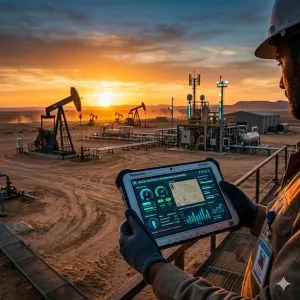
In this context, unplanned downtime at a major gas processing facility costs on the order of millions of dollars per day. Industry benchmarks from Repsol and Baker Hughes deployments cited across upstream coverage put AI-driven predictive maintenance downtime reduction at roughly 15% — a figure that translates into outsized savings when applied to assets like Hassi R’Mel.
What Sonatrach Is Already Doing
Sonatrach’s digital transformation is not theoretical. Two concrete programs are already underway:
Baker Hughes partnership. In December 2024, Baker Hughes secured a USD 180 million contract extension with Sonatrach for digital oilfield services across multiple Saharan production facilities, including AI-powered predictive maintenance systems and real-time production optimization technologies. This partnership has evolved from equipment manufacturing into comprehensive digital solutions that tie downhole sensors, compressor monitoring, and asset performance management into a single analytics layer.
Huawei fiber-optic sensing. Sonatrach and Huawei have deployed fiber-optic sensing across 2,000 km of trunk lines for real-time leak detection. This is adjacent to predictive maintenance but shares the underlying data infrastructure: high-frequency telemetry streams feeding ML models that surface anomalies before they become failures.
The US Trade Administration commercial guide and the TechaHub AI-in-Algeria analysis both flag hydrocarbon digitalization as the most concrete AI investment domain in the country, with spending driven by Sonatrach and complemented by IOC partners like Eni, TotalEnergies, and Repsol.
The Technical Stack That Makes This Work
Predictive maintenance at hydrocarbon scale is not a single model. It’s a layered stack:
- Sensor layer: vibration sensors on compressors and pumps, pressure/temperature transmitters on pipelines, acoustic monitoring, fiber-optic distributed acoustic sensing.
- Data pipeline: time-series ingestion at sub-second resolution, edge preprocessing to reduce backhaul costs, then aggregation to a central data lake.
- ML models: anomaly detection (isolation forests, autoencoders), remaining useful life (RUL) estimation using survival analysis and recurrent models, and increasingly LLM-based root cause narratives fed by structured telemetry plus maintenance logs.
- Workflow integration: model outputs must flow into CMMS systems (SAP PM, IBM Maximo) so that predictions become scheduled work orders, not ignored dashboards.
- Human-in-the-loop: senior field engineers validate high-severity predictions before dispatching crews. This is non-negotiable in hydrocarbon contexts — false positives cost money, false negatives cost lives.
Advertisement
The Talent Gap Is the Real Bottleneck
Sonatrach has the capital to buy best-of-breed platforms from Baker Hughes, Schlumberger (SLB), or Emerson. The constraint is talent. Operating a predictive maintenance program requires a specific combination: domain knowledge of rotating equipment and hydrocarbon processes + data engineering + ML modeling + MLOps. The New Lines Institute analysis notes that Algeria’s universities produce strong engineers but industry-ready AI/ML operators are scarce, with many graduates leaving for France and the Gulf.
Three structural responses are visible:
- In-house centers of excellence. Sonatrach has been expanding internal digital teams, including data science units embedded within production assets.
- University partnerships. Collaboration with USTHB, the Ecole Nationale Polytechnique, and international institutions for graduate placement programs in energy analytics.
- Vendor knowledge transfer clauses. Contracts with Baker Hughes and SLB increasingly include training and co-operation clauses that reduce long-term vendor dependency — though execution quality on these clauses is uneven.
Where AI Predictive Maintenance Fails
The global failure modes at hydrocarbon scale are consistent, and they apply to Sonatrach:
- Sensor data quality. Many legacy assets in Algeria predate modern instrumentation. Retrofitting sensors is capital-intensive and often skipped. Models trained on incomplete data produce confident but wrong predictions.
- Alert fatigue. Early deployments that fire too many alerts get ignored by operators. Tuning precision/recall trade-offs for specific asset classes requires months of calibration with field engineers.
- Integration debt. Maintenance work only happens if a prediction becomes a CMMS work order. When models live in a separate dashboard, the economic value doesn’t materialize.
- Vendor lock-in. Proprietary platforms from Baker Hughes or SLB deliver fast wins but create data portability issues. A sovereignty-aware procurement strategy requires open data export clauses.
The Adjacent Research R&D Signal
In January 2026, Sonatrach and Ghana National Petroleum Corporation (GNPC) signed a new R&D agreement to expand upstream innovation, as reported by World Oil. While the GNPC partnership is primarily upstream exploration, it signals that Sonatrach is positioning its digital and research capabilities as exportable — reinforcing that predictive maintenance and adjacent data analytics are not just cost centers but potential revenue lines in African energy markets.
What Algeria Should Do With This
The policy conclusion is specific. If Algeria’s National AI Strategy and the Algerie Telecom 1.5 billion DZD fund want to generate measurable GDP impact fast, the highest-ROI allocation is not a consumer AI startup. It’s funding a tier of Algerian startups and academic labs building predictive maintenance, computer vision for hydrocarbon inspection, and process optimization tools that can plug into Sonatrach’s existing Baker Hughes and Huawei stacks. Those companies have a credible anchor customer and a measurable savings story.
Everything else is secondary to this economic reality: the single largest AI payoff in Algeria will be measured in reduced compressor failures at Hassi R’Mel, not in consumer app downloads.
Frequently Asked Questions
Why is predictive maintenance the highest-value AI use case in Algeria?
Sonatrach generates roughly 20% of Algeria’s GDP and more than 90% of its export revenue. Even a 1-2% reduction in unplanned downtime at major gas processing facilities like Hassi R’Mel translates into hundreds of millions of dollars in savings. No consumer AI use case — chatbots, recommendation engines, content generation — comes close to matching this scale of economic impact for the Algerian economy.
What AI technologies is Sonatrach actually deploying today?
Sonatrach has two concrete programs: a USD 180 million contract extension with Baker Hughes signed in late 2024 for AI-powered predictive maintenance and real-time production optimization across multiple Saharan facilities, and a Huawei fiber-optic sensing deployment across 2,000 km of trunk lines for real-time leak detection. Both programs generate the time-series telemetry that feeds predictive maintenance ML models.
What is the main barrier to scaling AI predictive maintenance at Sonatrach?
Talent, not capital. Sonatrach can afford best-of-breed platforms from Baker Hughes or SLB. The real constraint is the combination of hydrocarbon domain expertise plus data engineering plus ML plus MLOps skill in the same teams. Algeria produces strong engineering graduates but loses many to France and the Gulf, making in-house centers of excellence and vendor knowledge-transfer clauses the critical levers for scaling.
Sources & Further Reading
- AI in Algeria: Insights & Practical Implementation Strategy — TechaHub
- Why Algeria Is Positioned To Become North Africa’s AI Leader — New Lines Institute
- Algeria Digital Economy Country Commercial Guide — U.S. International Trade Administration
- Algeria Oil and Gas Market Report — Mordor Intelligence
- Sonatrach, GNPC Expand Upstream Innovation Through New R&D Agreement — World Oil