Quick Take: Algeria has a functional telecommunications satellite with significant unused Ka-band capacity and, for now, no LEO competition. The January 2026 Alsat-3A and Alsat-3B launches show ASAL accelerating, but the critical gap is not hardware — it is the commercial and logistical framework to deploy satellite broadband at scale in the south. Alcomsat-1’s remaining operational life represents a closing window to maximize the return on the country’s largest sovereign space investment.
Algeria’s Place in the Space Communications Landscape
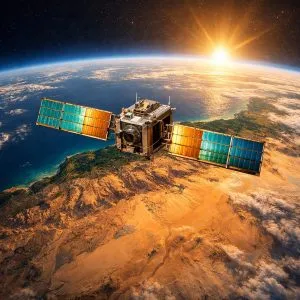
On December 10, 2017, Algeria launched Alcomsat-1, its first telecommunications satellite, from the Xichang Satellite Launch Center in China aboard a Long March 3B rocket. Built by the China Academy of Space Technology (CAST) based on the DFH-4 platform, the 5,225 kg satellite was positioned in geostationary orbit at 24.8 degrees West, providing coverage across Algeria and parts of North Africa, the Sahel, and southern Europe. Designed with a 15-year operational lifespan, Alcomsat-1 carries Ku-band, Ka-band, L-band, X-band, UHF, and EHF transponders capable of supporting television broadcast, internet connectivity, telephony, and secure government and military communications.
The satellite represented a major sovereign investment by the Algerian government, reported at approximately $250 million, though no official breakdown has been publicly confirmed. The project is managed under the Agence Spatiale Algerienne (ASAL), the country’s space agency established in 2002, with day-to-day satellite operations handled by Algerie Telecom Satellite (ATS). ASAL’s mandate extends beyond telecommunications to include Earth observation, geodesy, and space science, but Alcomsat-1 remains its most visible and strategically significant asset. The satellite was conceived to address a fundamental infrastructure challenge: Algeria is the largest country in Africa by area (2.38 million square kilometers), with vast southern territories where terrestrial fiber optic and mobile tower infrastructure is economically impractical to deploy at density.
Two dedicated ground control centers support the satellite: the Centre d’Exploitation des Systemes de Telecommunications Spatiales (CESTS) in Bouchaoui, Algiers, and the Centre Operationnel des Telecommunications Spatiales (COTS) in Boughezoul, Medea. Together, these facilities provide telemetry, tracking, and command functions as well as payload management for all transponder bands.
Before Alcomsat-1, Algeria leased satellite capacity from international operators including Eutelsat, Arabsat, and Intelsat to carry its terrestrial television channels (ENTV, Canal Algerie) and provide VSAT connectivity to remote government installations. The recurring cost of leased transponder capacity provided a core financial justification for sovereign satellite ownership. The question, now eight years post-launch, is whether Alcomsat-1 has delivered on its promise.
Alcomsat-1 Capacity and Utilization
Alcomsat-1’s payload includes 33 transponders across multiple frequency bands: 19 Ku-band transponders for direct-to-home (DTH) television and data services, 12 Ka-band transponders for broadband internet, and 2 L-band transponders for mobile and secure communications. The satellite also carries X-band, UHF, and EHF transponders dedicated to government and military applications, supported by two transmission and three receiver antennas. The Ku-band capacity is the most heavily utilized, carrying Algerian public television channels and radio stations that were previously hosted on leased Eutelsat and Arabsat capacity. This migration to sovereign capacity was completed within the first two years of operation, eliminating recurring international lease costs.
The Ka-band segment, designed for broadband internet, represents the satellite’s most strategically important capability. Ka-band can deliver download speeds of up to 20 Mbps to individual terminals, making it a viable broadband solution for communities beyond fiber and 4G reach. Algerie Telecom Satellite (ATS) has deployed Ka-band VSAT terminals at government offices, schools, and health clinics in southern wilayas including Tamanrasset, Illizi, Tindouf, and Adrar. However, the scale of deployment has remained below the satellite’s theoretical capacity, with terminals numbering in the low thousands rather than the tens of thousands the system could support.
The underutilization reflects several factors. Ground terminal costs (the VSAT dish and modem equipment) are reported at $1,500 to $3,000 per installation, limiting deployment largely to government-funded sites rather than commercial or residential subscribers. Algeria Telecom has not launched a consumer satellite broadband product comparable to what operators in Morocco (using Eutelsat Konnect) or Sub-Saharan Africa (using Yahsat’s Al Yah 3) offer. The L-band and military-band capacity serves national defense and civil protection communications with limited public visibility into its utilization. Industry observers suggest that Alcomsat-1 operates below its full capacity potential, a common pattern for nationally owned telecommunications satellites that lack a commercial retail distribution model.
Advertisement
ASAL’s Broadening Satellite Portfolio
ASAL’s satellite program extends well beyond Alcomsat-1 to include a growing series of Earth observation satellites. Alsat-1, launched in 2002, was Algeria’s first satellite, a 90 kg microsatellite built in partnership with Surrey Satellite Technology Limited (SSTL) of the UK, providing 32-meter resolution multispectral imagery. It was followed by Alsat-2A (2010) and Alsat-2B (2016), built with Airbus Defence and Space, offering 2.5-meter resolution panchromatic and 10-meter multispectral imagery. Alsat-1B, launched in 2016, continued the medium-resolution imaging mission.
In January 2026, Algeria significantly expanded its Earth observation capabilities with two rapid-succession launches from the Jiuquan Satellite Launch Center in China. Alsat-3A launched on January 15, 2026, and Alsat-3B followed on January 31, 2026, both aboard Long March-2C rockets. Built by CAST and the China Great Wall Industry Corporation (CGWIC) in collaboration with ASAL, these next-generation satellites deliver 3 to 5-meter resolution imagery across visible and infrared spectra. Their applications span geological surveying, land-use monitoring, precision agriculture, environmental assessment, and disaster response. Two satellites launched within sixteen days represents the most intensive period of space activity in Algeria’s history and signals a clear acceleration in ASAL’s operational tempo.
These Earth observation satellites serve practical national functions: monitoring desertification and soil erosion, tracking urban expansion, supporting agricultural planning, mapping natural disaster impacts (particularly flooding in northern Algeria), and providing cartographic and surveillance data. ASAL operates ground stations including the Centre de Developpement des Satellites (CDS) in Oran, where engineers command satellites and process imagery data. The Oran facility has also served as a training ground for Algerian engineers who participated in satellite assembly, integration, and testing alongside international partners.
ASAL’s published roadmap includes plans for an eventual Alcomsat-2 telecommunications satellite to succeed Alcomsat-1 before its end of life around 2032. The agency has also expressed interest in synthetic aperture radar (SAR) satellite capability, which would enable all-weather, day-and-night Earth observation valuable for border monitoring and environmental surveillance. In November 2025, ASAL initiated construction of a new Space Telecommunications facility, signaling investment in expanded ground infrastructure. And in December 2024, ASAL signed a memorandum of understanding with the South African National Space Agency (SANSA) to collaborate on space science and technology, expanding Algeria’s partnerships beyond its traditional Chinese and European partners.
Algeria’s space budget remains modest compared to regional peers like Egypt (which launched the EgyptSat series and Tiba-1 communications satellite) and South Africa (with its SumbandilaSat and ZACube programs). The challenge for ASAL is translating growing technical competency and accelerating launch cadence into sustained operational impact at scale.
Satellite vs. Terrestrial: The Southern Connectivity Question
Algeria’s connectivity challenge has a clear geographic dimension. The northern strip, where roughly 90% of the population lives within 300 km of the Mediterranean coast, is served by Algerie Telecom’s fiber backbone, 4G mobile coverage from Mobilis, Djezzy, and Ooredoo, and growing FTTH (fiber to the home) deployments. The southern two-thirds of the country, the Saharan wilayas of Bechar, Adrar, Tamanrasset, Illizi, Tindouf, Ghardaia, Ouargla, and El Oued, have fiber backhaul to wilaya capitals but rely on microwave links and satellite for last-mile connectivity to remote communes.
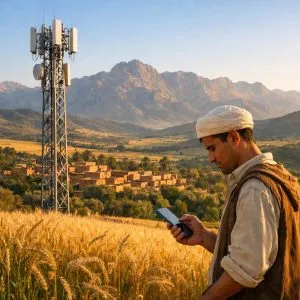
Alcomsat-1’s Ka-band broadband was designed precisely for this scenario. A single geostationary satellite can cover the entire southern territory without the per-kilometer cost of laying fiber across desert. The economics are stark: extending fiber 500 km from Adrar to a commune of 5,000 people costs millions of dollars and months of construction; installing a VSAT terminal costs a few thousand dollars and takes a day. For schools, clinics, and municipal offices in In Salah, Djanet, or Bordj Badji Mokhtar, satellite broadband is the only viable path to reliable connectivity.
The opportunity is wide open. Starlink, the LEO satellite broadband service operated by SpaceX, now operates in more than 25 African countries as of December 2025 and offers lower latency than geostationary alternatives. Algeria currently has a window of advantage: sovereign satellite capacity, ahead of regional LEO entrants, and unserved populations in the south. The next layer to build is a commercially structured satellite broadband offering — with affordable terminal subsidies, predictable monthly pricing, and an installation logistics chain — that transforms Alcomsat-1 from a government infrastructure tool into a connectivity solution for hundreds of thousands of underserved Algerians. As Alcomsat-1 approaches the midpoint of its operational life, the timing for that build is now.
Frequently Asked Questions
What is algeria in space?
Algeria in Space: Alcomsat-1, ASAL, and the Satellite Communications Infrastructure covers the essential aspects of this topic, examining current trends, key players, and practical implications for professionals and organizations in 2026.
Why is algeria in space important for Algeria?
This topic is significant for Algeria because it intersects with the country’s digital transformation goals, economic diversification strategy, and growing technology ecosystem. The article provides specific context for Algerian stakeholders.
How does alcomsat-1 capacity and utilization work?
The article examines this through the lens of alcomsat-1 capacity and utilization, providing detailed analysis of the mechanisms, trade-offs, and practical implications for stakeholders.
Sources & Further Reading
- Alcomsat-1 — Wikipedia
- Alcomsat-1 Communications Satellite — Airport Technology
- Algeria Launches Its Next-Generation Earth Observation Satellite Alsat-3A — Space in Africa
- Algeria Launches Second Satellite in 2026 — ConnectingAfrica
- Algeria Accelerates Space Program With Two Satellite Launches — Ecofin Agency
- Algerian Space Agency — Wikipedia
- Satellites, Starlink and the Race to Connect Africa — DevelopingTelecoms
- Chinese Long March 3B Launches Algeria’s First Telecom Satellite — SpaceNews