From Phase 1 to Phase 2: Scaling the Deployment
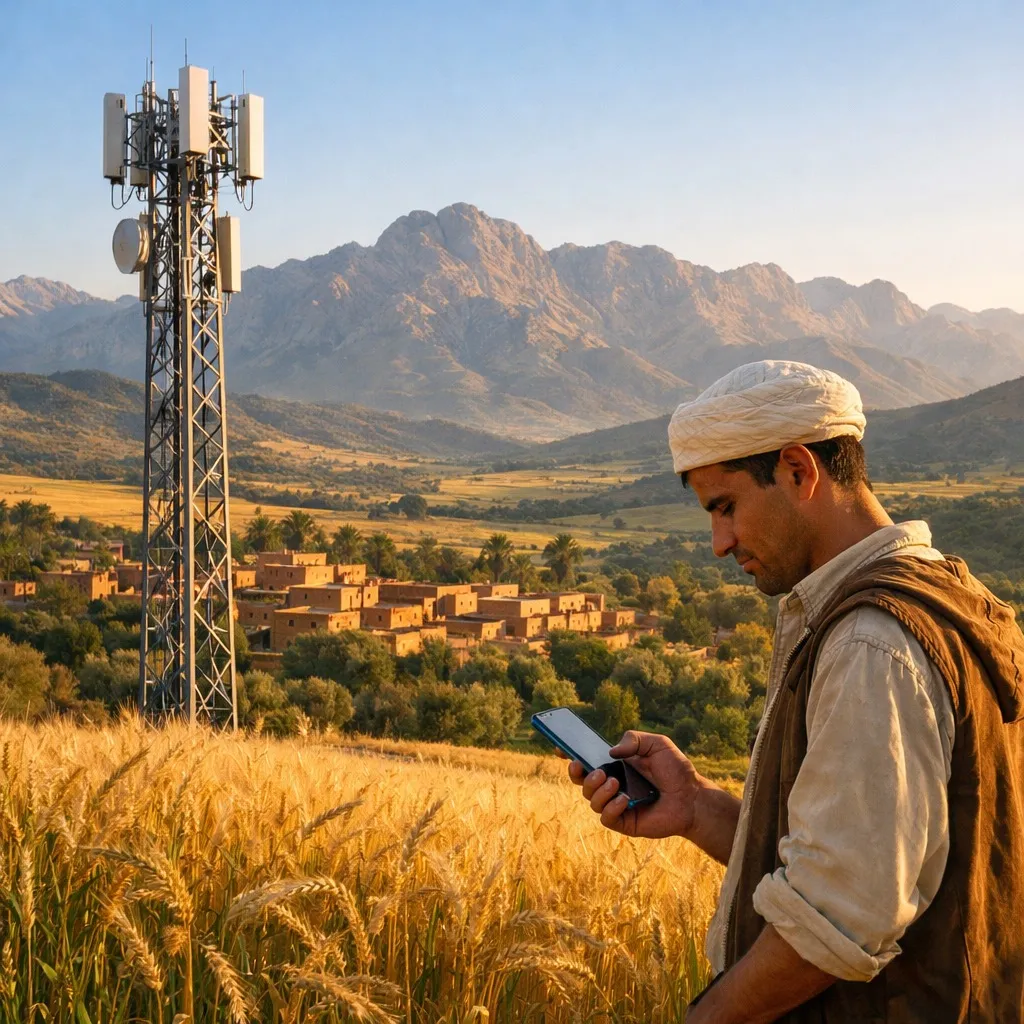
Drive two hours south of Algiers and the 4G signal that blankets the capital starts to fragment and disappear. For residents of the roughly 4,500 rural zones the government has identified as underserved — communities of 500 to 2,000 people scattered across the high plateaus, the Saharan Atlas mountains, and the deep south — reliable mobile connectivity remains more aspiration than reality.
Minister of Posts and Telecommunications Sid Ali Zerrouki announced the second phase of the national mobile coverage program in November 2024, targeting these communities specifically. Phase 1, now complete, covered 1,400 areas with 1,200 stations assigned and 800 already installed. Phase 2 aims to connect an additional one million people by the end of 2026, with the full 4,500-area program completing in 2027.
The scale of the challenge is difficult to overstate. Algeria is the largest country in Africa by area, spanning 2.38 million square kilometers — roughly equivalent to Western Europe from Portugal to Poland. Its population of approximately 47.4 million is heavily concentrated in the northern third of the country, with the Algiers metropolitan area accounting for about 3 million residents. The southern two-thirds, while vast, is home to only a small fraction of the population, yet these scattered communities are precisely the ones the program must reach.
Why Phase 2 Is Harder Than Phase 1
Phase 1 targeted communities within economically feasible reach of existing backbone infrastructure — areas where extending fiber or microwave backhaul to a new cell site was manageable relative to the population served. Phase 2 addresses what remains: communities further from backbone infrastructure, in more challenging terrain, with smaller populations that make per-capita economics less favorable.
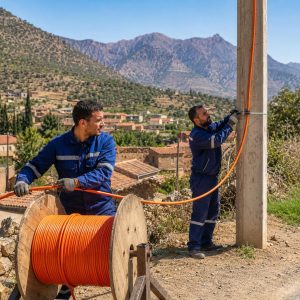
Many Phase 2 sites sit in the Hauts Plateaux between the Tell Atlas and Saharan Atlas ranges, in mountainous Kabylie and Aures regions, or in the deep Saharan south where distances between communities stretch hundreds of kilometers. Equipment must withstand temperatures exceeding 50 degrees Celsius, sand infiltration, UV degradation, winter ice loading in mountain zones, and lightning exposure on exposed peaks. Solar-hybrid power systems replace unreliable grid electricity at many sites. Roads may be unpaved or seasonal.
The infrastructure economics are stark. A base station near existing infrastructure might cost $50,000 to $100,000 to deploy, serving 5,000 or more people. The same station in a remote Saharan community can cost $200,000 to $400,000 while serving only 500 to 1,000 residents. This gap is why Algeria funds the program through a combination of universal service fund contributions from operators, direct government investment, and coverage obligations embedded in the 5G license terms awarded to Mobilis, Djezzy, and Ooredoo in July 2025 for a combined $492 million.
Advertisement
The Multi-Technology Stack
4G as the primary access layer
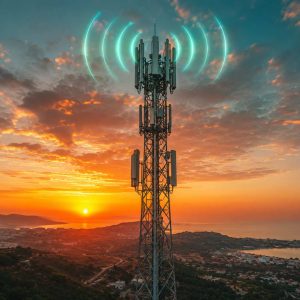
4G LTE is the workhorse. It offers the right balance: coverage range of 10 to 30 kilometers in open terrain, data capability sufficient for streaming and cloud applications, mature device ecosystem compatibility, and manageable deployment cost. The choice of 4G over 5G for rural areas is deliberate — Algeria launched commercial 5G in December 2025 for urban centers, but 5G’s advantages in bandwidth and latency serve high-density environments, not sparse rural ones. Low-frequency bands at 700 and 800 MHz maximize range per base station in rural deployment.
Fiber backbone and microwave last-mile
Algeria Telecom’s national backbone, recently upgraded to 400G WDM capacity in partnership with Huawei, provides the trunk infrastructure. A separate initiative announced in February 2026 adds 345 new 4G base stations across 44 provinces to strengthen capacity in high-demand areas. For rural sites, fiber spur routes extend from backbone nodes to intermediate points, with microwave radio links (operating in the 7 to 38 GHz range, spanning 10 to 50 kilometers) bridging the remaining distance to individual base stations.
Alcomsat-1 satellite for the most remote sites
For communities beyond the economic reach of terrestrial backhaul, Algeria deploys its Alcomsat-1 communications satellite — launched on 10 December 2017 from Xichang, China, aboard a Long March 3B rocket. The satellite, built by the China Academy of Space Technology on the DFH-4 platform, carries 33 transponders (19 Ku-band, 12 Ka-band, 2 L-band) from its geostationary position at 24.8 degrees West, covering Algeria’s entire territory.
Satellite backhaul connects a base station via VSAT antenna to the satellite, which relays the signal to a hub station on the terrestrial network. The tradeoff is latency — geostationary orbit at approximately 35,786 kilometers produces a round-trip delay of roughly 600 milliseconds. This is noticeable for voice calls but acceptable for data services. For communities with no alternative, satellite-backhauled 4G is transformatively better than no connectivity at all.
As terrestrial infrastructure extends, satellite-dependent sites can migrate to fiber or microwave backhaul — reducing latency and operating costs while making productive use of Algeria’s estimated $250 million investment in sovereign space infrastructure.
What Connectivity Enables on the Ground
The economic case extends beyond infrastructure. Agriculture accounts for approximately 13% of Algeria’s GDP, and rural connectivity enables real-time market price information, weather services, mobile banking, and logistics coordination that can measurably improve farm productivity. In the high plateau grain belt and the Saharan oasis date-palm regions, mobile broadband access translates directly into better-informed planting and selling decisions.
Healthcare benefits are equally concrete. Telemedicine connecting rural clinics to urban specialists via video consultation can reduce unnecessary travel and improve diagnostic accuracy in a health system that concentrates specialist care in major cities. Education gains follow the same pattern: online learning platforms and digital textbooks supplement limited rural school resources.
Algeria’s e-government initiatives — digital identity, online administrative procedures, mobile payment systems — are accessible only to connected citizens. The rural connectivity program has a governance dimension: enabling equitable service delivery regardless of location. The milestone of 3 million households connected to fiber-to-the-home services, announced by Minister Zerrouki in February 2026, underscores the broader ambition, but the last mile to remote communities remains the hardest to close.
Execution Risks and Milestones to Watch
Connecting 4,500 areas by 2027 requires deploying roughly 150 to 200 new sites per month across challenging terrain while extending backhaul infrastructure simultaneously. Supply chain availability for telecom equipment, spectrum coordination between operators in overlapping rural areas, land acquisition in remote locations, and a finite skilled workforce for tower construction and commissioning all pose execution risks.
The milestones to track: quarterly deployment counts, the ratio of satellite versus terrestrial backhaul at new sites, and — most critically — actual usage data from connected communities. Infrastructure built but unused represents investment without return. World Bank research suggests that a 10-percentage-point increase in broadband penetration correlates with approximately 1.4% GDP growth in developing economies, but that return materializes only when people adopt the services connectivity makes possible.
Algeria’s rural connectivity program is fundamentally an investment in national cohesion — an acknowledgment that the country cannot digitally transform while leaving a million citizens on the wrong side of the connectivity divide.
Frequently Asked Questions
How many rural areas will Algeria’s connectivity program cover?
The program targets 4,500 underserved rural areas in total. Phase 1 covered approximately 1,400 areas with 1,200 stations assigned and 800 installed. Phase 2 aims to connect an additional one million people by the end of 2026, with full completion of all 4,500 areas by 2027. These are communities of 500 to 2,000 residents beyond commercial operator reach.
Why does Algeria use 4G instead of 5G for rural deployment?
Algeria launched commercial 5G in December 2025 for urban centers, but 5G’s primary advantages — very high bandwidth and ultra-low latency — serve high-density environments. In rural areas with sparse populations, 4G provides more than adequate bandwidth per user while offering significantly better range per base station using low-frequency 700 and 800 MHz bands, reducing the number of sites needed to cover large areas.
How does the Alcomsat-1 satellite support the rural program?
Alcomsat-1, launched in December 2017, provides satellite backhaul for base stations in the most remote locations where extending terrestrial fiber or microwave links is prohibitively expensive. The satellite covers Algeria’s entire territory from geostationary orbit at 24.8 degrees West. As terrestrial infrastructure expands over time, sites can migrate from satellite to fiber or microwave backhaul, improving latency and reducing operating costs.
Sources & Further Reading
- Algeria Plans Mobile Network Expansion to 4,500 New Areas by 2027 — Ecofin Agency
- Algeria’s Connectivity Revolution: 4G for 1,400 Rural Communities — Telecom Review Africa
- Algeria’s 4G Expansion to Rural Areas Set to Drive Economic and Social Transformation — SAMENA Council
- Algeria Telecom Partners with Huawei to Deliver 400G WDM National Backbone — Huawei
- Algeria Awards 5G Licenses to Three Operators for Nearly $492 Million — Ecofin Agency
- Algeria Reaches Milestone as 3 Million Households Connect to Fibre Broadband — TechAfrica News