What Sony AI Actually Demonstrated
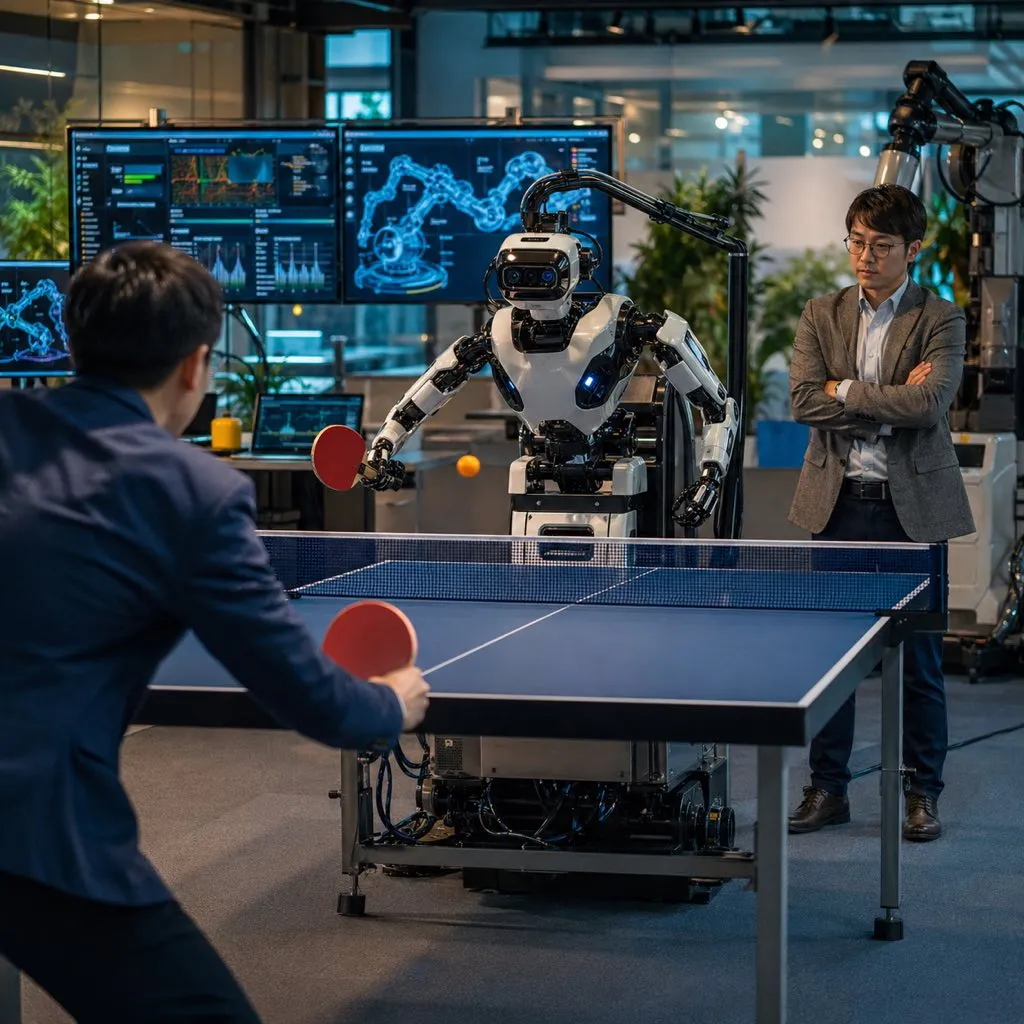
The Nature paper published on April 23, 2026 documents three rounds of competitive matches between Sony AI’s Ace robot and human table-tennis players. In the first round, Ace won 3 of 5 matches against elite-level human competitors and scored 16 “aces” (direct points after serving) compared with 8 collectively scored by all elite opponents. In December 2025, Ace defeated both elite players tested and one of two professionals. In March 2026, the system won at least once against all three professional opponents tested. These are not lab-controlled trick shots against compliant test subjects — they are real matches against players ranked at the top of the human distribution.
The technical specification published in Nature is what makes the result more than a sports headline. The robot achieved an over-75% return rate handling balls with spins up to 450 radians per second. It demonstrated reaction speed matching elite human players. And it adapted in real time to rare situations like net-bouncing balls — exactly the long-tail edge cases where most physical-AI systems fail in deployment. The combination of high return rate, elite-matching reaction speed, and edge-case adaptation is what justifies Nature’s editorial framing of the result as a breakthrough rather than an incremental advance.
The Three Systems That Make Ace Work
The hardware-software stack described in the Sony AI documentation has three integrated layers. First is perception: nine APS cameras built on Sony’s IMX273 sensors handle 3D ball tracking, while three gaze-control systems use IMX636 event-based vision sensors to measure ball spin in real time. Event-based sensors are the technical innovation that matters most here — they fire pixels asynchronously when a scene changes, rather than capturing full frames at fixed intervals. For a ball spinning at 450 rad/s, conventional frame-based vision either misses the spin signature entirely or requires impossibly high frame rates to catch it; event-based vision captures the change information directly with a fraction of the data load.
Second is decision-making, built on model-free reinforcement learning. Sony’s choice of model-free RL — rather than model-based RL or scripted behaviour trees — means the robot learned its returns by trial-and-error in simulation and then in physical practice, without an explicit model of physics or opponent strategy. The advantage is rapid adaptation without pre-programmed responses; the disadvantage is the famous data inefficiency of model-free RL. The fact that Sony made this work at elite human-competitive level suggests the simulation pipeline and the sim-to-real transfer are both solved well enough for production-grade deployment.
Third is the high-speed robotic apparatus itself. The arm and the gaze system have to physically reach the right point in space within reaction times that match elite human players — sub-100ms latency from ball-leaving-opponent’s-paddle to robot-arm-positioned-for-return. That mechanical capability is the hardest commodity to acquire in robotics today, and Sony has long-running expertise from its imaging-sensor and consumer-electronics product lines.
Why This Is a Breakthrough for Physical AI
Physical AI — the term that Jensen Huang and the NVIDIA leadership have used heavily in 2025 and 2026 to describe robotics with foundation-model-style learning — has been promised for several years. Boston Dynamics’ Atlas, Figure AI’s humanoids, Tesla’s Optimus, 1X’s NEO, Agility Robotics’ Digit, and the wave of Chinese humanoid programmes have all produced impressive demos. What has been scarce is rigorous evidence of physical AI competing successfully against expert humans in real-time adversarial environments. Most published physical-AI demos are scripted, single-task, or evaluated against benchmarks the demonstrating team designed.
Sony’s Project Ace clears a different bar. The opponents are top-distribution human professionals. The matches are competitive games, not curated trick shots. The publication venue is Nature, the most reviewed scientific journal in the field. And the technical stack — event-based perception plus model-free RL plus high-speed mechanical execution — is the same recipe that physical-AI researchers have been promising would work at scale. Ace is not the first robot to play table tennis, but it is the first to convincingly outplay professional humans in published, peer-reviewed, real-match conditions.
Advertisement
What Ace Tells Us About the Robotics Stack
The most consequential lesson is sensor-stack-specific: event-based vision is now production-validated for high-speed adversarial robotics. Sony has been the dominant manufacturer of event-based sensors (the IMX636 used in Ace is a Sony Semiconductor product), and Project Ace effectively turns the company’s sensor IP into a robotics application showcase. Expect the next 12-18 months to see event-based vision integrated into a wave of physical-AI products — drone navigation, autonomous-vehicle edge cases, surgical robotics, and high-speed industrial sorting — by teams who saw the Nature paper and now have a real-world reference deployment.
The second lesson is reinforcement-learning-specific: model-free RL works at elite human-competitive level when the simulation is good enough and the mechanical execution is fast enough. Robotics researchers have argued for years about whether model-based or model-free RL is the right path for physical AI. Sony’s published result is a data point — not a settlement of the debate, but a strong existence proof that model-free RL can clear the highest competitive bar with the right surrounding stack. Founders building applied robotics ventures should treat this as evidence that the model-free path is viable for production, not just for research.
What Robotics Founders and Enterprise Buyers Should Do Now
1. Audit your perception stack against event-based sensor capability before scaling
If you are building any robotics or physical-AI product that involves high-speed motion, adversarial environments, or rare-event handling, your current frame-based perception stack may be the single largest constraint on your product’s ceiling. Sony’s Project Ace demonstrates that event-based vision is the difference between “demo-quality” and “elite-human-competitive” on the perception axis. Before your next prototype iteration, run a sensor-substitution analysis: would your hardest failure mode (occlusion, motion blur, spin estimation, edge-case timing) become tractable with an IMX636-class event sensor? If yes, factor the sensor cost and integration timeline into your roadmap now.
2. Evaluate model-free RL as a production candidate, not just a research toy
Many robotics teams have shelved model-free RL after early sim-to-real disappointments and have defaulted to scripted behaviour trees plus learned modules. Project Ace is published evidence that a well-instrumented model-free RL stack can produce production-grade behaviour at elite human-competitive level. Re-open the model-free RL evaluation for your specific application, with two questions: how good is your simulation fidelity, and how fast is your mechanical execution? If both are strong, model-free RL is now a credible production path. If either is weak, fix that first before evaluating RL choices.
3. Plan your sensor supply chain assuming event-based vision becomes commodity
Sony’s market dominance in event-based sensors will shift over the next 24-36 months as Samsung, OmniVision, and Chinese imaging vendors invest in competing products. The lesson for robotics buyers and integrators is to design sensor-agnostic perception stacks now: abstract the event-stream API, avoid hard-coding to a single vendor’s calibration profile, and run procurement with at least two sensor sources in mind. Robotics teams that locked into proprietary sensor APIs in 2018-2020 paid heavy switching costs in 2023-2025 when supply-chain economics shifted; the lesson is repeating with event-based vision today.
4. Set your physical-AI evaluation bar against published peer-reviewed results
The flood of physical-AI demo videos on social media in 2025 and 2026 has created an evaluation problem: it is genuinely difficult for an enterprise buyer to distinguish a curated 30-second highlight reel from a robust production-ready capability. Sony’s Nature publication sets a useful new bar. When evaluating a robotics vendor’s physical-AI claims, ask: what is the equivalent competitive evidence? Has the system been tested against expert humans in real adversarial conditions? Has the result been peer-reviewed? Vendors who cannot answer these questions clearly are still at the demo stage, regardless of their valuation.
The Bigger Picture
Sony’s Project Ace publication is the strongest evidence to date that physical AI is moving from demos to deployments. The next 12-18 months will see the same recipe — event-based perception, model-free RL, high-speed mechanical execution — applied to a wide range of adversarial robotics problems. Some will succeed and produce category-defining products. Many will fail and reveal that table-tennis was a relatively well-defined problem compared with warehouse manipulation, surgical robotics, or autonomous driving in unstructured environments.
What Project Ace reveals about the broader physical-AI race is that hardware-IP-rich incumbents like Sony, Honda, and the established imaging-sensor vendors have a structural advantage that the pure-software AI labs do not. The frontier in physical AI is not just the model — it is the sensor, the actuator, the mechanical execution layer, and the integration of all three. Companies with deep imaging-sensor and consumer-electronics product lines are positioned to convert that IP into physical-AI applications faster than software-first labs can vertically integrate. The competitive map of physical AI in 2027 may look more like the consumer-electronics industry than the foundation-model industry.
Frequently Asked Questions
What is Sony AI’s Project Ace?
Project Ace is an autonomous table-tennis robot developed by Sony AI and documented in a Nature paper published April 23, 2026. The system combines nine APS cameras with Sony IMX273 sensors for 3D ball tracking, three gaze-control systems with IMX636 event-based vision sensors for spin measurement, model-free reinforcement learning for decision-making, and high-speed robotic hardware. It defeated elite-level players 3-of-5 matches and won at least once against all three professional opponents tested in March 2026.
Why does the Nature publication matter beyond table tennis?
The publication validates a specific physical-AI recipe — event-based perception plus model-free reinforcement learning plus high-speed mechanical execution — under peer review and against expert human opponents in real-time adversarial conditions. Most prior physical-AI demonstrations were curated single-task showcases. Project Ace is the strongest evidence to date that this technical stack can clear the highest competitive bar in real deployment, with implications for industrial robotics, surgical robotics, drones, and autonomous vehicles.
What should a robotics or AI founder learn from this result?
The most actionable lessons are: event-based vision is now production-validated for high-speed adversarial robotics; model-free reinforcement learning is a credible production path when simulation fidelity and mechanical execution are both strong; hardware-IP-rich incumbents have structural advantages over software-first labs in physical AI; and peer-reviewed competitive evidence is now a useful evaluation bar when assessing vendor claims about robotics capability.
Sources & Further Reading
- Sony AI Announces Breakthrough Research in Real-World Artificial Intelligence and Robotics — Sony AI
- Inside Project Ace: The Robot Athlete That Competes With Professional Table-Tennis Players — Sony AI
- Sony AI Project Ace Table Tennis Robot — Interesting Engineering
- Ping-Pong Robot — The Japan Times
- Sony AI’s Ace Robot Beats Elite Table Tennis Players in Real-World Matches — TechStartups