What the MoU Actually Established
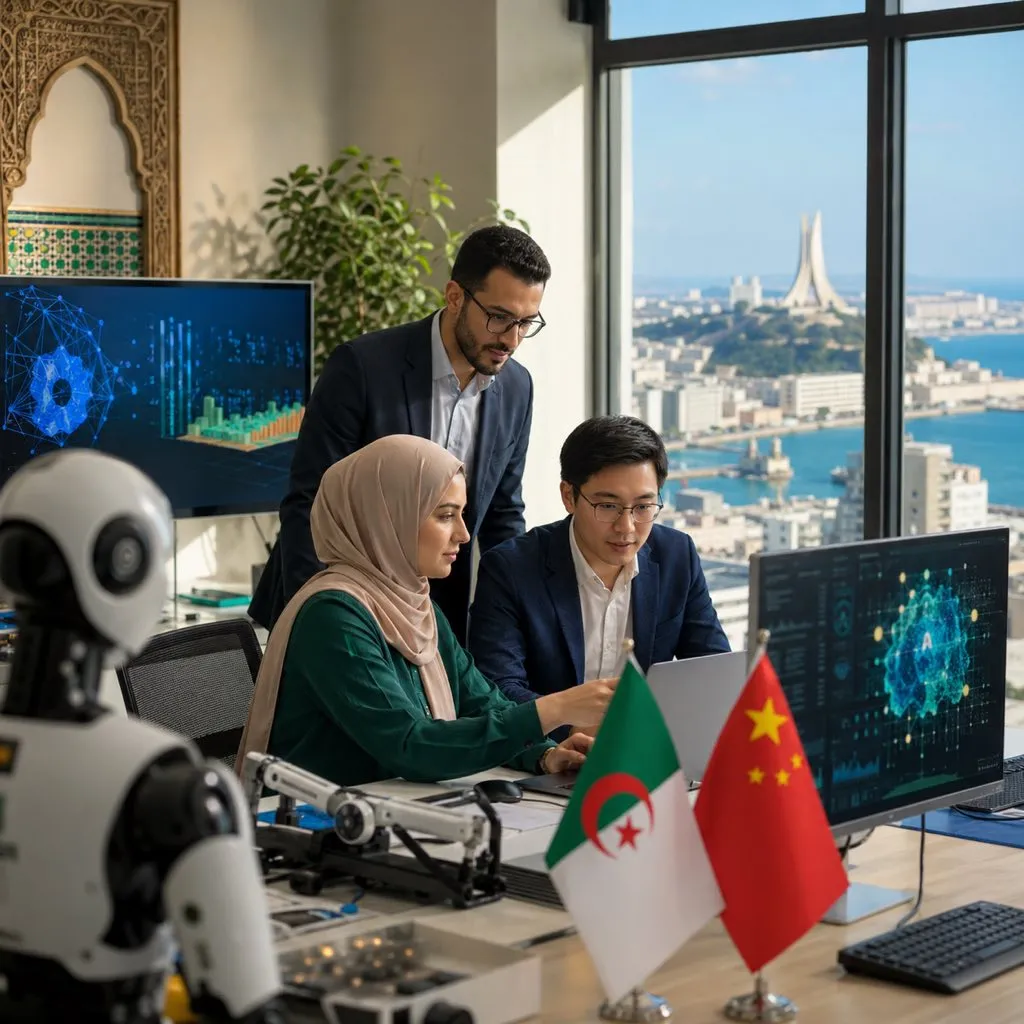
The Memorandum of Understanding signed on March 12, 2025 between ENSIA and Tsinghua University’s Institute for AI Industry Research (AIR) committed both institutions to establishing a China-Algeria Joint Laboratory for Artificial Intelligence. ENSIA, established in 2021 and ranked by Times Higher Education among Algeria’s most internationalised AI research institutions, becomes the Algerian anchor. Tsinghua AIR — the industry-facing arm of one of China’s three apex AI research universities, alongside Peking University and the Chinese Academy of Sciences — becomes the Chinese anchor.
The MoU is not a standalone agreement. As ENSIA’s announcement makes clear, it builds on the Memorandum of Understanding on the Joint Construction of the China-Algeria Technology Transfer Centre, signed on July 18, 2023 between Algeria’s Ministry of Higher Education and Scientific Research and China’s Ministry of Science and Technology. That earlier ministry-level MoU established the policy and funding scaffolding under which institutional partnerships like ENSIA-Tsinghua can operate. The 2025 MoU is the operational layer that names a specific Algerian school, a specific Chinese partner, and a specific deliverable — a joint laboratory rather than a generic cooperation declaration.
Why a Tsinghua Partnership Matters Differently
For Algerian AI research, the choice of partner is decisive. Tsinghua’s AI Research Institute is led by computer scientist Ya-Qin Zhang and has been one of the most prolific publishers in the Chinese AI ecosystem on autonomous driving, foundation-model alignment, and AI for science. The institute also operates as a translation engine between academic research and industrial pilots — its alumni and spin-outs populate Baidu, Alibaba, ByteDance, and the open-source frontier models that have reshaped the global AI cost curve in 2024 and 2025, including DeepSeek and Qwen.
A direct Tsinghua AIR bridge therefore gives ENSIA-trained doctoral candidates and faculty access to a research network that is currently competitive with Stanford and CMU in publication volume and arguably ahead in industrial deployment velocity. For Algeria, which has historically routed its strongest AI researchers through France and the United States, the Tsinghua connection is the first institutional bridge to the Chinese AI research ecosystem at peer-school level. It complements rather than replaces existing Western academic ties, and it widens the pool of co-authors, equipment access, and post-doctoral opportunities available to Algerian researchers.
What the MoU Does and Does Not Specify
ENSIA’s published announcement is deliberately spare on operational details. It does not specify named officials beyond the institutional signatories, does not name research focus areas for the joint laboratory, does not disclose funding amounts, does not give a physical location for the lab beyond ENSIA’s general Sidi Abdellah campus, and does not detail student or faculty exchange programmes. That spareness is consistent with how MoUs at this level typically work in the Chinese academic system: the framework agreement is signed first, and detailed work programmes are negotiated by working groups across the following 12-24 months.
For Algerian observers, the absence of specifics means the strategic question is not “what was signed” but “what will be loaded onto the framework.” The most consequential decisions — whether the lab will focus on generative AI, computer vision, AI for healthcare, or AI for energy systems; whether it will host an annual exchange of doctoral candidates; whether it will produce co-authored papers and shared datasets — will be made in working-group meetings that have not yet been publicly reported. Algerian researchers and founders who want to influence the lab’s research agenda need to engage with ENSIA leadership now, not after the work programme is locked.
Advertisement
Where This Sits in Algeria’s Broader China Track
The ENSIA-Tsinghua MoU is one node in a denser China-Algeria digital cooperation architecture that has accelerated since 2023. The July 2023 ministry-level MoU on the Technology Transfer Centre was followed by Huawei’s expansion of its ICT Academy footprint and its joint vocational training programme with the Ministry of Vocational Training, by Chinese involvement in Algeria’s national data-centre buildout, and by the Sidi Abdellah AI and cybersecurity startup cluster inaugurated on April 20, 2026 — three weeks before this article. The ENSIA-Tsinghua bridge is the academic-research layer that complements the vocational and infrastructure layers already in flight.
What this means in practice is that Algerian AI talent is increasingly being trained, equipped, and credentialed inside an architecture in which Chinese institutions occupy strategic nodes. That architecture coexists with continuing French, U.S., and EU partnerships — Algeria has not signalled a strategic exclusivity. But the rate of new Chinese institutional ties is materially higher than the rate of new Western ties over the 2023-2026 period, and the cumulative effect is that an Algerian AI graduate in 2027 is more likely to have a Tsinghua-AIR co-author or a Huawei-trained certification than they would have been in 2022.
What Algerian Researchers and Founders Should Do Now
1. Engage ENSIA leadership before the joint-lab work programme is locked
The 12-24 month window between MoU signing and operational work programme is the only window where Algerian researchers can shape the lab’s research agenda. If you have a research question that fits ENSIA’s strengths and Tsinghua AIR’s interests — AI for energy systems, North African Arabic NLP, agritech computer vision, post-quantum cryptography — write a 2-page concept note now and request a meeting with the relevant ENSIA department head. Concept notes that arrive after the work programme is locked typically end up in a queue for the next biennium.
2. Build a co-authorship strategy that includes Chinese venues
The publication strategy of an Algerian doctoral candidate matters more than the prestige of the supervising school. Co-authoring with a Tsinghua AIR researcher in a venue that is read by both Western and Chinese AI communities — NeurIPS, ICML, AAAI, or specialist venues like ACL for NLP — gives an Algerian PhD a dual visibility that single-country supervision cannot provide. Plan the publication strategy backward from a target venue, not forward from supervisor availability. Founders Network and academic mentorship guides have written extensively on this for early-career researchers.
3. Map the joint lab’s likely focus areas to your venture’s data assets
If you are an Algerian founder building a deep-tech venture, the joint lab will eventually issue calls for industrial pilots, shared datasets, or applied-research collaborations. Founders whose ventures sit on a useful data asset — anonymised health records from a partner hospital, agricultural sensor data from a wilaya programme, energy-grid telemetry from Sonelgaz, Arabic-language transcripts — will be the most attractive industrial counterparts. Spend the next 6-12 months building data-access agreements with sectoral partners; do not wait for the lab to ask. Ventures with no data asset and no compute asset have nothing to bring to the table.
4. Secure your IP position before signing any joint-research arrangement
Joint laboratories with Chinese institutional anchors operate under different IP defaults than U.S. or EU partnerships. Before signing any joint research agreement, founders and faculty should secure: explicit ownership terms for pre-existing IP, defined publication rights for both parties, named provisions for follow-on commercialisation rights, and a clear position on whether Chinese export-control rules or Algerian state-IP rules apply to specific outputs. These are not theoretical concerns — they are the operational details that determine whether a joint paper or joint patent benefits both anchors equally or asymmetrically. Get specialist legal advice before signing.
The Bigger Picture
The ENSIA-Tsinghua MoU should be read alongside the April 20, 2026 Sidi Abdellah cluster inauguration as two halves of a single strategic move. The cluster is the venture-creation layer; the joint laboratory is the research-and-talent layer. Together they define what Algeria’s AI policy actually looks like in 2026: vertically focused on AI and cybersecurity, anchored to a single Sidi Abdellah campus, governed by tri-ministerial coordination, and increasingly tied to a Chinese institutional ecosystem at both the vocational and tier-one academic levels.
What this reveals about the broader Algerian playbook is that the country has chosen not to build sovereign AI capability solely through its own university system or solely through Western partnerships. The chosen path is a hybrid: keep the Western and French ties for diaspora-mediated talent flows and EU programmes, add Chinese institutional ties for industrial deployment velocity and frontier-model expertise, and concentrate both at a single national school. Whether the hybrid produces compounding returns or strategic ambiguity will be visible by 2028 in the publication output, the patent flow, and the venture exits that come out of Sidi Abdellah.
Frequently Asked Questions
What is the ENSIA-Tsinghua joint AI laboratory?
It is a planned research laboratory established under a Memorandum of Understanding signed on March 12, 2025 between Algeria’s National School of Artificial Intelligence (ENSIA) and Tsinghua University’s Institute for AI Industry Research (AIR). The lab is anchored at ENSIA’s Sidi Abdellah campus and is intended to produce joint research, shared talent flows, and applied AI projects between Algerian and Chinese researchers.
How does this fit with Algeria’s broader China cooperation?
The MoU extends a ministry-level Memorandum on the Joint Construction of the China-Algeria Technology Transfer Centre, signed on July 18, 2023 between Algeria’s Ministry of Higher Education and Scientific Research and China’s Ministry of Science and Technology. It complements other cooperation tracks including Huawei’s ICT Academy footprint, vocational training MoUs, and Chinese involvement in Algeria’s national data-centre programme.
What should Algerian researchers do to engage with the joint laboratory?
Engage ENSIA leadership before the joint-lab work programme is locked. The window between MoU signing and operational work programme — typically 12-24 months — is when research priorities are decided. Researchers should submit concept notes that match ENSIA strengths and Tsinghua AIR interests, plan publication strategies that include venues read by both Western and Chinese AI communities, and prepare data assets that make their ventures attractive industrial counterparts.