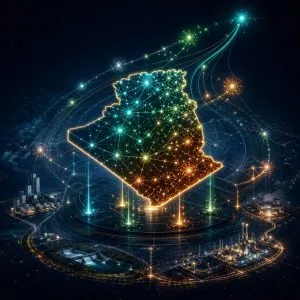
What the 500-Project Pledge Actually Committed To
On 25 December 2024, the High Commissioner for Digitisation Meriem Benmouloud announced that Algeria would implement more than 500 digital projects between 2025 and 2026 as part of the National Digital Transformation Strategy (SNTN), positioned under the broader “Digital Algeria 2030” umbrella. According to coverage by Telecom Review Africa and Techpression, 75% of those projects target the modernisation of public services. Two anchor deliverables were named explicitly: an Interactive National Portal for Digital Services, and an interoperability platform designed to centralise procedures, reduce unnecessary travel, and improve information access for remote communities.
The headline economic ambition is to lift the digital sector’s share of GDP to 20% by 2030. That figure is the benchmark every operator and SME should track, because it implies a multi-year procurement and integration pipeline of a different magnitude than the country has seen before. The reference point in 2024 was a 0.5956 score on the UN E-Government Development Index, ranking Algeria 116th of 193 countries — a modest improvement from the 0.5611 scored in 2022 but still well below the regional leaders.
What Has Shipped So Far — The Mid-2026 Snapshot
Three categories of progress are visible in the public record at the end of April 2026.
The first is fixed-broadband infrastructure. As of February 2026, Algerie Telecom has connected 3 million homes to fibre-to-the-home, up from approximately 53,000 in November 2020 — a roughly 56× expansion in five years, announced by Sid Ali Zerrouki, Minister of Post and Telecommunications, in a 20 February 2026 video message. Effective 13 April 2026, Algerie Telecom raised the baseline FTTH tier from 60 Mbps to 100 Mbps and doubled the ADSL baseline from 10 Mbps to 20 Mbps at no additional cost. The “All Fiber” plan targets generalised fibre coverage, the phase-out of copper, and 7 million households on fixed internet by end-2027.
The second is the postal and payments rail. Algerie Poste launched CCP Business Cashless on 5 March 2026, opening commercial CCP accounts and BaridiMob QR acceptance to merchants, entrepreneurs, and SMEs for the first time. This is a foundational interoperability project that connects the postal payment rail to the merchant economy, and it ships exactly the kind of “modernise public services” deliverable the SNTN promised.
The third is convening and standards. Algiers is positioning itself as the venue for the Global Africa Tech 2026 digital sovereignty summit, with the country’s 3-million FTTH milestone, fastest-residential-fibre tier (Algeria became the first African market to offer 1.6 Gbps residential FTTH in August 2025), and a fresh 5G launch as the headline credentials.
Advertisement
What Has Not Yet Shipped at Visible Scale
The interactive national portal and the interoperability platform — the two named anchor deliverables — do not yet have a single public URL that aggregates ministry services with measurable usage. The 2024 EGDI score of 0.5956 is a snapshot taken before the SNTN execution window began, so the next ranking cycle (2026 update) will be the first independent read on whether the 500-project programme is moving the needle. E-commerce penetration, B2B procurement digitisation, and cross-ministry data interoperability — the dimensions that drive real digital-GDP capture — remain partially executed in April 2026, and the pace of inter-agency integration is the binding constraint, not the network layer.
What this means for Algerian operators and SMEs
1. Treat the FTTH 100 Mbps baseline as a 2026 product-design assumption, not a 2027 hope
Any consumer or SaaS product launching in Algeria in 2026 should design for a 100 Mbps household baseline and a 20 Mbps ADSL fallback, with 1.6 Gbps as the premium tier where the addressable customer warrants it. That is a fundamentally different envelope from the 8-20 Mbps assumption Algerian product teams used in 2022-2024. The practical implication is that streaming, cloud-native SaaS, video-conferencing, and even on-device AI inference become viable mass-market features rather than premium ones. Re-spec your product roadmap against the new baseline before a competitor does — and use the new tier explicitly in marketing, because “designed for fibre Algeria” is a credible 2026 differentiator.
2. Build your e-government integration roadmap around the interoperability platform, not around individual ministries
The named anchor deliverable is a national interoperability platform — the equivalent of Estonia’s X-Road — that centralises procedures across ministries. If you are building any product that touches identity, business registration, tax, customs, or licensing, your integration roadmap should assume the platform becomes the canonical entry point in 2026-2027 rather than ministry-by-ministry portals. Put a placeholder integration epic on your backlog now; track public RFPs and MNT (Ministère de la Numérisation) communications quarterly; and resist the temptation to build deep custom integrations with individual ministry endpoints that the platform will eventually deprecate.
3. Position Algerie Poste rails as your default payment integration, with banking as a complement
Because CCP Business Cashless is now live and BaridiMob is the dominant rail by transaction volume and value, the realistic 2026 default for any merchant-facing or consumer-facing product is to integrate Algerie Poste first, then add CIB/SATIM as a complementary tier. Operators that lead with banking-rail integration in 2026 are starting at the smaller end of the addressable market and adding 6-9 months of certification time before they see Day-1 transactions. Lead with the post, layer the bank later — that is the sequence the SNTN execution and the CERIST transaction data both point to.
4. Audit your 5G dependency assumptions before committing to roadmap
Algeria’s 5G launch is now part of the public record, but 5G coverage at scale across all 58 wilayas will be a 2027-2028 build-out, not a 2026 reality. If your product roadmap assumes 5G-grade latency or capacity by end-2026 in second-tier cities, derate that assumption to “Algiers, Oran, Constantine, Annaba” plus business districts in 2026, with broader coverage as a 2027 expansion. Keep your application-layer design 4G-resilient as the floor; treat 5G as an opt-in premium experience until ARPCE publishes coverage-area data that justifies a different posture.
5. Schedule a Q1-2027 reckoning against the 500-project milestone, not a Q4-2026 one
The 500-project programme runs through end-2026 by the original announcement, but the real evidence — measurable launches, user adoption, EGDI score, digital share of GDP — will only crystallise in Q1-Q2 2027. Build your strategic-planning cadence accordingly: a major review of Algeria’s digital-economy posture in Q1 2027 will give you cleaner data than a December 2026 snapshot, which is too close to the deadline to capture real outcomes. Investors and SME operators alike should resist the optical “did they ship 500?” framing and focus instead on the 2027 EGDI cycle, the digital-GDP estimate, and the named anchor platforms’ usage telemetry.
What Comes Next
The 16-month report on the SNTN points to a country that has executed strongly on the network and rails layers — fibre, postal payments, 5G — and is still in mid-stride on the application and interoperability layers, where digital GDP is actually generated. That sequencing is not unusual; it mirrors what Estonia, Saudi Arabia, and Singapore experienced in their own digital-government build-outs. What matters now is the second-half cadence: visible ministry-to-platform onboarding, measurable e-service usage, and the first cross-cutting use cases (a single-window business registration, a mobile-first national identity wallet, a shared health-record exchange) that justify the 20%-of-GDP narrative. For private operators, the strategic posture is patience-with-instrumentation: keep building against the new baseline, track public-portal launches monthly, and be ready to integrate at the platform level the moment the canonical APIs go live. The pledge has bought a 24-month window of policy clarity. The next 12 months will tell us whether the national stack ends 2027 as a cited reference architecture or as a still-in-progress promise.
Frequently Asked Questions
What has Algeria actually delivered under its 500-digital-projects pledge at the 16-month mark?
The most visible deliverables at April 2026 are infrastructure: Algerie Telecom has connected 3 million households to FTTH (up from 53,000 in 2020), raised the baseline tier to 100 Mbps effective April 13 2026, and launched 5G. On the payments rail, Algerie Poste launched CCP Business Cashless on March 5 2026, enabling merchant QR acceptance for SMEs and entrepreneurs. What has not yet shipped at visible scale are the two named anchor deliverables — an Interactive National Portal for Digital Services and the national interoperability platform — which have no single public URL aggregating ministry services with measurable usage.
Why should Algerian product teams prioritise BaridiMob over CIB-SATIM in their 2026 payment integrations?
The CERIST-indexed transaction research confirms BaridiMob and the postal Edahabia card dominate Algerian digital payment volume and value. Algerie Poste’s CCP Business Cashless launch in March 2026 extended the postal stack to merchant checkout, meaning a 2026 product can get a small retailer accepting BaridiMob in 48 hours versus weeks for a SATIM POS deployment. Starting with CIB-SATIM integration puts a product team at the smaller end of the addressable market for 9-12 months of certification time before Day-1 transactions — a sequencing error that multiple 2023-2024 operators made.
When is the right checkpoint to assess whether Algeria’s digital transformation hit its 500-project target?
Not December 2026 — that snapshot is too close to the deadline to capture real adoption outcomes. The right checkpoint is Q1-Q2 2027, when the 2026 UN E-Government Development Index update will provide independent measurement, when digital-GDP share estimates will be published, and when the national interoperability platform’s actual usage telemetry (if it launches) will be visible. Operators and investors who treat a December 2026 “did they ship 500 projects?” count as the signal will miss the more meaningful indicators: measurable e-service adoption, cross-ministry data flows, and the 20%-of-GDP metric trajectory.
Sources & Further Reading
- Algeria to Launch Over 500 Digital Projects by 2026 — MEA Tech Watch
- 75% of Algeria’s Digital Projects to Focus on Modernizing Public Services — Telecom Review Africa
- Algeria Reaches 3 Million Fibre Households Milestone — TechAfrica News
- Algeria Unveils Strategy to Boost Digital Economy with 500+ Projects — Techpression
- Algeria Digital Economy — US Trade.gov Country Commercial Guide