The Number That Broke the Grid-Planning Model
For two years, the story of the AI boom has been told in gigawatts. Every hyperscaler announcement, every “5 GW supercluster,” every utility interconnection filing has been read as a signal of real, committed demand. In August 2026 that reading collapsed under its own arithmetic.
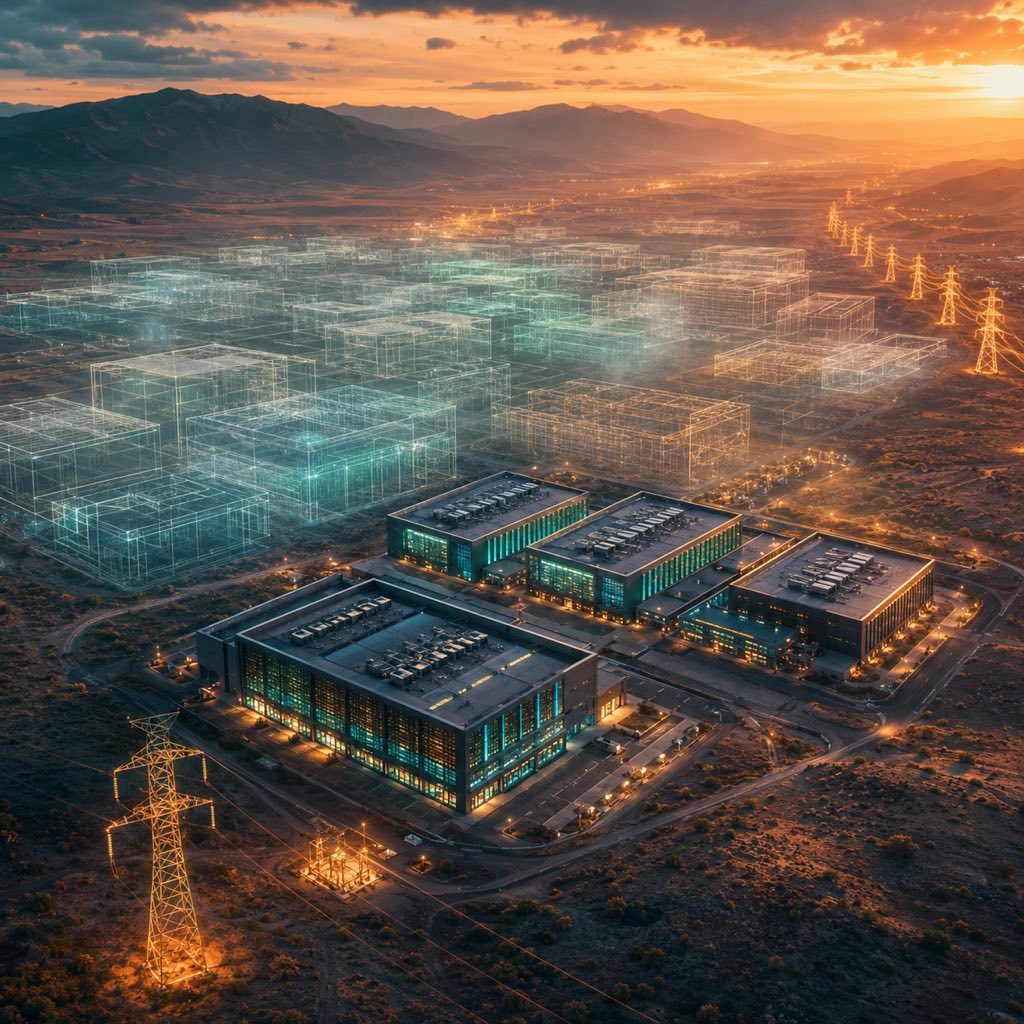
A Wood Mackenzie analysis first reported by Bloomberg on 12 August 2026 found that US grid operators are now fielding 1,066 gigawatts of data center requests but will realistically commit to only about 28% — roughly 298 gigawatts. That leaves close to 768 GW as what the industry has started calling “phantom” demand. To grasp the scale of the raw number, these requests represent roughly 83% of the nation’s entire utility-scale generation capacity at the end of last year, per US Energy Information Administration data — as if AI planners had asked to nearly double the American grid in a handful of years.
This is not a rounding error. It is a structural flaw in how the world has been measuring the AI infrastructure race — and it reframes a debate that has driven trillions in capex commitments, nuclear restarts, gas-turbine backlogs and sovereign-cloud strategy from Texas to Algiers.
How the Queue Became a Mirage
The mechanism is almost embarrassingly simple. Data center developers, uncertain which utility could deliver power fastest and cheapest, filed the same project as separate interconnection requests at multiple utilities and multiple sites — then kept every option open until one penciled out. As one analysis of the Wood Mackenzie findings put it, each request “counted as a real demand signal in interconnection queues” while “none required meaningful financial commitment upfront”.
Because interconnection applications are non-binding and cheap to file, there was no penalty for hedging. A single campus filed across five queues shows up five times over — i.e., its megawatts counted several times as separate “demand.” Grid planners, utilities and policymakers then aggregated those duplicative bids and treated the sum as a load forecast — the basis for generation build-outs, transmission upgrades and, in some states, emergency energy legislation.
Wood Mackenzie had already flagged the gap in a quieter form. Its April 2026 electrical-equipment analysis found roughly 600 GW of data center projects still searching for power capacity against just 183 GW that had actually signed construction or electricity-supply agreements — a firm-commitment rate near 23%. Ben Hertz-Shargel, Wood Mackenzie’s Global Head of Grid Edge, has tied the distortion to a wave of new, speculative developers whose projects disproportionately target the US South and Southwest, where land and interconnection promises are easy to secure but firm power is not.
Texas Is the Canary
Nowhere is the phantom queue more visible than Texas. ERCOT, the state’s grid operator, is tracking about 474 GW of connection requests — with roughly 90% of it from data centers — a figure more than five times the grid’s actual peak demand. That is not a forecast anyone can build to; it is a queue stuffed with optionality.
The state has started treating it as a risk rather than a bonanza. Governor Greg Abbott ordered an audit of data center projects on 3 August 2026, a move that puts an estimated $13 billion in industry revenue at risk and threatens to delay almost a fifth of America’s data center pipeline. Independent analysts are even more skeptical than Wood Mackenzie: Rapidan Energy Group’s Glenn Schwartz estimates only 20–30% of the sought-after power will reach projects that actually get built, and Rystad Energy calculates that only about 14% of applications on the main Texas grid are legitimate.
The consequence of over-counting is not merely embarrassing spreadsheets. When a grid operator plans firm generation, transmission and reserve margins around 474 GW of requests, ratepayers and taxpayers can end up funding infrastructure for load that never arrives — the classic stranded-asset problem, at national scale.
Advertisement
What the Real Number Probably Is
Strip out the duplicates and speculation, and a more sober picture emerges. Wood Mackenzie projects US data center capacity reaching roughly 110 GW by 2030, up from about 24 GW in 2026 — a genuine near-quintupling that is historically enormous, but a fraction of the 1,066 GW headline. On the delivery timeline, a Bernstein analysis cited in the coverage judged a target of about 88 GW by the end of 2028 “highly unlikely,” and pegged even the credible slice of the pipeline as a five-to-ten-year build rather than an overnight surge.
The takeaway is not that AI demand is fake. It is that the shape of the demand has been badly misread: real, large and durable, but slower, more concentrated in a few firm projects, and far below the queue-implied ceiling. Distinguishing the two is now the single most valuable skill in infrastructure planning.
What This Means for Algerian and African Infrastructure Planners
Algeria is not filing 500 MW interconnection requests — but the phantom-demand lesson lands directly on how the country and its neighbors should read the global AI-infrastructure story before committing scarce capital and power.
1. Discount hyperscaler “gigawatt” headlines by at least two-thirds before planning around them
When a global cloud provider or regional partner floats a multi-hundred-megawatt campus, treat it as an option, not a commitment. Wood Mackenzie’s data shows firm commitments running near a quarter of announced requests; apply the same haircut to any pipeline pitched into North Africa. Base Algeria’s own capacity planning on signed power-supply agreements and paid deposits, not press releases.
2. Make interconnection requests binding — design the queue the West wishes it had
The phantom-load crisis is a governance failure the US backed into. Algeria and African regulators building their first large data-center connection frameworks can leapfrog it by requiring meaningful deposits, milestone payments and single-filing rules from day one. A queue with financial skin in the game produces a load forecast Sonelgaz can actually plan generation around.
3. Treat power, not permits, as the binding constraint on any national cloud ambition
Algeria’s national program targets 22 GW of renewable capacity by 2030, a build-out spread across the whole decade. Meanwhile a single Western AI supercluster now plans for 5 GW on its own. That math should reframe every “sovereign cloud” conversation: the question is not whether Algeria can license a facility, but whether it can firm the power without cannibalizing households and industry.
4. Position renewables and gas as the arbitrage, not the afterthought
The US phantom queue exists partly because firm power is scarce and slow. Algeria’s comparative advantage — abundant gas plus a large, underbuilt solar resource — is exactly what stranded Western projects lack. A credibly-powered, right-sized facility in Algeria beats a speculative gigawatt that never energizes. Sell firm electrons, not floor space.
The Correction Scenario
The phantom-demand revelation is the first crack in the AI-infrastructure narrative that markets have not been able to wave away, because it comes from the grid operators themselves. If Wood Mackenzie, Rapidan and Rystad are even roughly right, then a large share of announced data-center capacity, and the generation and equipment orders behind it, is priced against demand that will never energize. That does not mean the AI build-out is a bubble — 110 GW of real US capacity by 2030 is a serious, financeable market. It means the distribution of winners will be brutal: firm-power projects with signed offtake will get built and the speculative queue-stuffers will quietly disappear. For infrastructure planners everywhere, including Algeria, the discipline the moment demands is old-fashioned — count committed megawatts, not requested ones, and build only for the load you can actually power.
Frequently Asked Questions
What is “phantom” data center power demand?
It is the gap between the power requested in interconnection queues and the power that will actually be built. Developers file the same project at multiple utilities with no financial commitment, so the same megawatts get counted several times. Wood Mackenzie estimates that of 1,066 GW of US requests, only about 298 GW (28%) will materialize; the remaining ~768 GW is “phantom.”
Why is Texas the starkest example?
ERCOT, the Texas grid operator, is tracking about 474 GW of connection requests, roughly 90% of it from data centers — more than five times the grid’s actual peak demand. Governor Greg Abbott ordered an audit on 3 August 2026, and independent analysts estimate only 14–30% of those requests are legitimate or will reach projects that get built.
Why does this matter for Algeria?
Because Algeria is courting sovereign-cloud and data-center investment. The lesson is to heavily discount “gigawatt” announcements, make its own future interconnection requests binding from the start, and treat firm power — not permits — as the real constraint. Its gas-plus-solar advantage lets it offer what stranded Western projects lack: power that actually turns on.
Sources & Further Reading
- Most Electricity Sought for AI Data Centers in US Will Never Materialize — Bloomberg
- Wood Mackenzie: 72% of US AI Data Center Power Requests Are Phantom Load — TFTC
- The Phantom Power Demand Problem: Why Most Data Center Power Requests Will Never Get Built — Landgate
- More Than Two-Thirds of the Power Sought for US Data Centers Will Never Materialize — ZeroHedge
- Data Center Demand Drives US Electrical Equipment Market to $65B — Wood Mackenzie
- Algeria’s Strategic Energy Vision: A Roadmap for Modernization and Diversification — Energy Capital & Power
🔗 Related Intelligence

The Data Center Capacity Mirage: Why Committed Gigawatts Aren’t Getting Built

The Hidden Bottleneck Halting the AI Data Center Boom: Transformer and Switchgear Shortages
AI Racks at 1 MW: How AI Is Forcing a Complete Rethink of Data Center Design
Grid Transformer Shortage: The 5-Year Bottleneck Stalling AI Data Centers in 2026