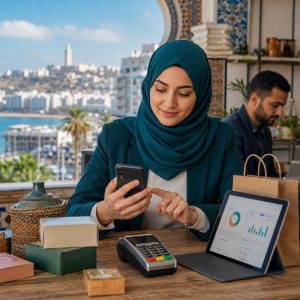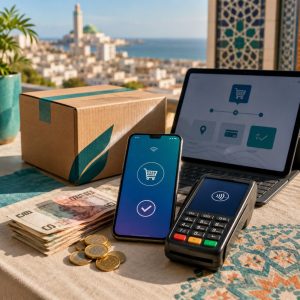
Algeria’s government has been digitizing with increasing urgency: 500 projects, a sovereign cloud, e-government portals, fiber optic expansion. What the official digital transformation narrative rarely acknowledges is that Algeria already has a thriving digital economy — it is just informal.
The traditional souk has migrated online. Not to formal e-commerce platforms with verified sellers, escrow accounts, and consumer protection, but to Ouedkniss classified listings, Facebook group markets, Instagram home-business pages, and WhatsApp trader networks. The scale of this digital informal commerce is larger than the formal digital economy by almost any measure — and it presents both an opportunity and a complication for every platform builder, regulator, and formal business trying to understand the real Algerian market.
The Scale of Algeria’s Informal Economy
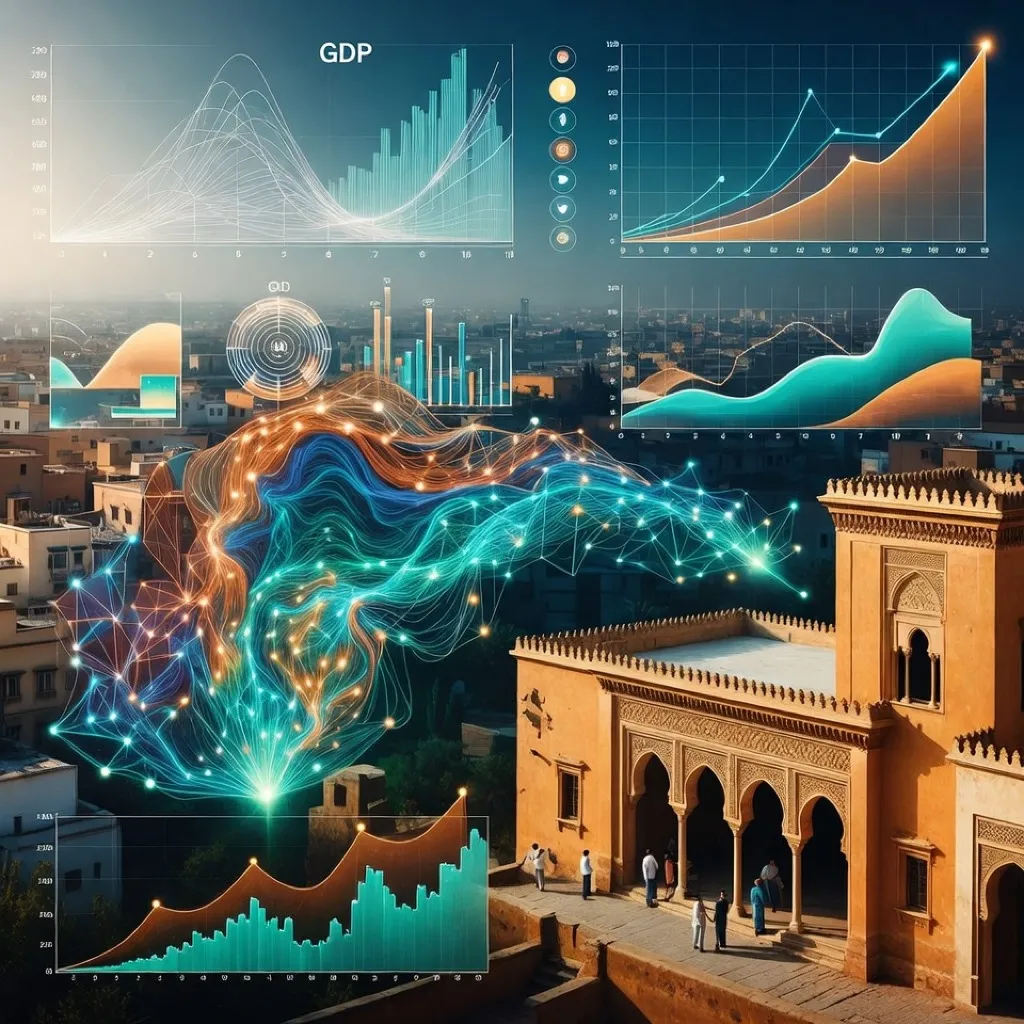
The International Labour Organization estimates that more than one-third of all employment in Algeria takes place in the informal economy. Academic research using the MIMIC model estimates the informal economy’s average size at 33.48% of official GDP — consistent with the World Bank’s frequently cited figure of approximately 30%. In the non-hydrocarbon economy, the share is higher: informal activity represents up to 50% of economic activity outside the oil and gas sector.
The cash dimension is equally significant. Currency circulating outside the formal banking system has consistently exceeded one-third of Algeria’s total money supply: the share stood at approximately 33–35% of M2 in both 2021 and 2022, and cash in circulation reached an estimated 8,300 billion DZD in 2023 — still representing over one-third of the M2 money supply for that year. (2024 full-year figures from the Bank of Algeria confirm the ratio remained in the same range, with no structural change.) This is not money that is unspent — it is money that is spent outside the visibility of banks, tax authorities, and digital payment systems. The physical souk, the neighborhood mechanic, the home-based seamstress, the informal car trader — these are real economic actors whose transactions happen in cash and leave no formal data trail.
This is the economy that digitization is now beginning to touch, not by formalizing it, but by giving it digital surfaces: a classifieds listing on Ouedkniss, a shop page on Instagram, a buyer inquiry on WhatsApp.
Ouedkniss: The Infrastructure of Informal Digital Commerce
Founded in 2006, Ouedkniss is the closest thing Algeria has to a national commerce platform. It is not an e-commerce site in the conventional sense — it is a classifieds marketplace, Algeria’s equivalent of Craigslist, where buyers and sellers post listings for cars, real estate, electronics, jobs, animals, and almost anything else. Early 2025 data ranks it as the ninth most visited website in Algeria, with approximately 17 million monthly visitors, 225 million pages viewed monthly, and 700,000 new listings posted each month.
The car market illustrates Ouedkniss’s role perfectly. In Algeria, car purchases are dominated by Ouedkniss. Both formal dealers and private sellers post listings. The buyer contacts the seller directly. Price is negotiated. Payment is cash at handover. The transaction is entirely outside the formal retail system, entirely unregulated, and entirely functional. It works because Algerians have developed informal trust mechanisms — meeting in public places, bringing a knowledgeable friend, verifying documents manually — that substitute for the escrow and verification systems that formal marketplaces provide.
Real estate, electronics, and labor markets follow the same model. The platform provides discovery; trust, verification, and payment happen off-platform through informal social mechanisms.
The Social Commerce Layer
Alongside Ouedkniss, a parallel informal commerce ecosystem operates across Facebook groups, Instagram shops, and WhatsApp networks. Algeria had approximately 25.6 million Facebook users and 36.2 million internet users in early 2025, with TikTok reaching 21.1 million users and Instagram 12.0 million (DataReportal, January 2025). The overlap between social media and informal commerce is near-total.
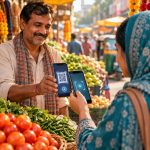
The pattern, documented by the US International Trade Administration’s Algeria e-commerce guide, is consistent: Instagram pages run by home-based clothing designers, food producers, or artisans post product photos. Interested buyers send a direct message. Orders are placed via WhatsApp. Delivery is in-person with cash payment, or via a courier company for cash-on-delivery. No invoice. No receipt. No tax record.
Facebook groups are the most active channel for the informal middle layer: not individual home businesses, but networks of small traders dealing in electronics, clothing, cosmetics, car parts, and fast-moving goods. These groups have tens of thousands of members, active daily posting, and entirely informal transaction infrastructure.
Trust and Fraud: The Informal Accountability System
The absence of formal consumer protection mechanisms is the most significant difference between the digital souk and formal e-commerce. On Ouedkniss, there are no verified seller badges, no escrow, no dispute resolution, and no recourse for buyers defrauded by fake listings. On Facebook, the same applies.
Trust is built through informal mechanisms that are surprisingly robust: social proof (other members of the group vouch for a seller), visual reputation (sellers who post consistently accumulate visible track records), and community accountability (scammers who defraud group members are named and shamed within the community, which functions as a reputation system).
These mechanisms work well enough to sustain significant commerce — but they fail at scale and for new sellers. Advance payment fraud is a documented problem on Ouedkniss: fraudulent listings for in-demand items (cars, iPhone models) request deposits before the buyer can inspect, then disappear. Algerian police maintain digital crime units that handle these cases, but enforcement against low-value fraud is limited.
For platform builders, the trust layer is both the problem and the opportunity. Formal escrow, verified seller identity, and structured dispute resolution are the next infrastructure pieces to build on top of the informal digital commerce ecosystem — and users would likely adopt them if the friction were low enough.
Advertisement
Payment: Why Cash on Delivery Is Non-Negotiable
Only 2.8% of Algeria’s population held credit cards in January 2024. Only 22.9% had debit cards. And only 8.2% made purchases via mobile phone or internet in 2023.
These figures explain why cash-on-delivery (COD) is not a workaround in Algeria’s informal digital commerce — it is the primary payment architecture. When a buyer cannot pay digitally and does not trust a seller enough to send cash in advance, the only viable transaction structure is: seller delivers, buyer inspects, buyer pays cash at the door.
COD imposes costs: courier companies must collect cash as well as deliver packages; sellers carry credit risk during transit; fraud takes the form of refused deliveries rather than advance payment scams. But it works in a market where digital payment infrastructure is nascent and trust is low.
Several formal e-commerce platforms have discovered this the hard way. Platforms that launched with digital payment as the primary option found conversion rates too low to sustain operations. Platforms that integrated COD from launch found significantly higher adoption. The informal souk understood this instinctively — it never tried to force digital payment.
Formalization Pressure: When the Informal Goes Visible
The informal digital commerce ecosystem is not invisible to authorities — it is simply tolerated and unmeasured. This is changing. The World Bank’s 2024 Algeria Economic Update highlights that tax enforcement is being upgraded with digital tools. Algeria’s Commercial Code and e-commerce regulations require registration for commercial selling activity, though enforcement against small social commerce sellers has been minimal to date.
The formalization pressure is building from multiple directions: the government’s digital transformation agenda creates data infrastructure that makes informal commerce more visible; tax authorities are developing capacity to identify commercial social media sellers; and the PSP (Payment Service Provider) framework, finalized in 2025, creates a clearer pathway for digital payment — but also makes digital payment transactions more auditable.
For informal sellers, this trajectory is clear: businesses that have been operating informally on Facebook and Ouedkniss will increasingly face the choice to formalize or reduce visibility. For platforms, the moment when informal sellers are motivated to formalize is the moment when they need platform services — invoicing, accounting, registered seller profiles — that Ouedkniss and Facebook do not provide.
Sector-by-Sector: How Digitization Differs by Category
Cars are the most mature informal digital market. Ouedkniss dominates. Both formal dealers and private sellers use the same channel. High transaction values justify the time investment in verification; buyers meet sellers in person.
Electronics have significant grey market dynamics. Parallel-imported products — imported through unofficial channels to avoid customs — are sold openly on Ouedkniss and in Facebook groups. Prices reflect the absence of import duties; quality guarantees are absent.
Clothing and fashion are heavily Instagram-driven. Home-based clothing businesses with active Instagram presence are abundant. Made-to-measure (khayat) businesses have moved from word-of-mouth to Instagram discovery; tailor shops post photos of their work; traditional dress makers serve diaspora clients with photos and WhatsApp sizing.
Food is the most regulatory-sensitive category. Home-based food businesses — pastry makers, prepared food sellers — operate on Instagram and Facebook without food safety licensing in most cases. This is both the fastest-growing social commerce category and the one where formalization pressure will likely arrive first.
Real estate uses Ouedkniss and direct agent networks. Unlike other categories, real estate involves notaries and legal documentation at the transaction stage; the informal element is primarily in the discovery and negotiation.
Opportunities for Platform Builders
The informal digital economy’s gaps are the platform builder’s opportunity map:
Escrow services do not exist at scale for Algerian consumer transactions. A mobile escrow product — hold payment until buyer confirms delivery — would resolve the trust problem that prevents higher-value transactions from completing digitally. The challenge is that escrow requires payment infrastructure that is still maturing.
Verified seller programs that leverage national ID verification (linked to Algeria’s digital identity system) could provide the social proof signal that informal communities currently build manually and slowly.
Embedded logistics with COD is the most immediately investable opportunity: companies that provide shipping + cash collection + remittance back to seller are solving the practical problem that COD creates. Several Algerian logistics startups are building precisely here.
Formalization tooling — simple invoicing, expense tracking, and tax registration assistance — will be increasingly valuable as formalization pressure rises. The seller who wants to formalize but does not know how to is a customer for light-touch business management software.
Frequently Asked Questions
What does “The Digital Souk” mean?
The Digital Souk: Algeria’s Informal Economy Is Going Online covers the essential aspects of this topic, examining current trends, key players, and practical implications for professionals and organizations in 2026.
Why does the digital souk matter?
This topic matters because it directly impacts how organizations plan their technology strategy, allocate resources, and position themselves in a rapidly evolving landscape. The article provides actionable analysis to help decision-makers navigate these changes.
How does ouedkniss: the infrastructure of informal digital commerce work?
The article examines this through the lens of ouedkniss: the infrastructure of informal digital commerce, providing detailed analysis of the mechanisms, trade-offs, and practical implications for stakeholders.
Sources & Further Reading
- The Informal Economy in Algeria: New Insights Using the MIMIC Approach — ScienceDirect
- Digital 2025: Algeria — DataReportal
- Algeria — eCommerce — US International Trade Administration
- Algeria — Digital Economy — US International Trade Administration
- E-commerce in Algeria — Lloyd’s Bank International Trade Portal
- Algeria: Investing in Data Key for Diversified Growth — World Bank
- Algeria: Ambitious Goals, Investor Skepticism — Global Finance Magazine
- Algeria’s Economy and Digital Marketing — Korhogo Agency
- Algeria: Informal Economy and the Black Market — Al-Safir Al-Arabi
- Algeria’s Ambitious Path for Development — World Bank Feature