Algeria has 25.6 million active social media users — 54.2% of the total population — and a median age of 28.6 years. That demographic profile is a brand manager’s dream. It has also quietly produced one of North Africa’s most active creator economies, where tech reviewers with seven-figure audiences command real influence over consumer electronics purchasing, app adoption, and even investment decisions. And it operates almost entirely outside any legal framework.
Algeria’s Social Media Landscape
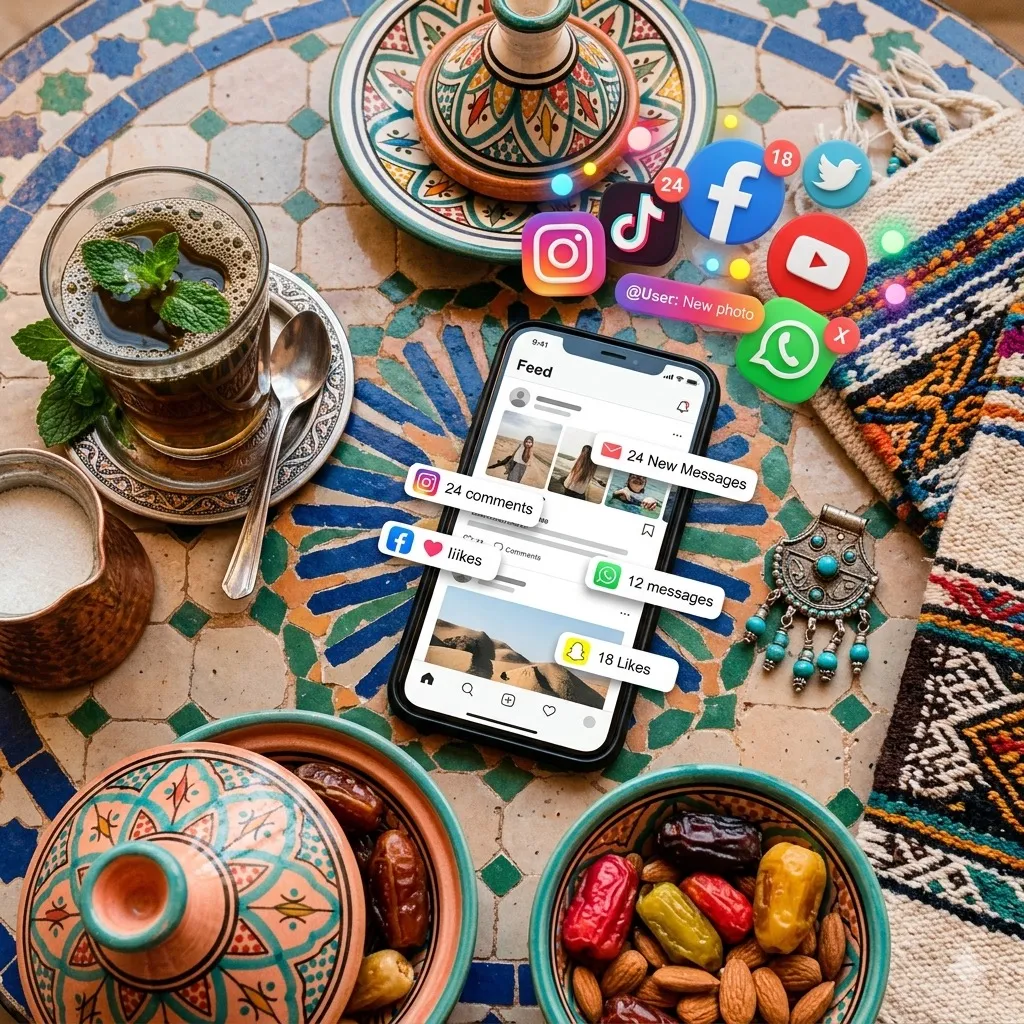
The scale of Algeria’s digital audience is not widely appreciated outside the region. According to DataReportal’s Digital 2025 Algeria report, Facebook leads with 25.6 million users — 83.5% of the adult population. YouTube and TikTok each reach 21.1 million users, representing 58.2% of all internet users. Instagram has 12 million users, Messenger 15.8 million, and Snapchat 9.1 million. LinkedIn, the professional outlier, has grown to 4.8 million registered members — a 23% year-on-year increase.
The gender split leans male (58% on Facebook, 62% on TikTok) but Instagram is near-balanced at 52.8% male and 47.2% female. This matters for brand strategy: consumer electronics and gaming content skews toward Facebook and TikTok’s male-dominated audiences, while fashion, beauty, and lifestyle content finds more balanced reach on Instagram.
What makes Algeria’s social landscape distinct is its linguistic plurality. Creators communicate in Modern Standard Arabic, Algerian Darija, French, Tamazight, or a code-switching blend of all four. This multilingual environment fragments the audience but also creates highly loyal niche communities — a Darija-speaking tech reviewer is not competing with a French-language lifestyle creator.
The Tech Influencer Ecosystem
Algeria’s tech creator community has produced genuine stars. Rafik Nezzar, a gadget reviewer operating primarily in Darija and French, has built a YouTube audience of 1.2 million subscribers. Yacine Tech, focused on smartphone tutorials and reviews, counts 980,000 subscribers. Amine Digital (750,000 subscribers) rounds out the tier-one tech creator category. These are not microinfluencers running affiliate link sidelines — they are media operations with production teams, upload schedules, and brand relationship calendars.
Below the top tier, Algeria has a dense mid-tier creator layer: hundreds of channels in the 50,000–500,000 subscriber range covering specific tech verticals — PC gaming, cybersecurity, Algerian startup news, app reviews, and Arabic coding tutorials. This layer is disproportionately important for brand campaigns because mid-tier creators typically maintain engagement rates of 4–8%, compared to 1–3% for mega-influencers. For an Algerian telecom launching a new data plan or an electronics retailer promoting a product line, a cluster of mid-tier tech creators often delivers better ROI than a single million-subscriber deal.
How the Money Works
The revenue architecture for Algerian creators draws from four streams.
YouTube ad revenue is available in Algeria — the country is part of the YouTube Partner Program. Algerian creators receive payments via bank transfer or Western Union. However, CPM rates in Algeria are significantly lower than Western markets, typically ranging from $1 to $3 per thousand views compared to $5–$15 in the United States or Europe. A creator with 500,000 monthly views earns roughly $500–$1,500 in pure ad revenue — meaningful but not sufficient as a sole income source.
Brand deals and sponsored content represent the real income. While no Algeria-specific rate card has been published, global benchmarks calibrated to local purchasing power suggest Algerian macro-influencers (500,000 followers) command $2,000–$8,000 per sponsored post, with top-tier creators in the $8,000–$25,000 range for integrated campaigns. Telecom companies (Djezzy, Ooredoo, Mobilis), electronics brands (Samsung, Huawei, Xiaomi’s Redmi), and financial apps represent the most active brand spenders in the tech creator category.
Affiliate commissions are the third pillar. Algerian creators link to products on Amazon (purchased through grey-market workarounds), AliExpress, Ouedkniss, and local retailers, earning referral fees. The COD-dominant payment environment limits conversion tracking, making formal affiliate programs harder to administer than in markets with card-based checkout.
Creator-launched products form the fourth and fastest-growing stream. Top Algerian creators are increasingly launching their own courses (video production, smartphone photography, coding bootcamps), digital communities with paid membership, and merchandise. This creator-as-entrepreneur model reduces platform dependency and builds assets independent of algorithm changes.
Local Platforms and Infrastructure
Influgrid is Algeria’s first dedicated influencer-brand matching platform. Launched locally, it allows companies to search for influencers by category, audience type, and geographic reach, while creators build profiles showcasing their rates and campaign capabilities. International influencer agencies — Arab Influencer Agency, Collabstr, Modash — also operate in the Algerian market, giving brands access to global campaign management infrastructure for local creator relationships.
The infrastructure gap is real but narrowing. Three years ago, a brand wanting to run an influencer campaign in Algeria would negotiate directly via Instagram DM, agree on deliverables over WhatsApp, transfer payment by wire or cash, and receive no analytics. Today, Influgrid and agency intermediaries provide at least structured discovery, campaign briefs, and basic performance reporting. What remains absent is any standardized measurement of viewership authenticity — follower inflation and engagement manipulation are not audited in the Algerian market.
Advertisement
The Regulatory Vacuum
Algeria’s Autorité de Régulation de l’Audiovisuel (ARAV) was established by the 2014 audiovisual law and monitors compliance with broadcast and audiovisual content standards. Its mandate has historically focused on television and radio. As digital content has eclipsed traditional broadcast for youth audiences, ARAV’s regulatory perimeter has expanded in law but not yet in practice for individual creators.
Algeria’s 2012 Organic Law on Information covers “the publication of all news, images, and opinions via any media, be it print, digital or audiovisual” — a broad mandate that theoretically encompasses creator content. In practice, enforcement against individual YouTubers or Instagram accounts has been selective and politically motivated, not commercially or consumer-protection driven.
For influencers, several commercial regulation layers are still being defined. Mandatory disclosure requirements are the next step — putting sponsored-content markers in place would make paid promotions visible to followers. A specific tax category for creator income is another building block — defining where brand-deal earnings fit in the tax code would bring them out of the grey zone. And a consumer protection framework for influencer-endorsed products is the third layer — giving followers a structured recourse when a recommendation turns out to be dishonest.
Brand Strategies
Algerian brands are learning influencer strategy through iteration. Early campaigns treated YouTubers as television ad slots — rigid script, single deliverable, no relationship building. The more sophisticated model emerging among major advertisers involves multi-video series, behind-the-scenes production access, creator involvement in product naming or design, and long-term ambassador contracts that build authenticity over time.
The measurement challenge is significant. In a COD-dominated market, attributing a sale to an influencer requires manual methods — unique promo codes, dedicated phone numbers, or post-purchase surveys. Digital attribution stacks (UTM parameters, pixel tracking) are limited to the minority of Algerian e-commerce sites that have mature analytics implementations. This makes ROI measurement for influencer campaigns substantially harder than in markets with card-based checkout and digital attribution infrastructure.
The Creator-as-Startup Model
The most commercially interesting development in Algeria’s creator economy is the pivot from personal brand to business entity. Several mid-tier to top-tier creators have formalized their operations — registering agencies, hiring editors and community managers, launching B2B services selling content strategy to brands. This mirrors the evolution of the creator economy in Egypt and Morocco, markets roughly 3–5 years ahead of Algeria on this curve.
One pattern: the Algerian tech creator who reaches 300,000–500,000 subscribers and monetizes their expertise not by selling smartphone reviews but by selling education. Online courses in web development, UI/UX design, data analysis, and digital marketing — priced in Algerian dinars, delivered via Telegram or WhatsApp channels, and marketed entirely through the creator’s own audience — represent a significant and growing informal revenue stream. No platform takes a cut. No regulator has a view on it.
What Regulation Would Look Like
The most likely near-term development is not comprehensive creator regulation but a narrower disclosure requirement — something analogous to what the FTC requires in the United States or the ASA enforces in the UK, requiring creators to label sponsored content with visible markers (#partenariat, #pub, or an Arabic equivalent). This is politically achievable without a new law, fitting within ARAV’s existing mandate and consistent with Algeria’s 2018 e-commerce legal framework, which already imposes transparency requirements on commercial digital activity.
Tax regulation is more complex and politically sensitive. A formal creator tax category would require the Ministry of Finance to acknowledge an informal economy sector that has thrived precisely because it is invisible to revenue authorities. Morocco introduced a 20% withholding tax on creator income in 2022; Algeria will likely follow within a 3–5 year window as the economy digitizes further.
Frequently Asked Questions
What is 29 million social users, zero regulation?
29 Million Social Users, Zero Regulation: Algeria’s Creator Economy covers the essential aspects of this topic, examining current trends, key players, and practical implications for professionals and organizations in 2026.
Why does 29 million social users, zero regulation matter?
This topic matters because it directly impacts how organizations plan their technology strategy, allocate resources, and position themselves in a rapidly evolving landscape. The article provides actionable analysis to help decision-makers navigate these changes.
How does the tech influencer ecosystem work?
The article examines this through the lens of the tech influencer ecosystem, providing detailed analysis of the mechanisms, trade-offs, and practical implications for stakeholders.
Sources & Further Reading
- Digital 2025: Algeria — DataReportal
- Top YouTube Technology Influencers in Algeria — StarNgage
- Top 20 Algerian Influencers — Modash
- Influgrid: Algeria’s Leading Influencer Marketing Platform
- Algeria New Media Law Tightens Restrictions on Online Content — SMEX
- DPA Digital Digest: Algeria 2025 — Digital Policy Alert
- Is YouTube Monetized in Algeria? — ViralPhantom
- Social Media Users in Algeria — NapoleonCat
- Top 20 Instagram Influencers in Algeria 2026 — Favikon
- Algeria — Digital Economy — US International Trade Administration