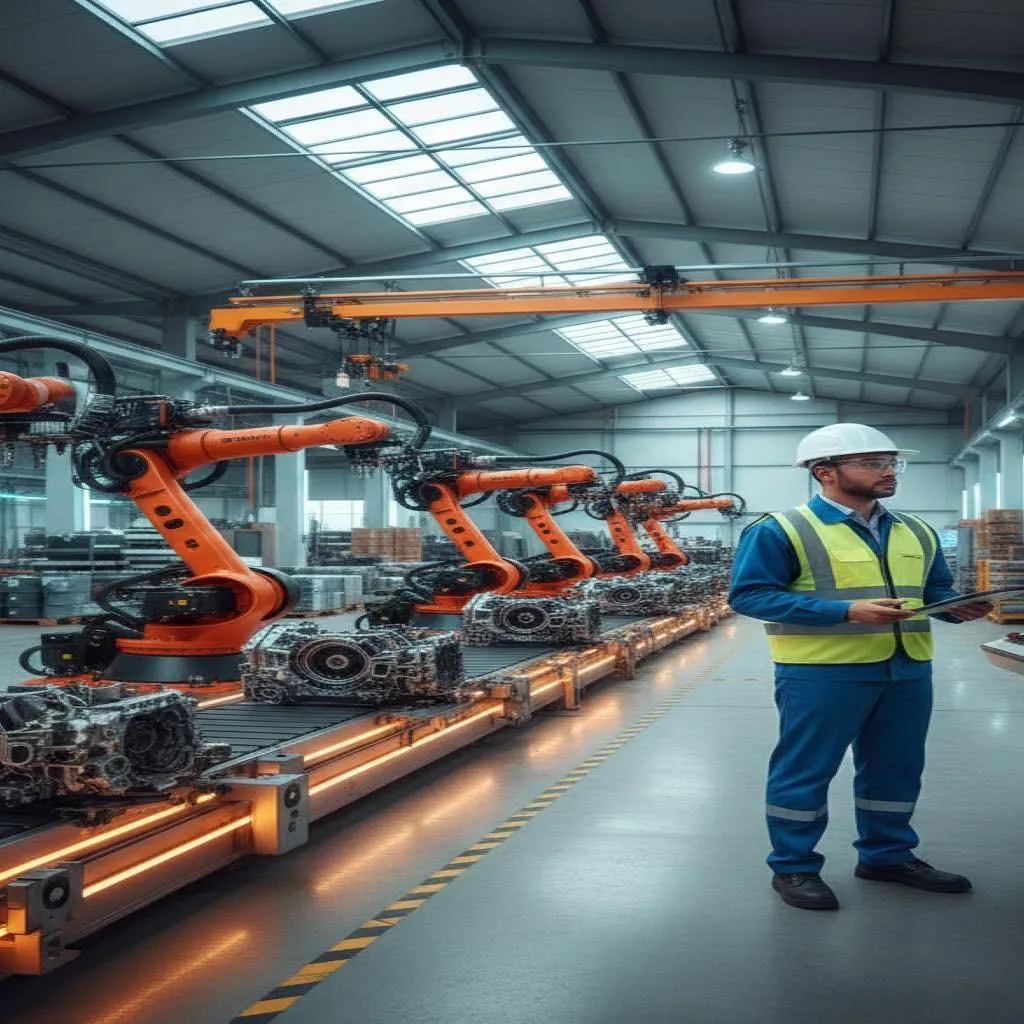
Quick Take: Algeria’s industrial base has the scale and diversity to justify robotics adoption, but the economic incentives, import channels, and skills ecosystem are not aligned. The most actionable step is establishing authorized robot training centers and cultivating local systems integrators — without these, even imported robots will underperform. Pharmaceutical and food processing offer the strongest near-term cases for deployment.
Algeria’s Robot Density Problem
The International Federation of Robotics (IFR) tracks robot density — the number of industrial robots per 10,000 manufacturing workers — as the definitive measure of automation adoption. According to the IFR’s 2024 report (covering 2023 data), South Korea leads the world at 1,012 robots per 10,000 workers. China has surged to 470, overtaking both Germany and Japan. The global average has reached 162, having doubled from 74 in just seven years. Algeria does not appear individually in IFR data, but North Africa collectively registers in the single digits — estimated between 3 and 8 robots per 10,000 manufacturing workers.
This is not simply a function of economic development. Turkey, with a comparable GDP per capita to Algeria, has a robot density estimated at 20-50 depending on the sector (with automotive significantly higher). Egypt has been growing its installed base. Vietnam, with lower income levels than Algeria, has been one of the fastest-growing robotics markets in the world, driven by foreign direct investment in electronics manufacturing. Algeria’s low automation rate reflects specific structural factors: an economy dominated by hydrocarbons rather than manufacturing, import restrictions on capital equipment, a labor market where low wages reduce the economic case for automation, and limited exposure to the global supply chains that typically drive technology transfer.
The installed base of industrial robots in Algeria is estimated at a few hundred units — mostly concentrated in the automotive assembly, pharmaceutical, and food processing sectors. Morocco’s automotive export industry, anchored by plants like Renault Tangier that employ thousands alongside robotic welding and assembly systems, drives significantly higher adoption. Understanding why Algeria lags, and what it would take to change, requires examining the country’s industrial structure factory by factory.
The Industrial Landscape: Who Has What
Sonatrach, Algeria’s state-owned oil and gas giant and the country’s dominant economic actor, operates extensive industrial infrastructure: refineries, LNG plants, petrochemical complexes, and pipeline networks. These facilities use advanced process automation — distributed control systems (DCS) from vendors like Honeywell, Yokogawa, and ABB — but this is process automation, not robotics. The distinction matters: a refinery is controlled by software and sensors that manage temperature, pressure, and flow, but it does not use articulated robots for physical tasks. Where robotics could add value in Sonatrach’s operations is in maintenance: robotic pipeline inspection (pigging with intelligent tools), drone-based facility inspection, and remotely operated vehicles for offshore and hazardous environments.
SNVI (Societe Nationale des Vehicules Industriels) in Rouiba assembles trucks, buses, and military vehicles. Its production lines have some automation — welding jigs, conveyor systems — but lack the robotic welding arms, automated painting cells, and vision-guided assembly systems that define modern automotive manufacturing. Renault Algeria’s assembly plant near Oran, inaugurated in November 2014 with an initial capacity of 25,000 vehicles per year, represented a step toward modern automotive production. However, the plant has been effectively suspended since 2020 due to disputes over local integration requirements and diplomatic tensions between Algeria and France. As of early 2025, Renault had submitted a new application to resume operations, but approval had not been granted, and the plant produced only approximately 2,400 vehicles in 2023.
Cevital’s Bejaia complex is among Algeria’s most modern industrial facilities. Its sugar refinery and vegetable oil processing lines incorporate automated filling, packaging, and palletizing — operations where robots excel. Tosyali Holding’s integrated steel complex in Oran has grown into one of Africa’s largest, with annual production capacity reaching 8.5 to 10 million tonnes of flat and long products following major expansions in 2024-2025, including a new DRI facility, electric arc furnace, and hot and cold rolling mills. Saidal Group, Algeria’s pharmaceutical producer, has GMP-compliant production lines with some automated filling and inspection. Across these facilities, the pattern is consistent: basic process automation exists, but advanced robotics — the kind that characterizes Industry 4.0 — is largely absent.
Advertisement
What Prevents Broader Adoption
The barriers to robotics adoption in Algeria are layered. The most fundamental is economic: when labor costs are low, the return on investment for a $150,000 industrial robot is harder to justify. An Algerian factory worker earns a fraction of what a German or Korean worker earns, stretching the payback period for automation investments from 2-3 years (typical in high-wage countries) to 7-10 years. This arithmetic changes only when quality requirements demand consistency that human workers cannot reliably deliver, or when production volumes reach scales where even low-cost labor cannot keep pace.
Import regulations and foreign currency access compound the problem. Industrial robots — predominantly manufactured by FANUC (Japan), ABB (Switzerland), KUKA (Germany), and Yaskawa (Japan) — must be imported along with their controllers, teach pendants, end-effectors, and spare parts. Algeria’s import licensing regime adds complexity and cost. Foreign currency constraints, a persistent challenge for Algerian importers, make capital equipment procurement unpredictable. A factory manager planning a robot cell installation needs to know they can import replacement parts when a servo motor fails in year three — without that certainty, the investment risk is prohibitive.
The skills gap may be the most critical barrier. Operating and maintaining industrial robots requires technicians trained in PLC programming, robot kinematics, sensor integration, and industrial networking. Algeria’s vocational training system (INSFP) and technical universities produce graduates with foundational skills, but hands-on experience with specific robot platforms (FANUC’s KAREL language, ABB’s RAPID, KUKA’s KRL) is limited by the absence of training cells equipped with actual robots. Without a critical mass of skilled integrators and maintenance technicians, even a company willing to invest in robotics faces operational risk.
Paths Forward: Training, Integrators, and Strategic Sectors
Addressing Algeria’s automation gap requires action on multiple fronts simultaneously. Training is the foundation. Several countries that have successfully accelerated robotics adoption — China, Vietnam, Turkey — did so partly by establishing vocational training centers equipped with industrial robot cells, often in partnership with robot manufacturers. FANUC and ABB both operate authorized training center programs globally; establishing such centers in Algiers, Oran, and Constantine could produce a pipeline of qualified technicians within 2-3 years.
The emergence of a local systems integrator ecosystem is equally important. In mature markets, companies do not buy robots from manufacturers directly — they contract systems integrators who design, install, program, and commission turnkey automation solutions. Algeria has electrical and industrial contractors, but dedicated robotics integrators are virtually nonexistent. Encouraging existing engineering firms to develop robotics integration capabilities — through partnerships with international integrators, technology transfer agreements, or targeted training — could bootstrap this critical intermediary layer.
Strategic sector selection matters. Not every industry needs robots immediately, but certain sectors offer compelling use cases. Pharmaceutical manufacturing, where Algeria is actively pursuing domestic production capacity (including vaccine manufacturing), demands the precision and sterility that robotics provides. Food processing for export requires the consistent quality that automated inspection and packaging deliver. The steel sector, where Tosyali’s massive expansion demonstrates Algeria’s industrial ambition, increasingly relies on automated handling and quality inspection at scale. Focusing incentives — tax breaks on robot imports, accelerated depreciation, matching grants for automation investments — on these strategic sectors could concentrate adoption where it creates the most economic value.
Frequently Asked Questions
What is industrial robotics in algeria?
Industrial Robotics in Algeria: The State of Manufacturing Automation from Sonatrach to covers the essential aspects of this topic, examining current trends, key players, and practical implications for professionals and organizations in 2026.
Why is industrial robotics in algeria important for Algeria?
This topic is significant for Algeria because it intersects with the country’s digital transformation goals, economic diversification strategy, and growing technology ecosystem. The article provides specific context for Algerian stakeholders.
How does the industrial landscape: who has what work?
The article examines this through the lens of the industrial landscape: who has what, providing detailed analysis of the mechanisms, trade-offs, and practical implications for stakeholders.
Sources & Further Reading
- Global Robot Density Doubled in Seven Years — International Federation of Robotics
- China Overtakes Germany and Japan in Robot Density — IFR via BusinessWire
- Tosyali Algerie Industrial Complex — Tosyali Algerie
- Tosyali Algerie Expansion — Global Energy Monitor
- Algeria Extends Suspension of Renault Plant — APA News
- Renault Oran Plant — Renault Group
- Sonatrach Industrial Operations — Sonatrach
- FANUC Global Training Programs — FANUC
- ABB Robotics and Automation — ABB