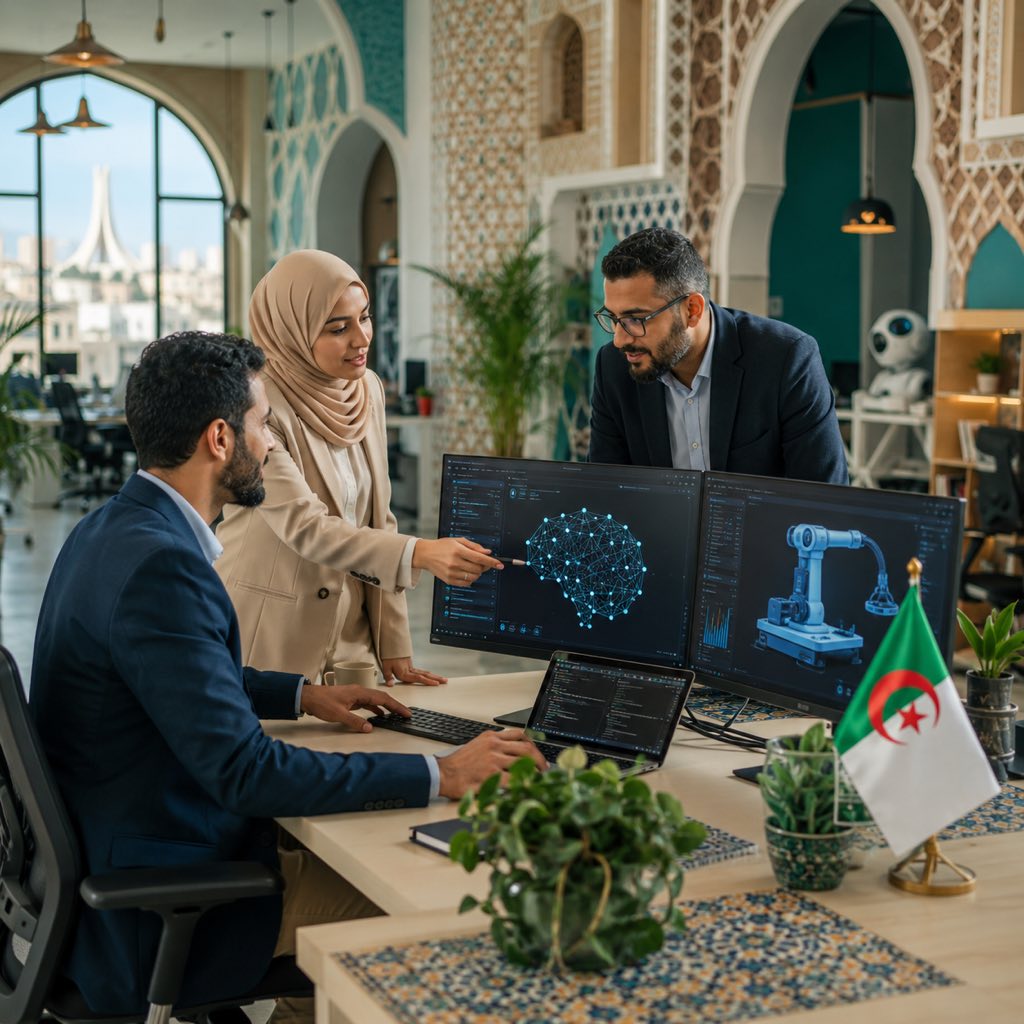
The Digitalization Gap That No-Code AI Can Close
Algeria has approximately 1.5 million registered enterprises, the overwhelming majority of them micro and small businesses. The government’s Digital Algeria 2030 roadmap sets an explicit target: 80% SME adoption of digital systems. The current reality, as documented in a 2026 academic analysis of digital transformation barriers in Algerian SMEs, falls dramatically short — with financial limitations, infrastructure gaps, and digital skills shortages identified as the three dominant blockers.
No-code AI automation platforms are a structural answer to all three constraints simultaneously. They require no software development skills, run in the cloud (eliminating hardware investment), and carry monthly costs that start below $50 for small teams. The skills barrier collapses because the logic is visual: users drag-and-drop workflow steps rather than writing code. The financial barrier shrinks because platforms like n8n’s self-hosted option carry zero licensing cost for businesses that can run a basic server.
This is not theoretical potential. n8n’s 2026 enterprise case studies document businesses saving 40-60% on automation costs versus legacy task-based alternatives, with small business owners reporting cuts of 15-25% in operational costs and recovery of 15+ hours per week through automated workflows. The workflow automation market itself is growing from $23.77 billion in 2025 to a projected $37.45 billion by 2030 — the tools are maturing precisely when Algeria is trying to scale adoption.
The Three Platforms Every Algerian SME Owner Should Know
The no-code automation landscape has three dominant players that a non-technical Algerian business owner can deploy without outside help. Each has a distinct profile:
n8n is open-source, self-hostable, and the most powerful of the three for technical users. n8n’s January 2026 version 2.0 release introduced AI Agent Tool Nodes for multi-agent orchestration, native LangChain integration with 70+ AI nodes, and persistent agent memory — transforming it from a workflow tool into a genuine AI agent platform. For Algerian businesses willing to run it on a local server or cheap VPS, the licensing cost is zero. This matters because cost is the most cited adoption barrier.
Make (formerly Integromat) is the best choice for SMEs that need powerful multi-step logic without any developer involvement. Its visual scenario builder supports 1,500+ app integrations and handles complex branching workflows. It is better suited than Zapier for processes that involve conditional logic — for example, “if a customer invoice is overdue by more than 15 days AND their account balance is above 50,000 DZD, send an escalation message via WhatsApp.”
Zapier is the simplest entry point and most appropriate for businesses that need a single trigger-action automation deployed in under an hour. With 9,000+ app integrations, it handles the most common SME automation: a form submission triggers a WhatsApp message, a payment confirms a CRM update, a new email generates a task in a project management tool. Zapier’s AI Copilot now accepts natural-language descriptions — “when someone submits the contact form on my website, add them to my mailing list and send a welcome message” — and builds the automation automatically.
Advertisement
Five Workflows That Algerian SMEs Can Deploy This Week
1. Automate invoice generation and payment follow-up
The most impactful single automation for Algerian SMEs is invoice-to-payment follow-up. The workflow: when an order is marked complete in a sales sheet or basic ERP, n8n or Make automatically generates an invoice PDF, emails it to the client, and schedules follow-up messages at 7, 14, and 30 days if payment is not confirmed. A final escalation at 45 days routes to a WhatsApp message with a payment link.
This eliminates the manual reminder process that typically consumes 3-5 hours per week for a small business managing 20-50 monthly invoices. The tools required are a Google Sheet or Airtable (both free tiers sufficient), Make or n8n (free or near-free), and a WhatsApp Business API connection (available at low cost through local resellers of the Meta Business API).
2. Customer inquiry routing and first-response via AI
Algerian SMEs in retail, services, and hospitality routinely lose customers to slow response times — particularly on WhatsApp, the dominant business communication channel. An AI-powered first-response workflow routes incoming WhatsApp inquiries through an n8n workflow that uses an AI node (connected to OpenAI or a local LLM) to classify the inquiry type and generate a relevant response draft, which can be auto-sent for standard queries or queued for human review for complex ones.
Zapier’s new Agents product allows a non-technical owner to describe this workflow in plain language and have it deployed within an hour. The practical effect is that an SME with two staff members can handle the inquiry volume of a team of five without increasing headcount.
3. Inventory alert automation for retail and distribution
For businesses managing physical stock — a common profile in Algerian retail, pharmaceuticals distribution, and agri-input supply — inventory threshold alerts are a high-value, low-complexity automation. When stock of a SKU drops below a defined minimum in a spreadsheet or inventory app, n8n triggers a reorder request via email or WhatsApp to the supplier, logs the event in a tracking sheet, and notifies the manager.
This prevents the stockout events that SME automation research identifies as one of the top five revenue-loss drivers for small retailers. Deployment requires a connected inventory source (even a Google Sheet works) and approximately two hours of setup time.
4. Social media and content scheduling
Algerian SMEs with any consumer-facing presence need consistent social content but rarely have the budget for a dedicated community manager. Make’s social media modules connect to Facebook, Instagram, and LinkedIn simultaneously — a business owner creates a single post draft, and Make distributes it across all channels at the optimal time, logs engagement metrics, and emails a weekly summary report.
Adding an AI text-generation node means the owner can input a product name and key message, and the automation drafts three platform-specific caption variants for review before scheduling. This is not replacing human creativity — it is eliminating the production friction that causes most SMEs to post inconsistently.
5. HR onboarding and document management automation
For businesses growing past ten employees, manual onboarding (collecting documents, setting up accounts, scheduling inductions) is a significant time sink. An n8n or Make workflow triggered by a new-hire form automatically sends a document checklist to the new employee via email, creates their accounts in connected tools (Google Workspace, Slack, Trello), schedules their calendar events, and notifies their manager when all steps are complete.
This workflow, which might take an HR administrator half a day manually, runs in under five minutes. It is relevant to any Algerian SME that is scaling and does not yet have a dedicated HR function.
What Comes Next for Algeria’s No-Code AI Ecosystem
The global no-code AI automation market is consolidating around platforms with native AI agent capabilities. By mid-2026, the distinction between “workflow automation” and “AI agent orchestration” has essentially disappeared — n8n, Make, and Zapier all allow users to deploy autonomous agents that monitor data sources, make conditional decisions, and execute multi-step tasks without human intervention on each cycle.
For Algeria’s SME ecosystem, the inflection point is training and awareness rather than technology access. The tools are available, the costs are manageable, and the documentation is extensive. What is missing is a structured adoption pathway — a national program that teaches Algerian business owners the five core automation patterns (notification, data sync, document generation, AI response, reporting) with localized examples in Arabic and French.
The Chambre Nationale de Commerce et d’Industrie (CNCI), the Ministry of Knowledge Economy (MTEIN), and the Agence Nationale de Soutien à l’Emploi des Jeunes (ANSEJ) are the natural delivery channels for such a program. A 20-hour certification curriculum on no-code AI automation, delivered through Algeria’s existing entrepreneurship support network, would have measurable impact on the 80% digitalization target at far lower cost than hardware-subsidy programs or large-scale ERP deployments.
The international comparison is instructive: Morocco’s OFPPT (Office de la Formation Professionnelle et de la Promotion du Travail) launched a no-code automation certification track in 2025 that has trained over 3,000 SME operators. Algeria’s equivalent infrastructure exists — it needs the curriculum content and the political mandate to deploy it.
Frequently Asked Questions
Do I need an internet connection and a local server to use n8n in Algeria?
n8n offers two deployment options: a cloud-hosted version (n8n Cloud, from approximately €20/month) and a self-hosted version that runs on any server or even a local machine. For businesses in wilayate with unreliable connectivity, the self-hosted option on a local server preserves workflow execution even during internet outages — though the integrations that connect to external services (email, WhatsApp) still require connectivity at the moment of execution. Zapier and Make are cloud-only and require a stable internet connection throughout.
Can no-code AI tools handle Arabic-language business processes?
Yes. All three major platforms (n8n, Make, Zapier) are Unicode-compliant and handle Arabic text in all fields, conditions, and outputs. WhatsApp Business API integrations transmit Arabic messages natively. The AI nodes connected to models like GPT-4o or Claude generate Arabic-language responses when instructed to do so. The platforms’ own interfaces are in English or French (not Arabic), but the data and outputs they process can be fully in Arabic.
What is the realistic implementation timeline for an Algerian SME with no technical background?
The invoice follow-up automation (Workflow 1) can be operational in 2-4 hours using Make’s visual interface and pre-built templates. The customer inquiry AI workflow (Workflow 2) typically takes 4-8 hours including API setup. Most small businesses can deploy their first three functional automations within a single working week, with no technical training beyond watching the platform’s tutorial videos. The most common blocker is WhatsApp Business API approval, which currently takes 2-5 business days through Meta’s review process.
Sources & Further Reading
- Digital Ecosystem Integration Barriers in Algerian SMEs — Taylor & Francis / EDPACS
- n8n Enterprise Use Cases: How Companies Save 60% on Automation Costs — Trigid Digital
- Best AI Workflow Automation Tools 2026 — n8n Blog
- 7 Best n8n Workflows That Save Time for Small Business — AI for Small Business
- Algeria’s Ambitious Digital Transformation Plan: 500+ Projects 2025-2026 — MEA Tech Watch
- Algeria Unveils AI Strategy — EcofinAgency
🔗 Related Intelligence

Algeria’s SMEs and AI: Closing the Automation Gap Before 2030

Algeria’s AI Trainer Pipeline: From Train-the-Trainers to Startup Lab Outcomes

Algeria’s Emerging AI Regulation: Balancing Innovation with Accountability

Generative AI Adoption in Algerian SMEs: Beyond the Hype