The Missing Link in Algeria’s AI Strategy
Algeria’s AI ambitions have, until recently, had an infrastructure gap that was difficult to name precisely. The country has universities — 52 of them offering AI programmes, with 57,702 enrolled students. It has a startup label system that has supported over 2,300 ventures. It has an $11 million Algérie Télécom AI and cybersecurity investment committed in 2025 and more than 500 digitalisaton projects planned for 2025–2026. What it has not had is a structured facility purpose-built to convert research outputs into commercially viable AI and cybersecurity products.
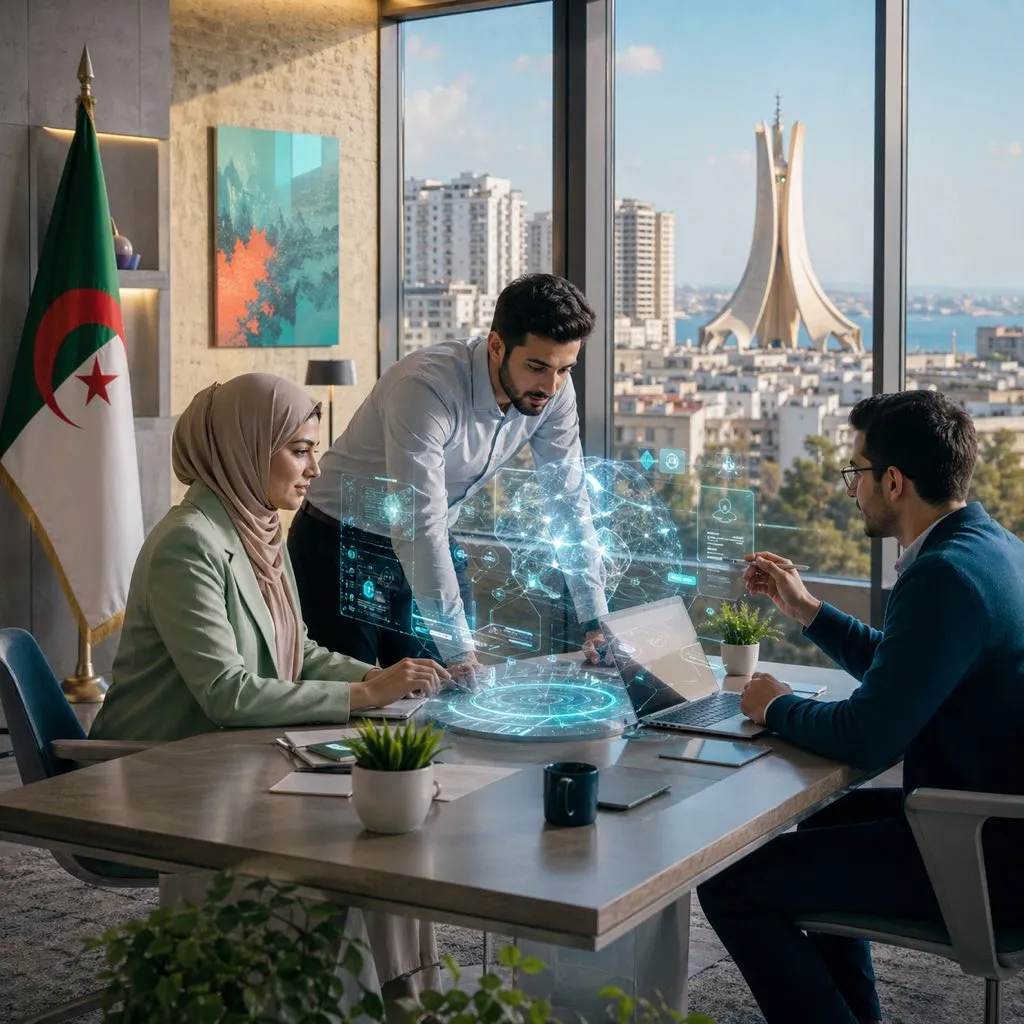
The cluster launched at Sidi Abdellah’s Scientific and Technological Pole “Chahid Abdelhafidh Ihaddaden” is the structural answer to that gap. Overseen at launch by three ministers — Kamel Baddari (Higher Education and Scientific Research), Noureddine Ouadah (Knowledge Economy and Startups), and Sid Ali Zerrouki (Post and Telecommunications) — the cluster is designed from the start as an ecosystem rather than a building. It brings together universities, research centres, and emerging companies in a single operating environment, with the explicit aim of accelerating “the transformation of ideas into viable businesses.”
The three-ministry structure is not ceremonial. It reflects the cluster’s actual span: research institutions (Baddari’s domain), startup formation and economy integration (Ouadah’s domain), and digital infrastructure and telecommunications (Zerrouki’s domain). Each minister is accountable for a segment of the commercialisation chain, which means the cluster has governmental backing across the full journey from prototype to product to market deployment.
What “Bringing Together Universities, Research Centres, and Companies” Actually Means
The cluster’s operating model — co-locating academic research, public research infrastructure, and emerging enterprises — is not unique globally, and it is now being rolled out in Algeria and across North Africa more broadly. Its design premise is that the main lever for AI commercialisation is not talent (Algeria’s universities produce it) or capital (the startup label and government funds provide it) but structural proximity: building the organic channel between research teams that have built AI models and enterprises that could deploy them — and giving startups that understand the commercial problem direct access to research infrastructure capable of solving it.
The Sidi Abdellah cluster creates that channel by design. The Scientific and Technological Pole already functions as a concentration point for technology-oriented institutions — co-locating the cluster within it means startups have physical and organisational access to university research teams, laboratory equipment, and the data infrastructure that serious AI development requires. This matters because Algerian data — structured around Arabic, Tamazight, Darija, and the specific regulatory and demographic characteristics of the Algerian market — is not well-represented in internationally available training datasets. AI models built at Sidi Abdellah, using Algerian data in proximity to Algerian researchers, have a structural advantage for local deployment that no imported model can easily replicate.
The cybersecurity focus is equally strategic. Algeria’s digital economy is expanding rapidly — 76.9% internet penetration, over 500 planned digitalisaton projects — but cybersecurity coverage has not kept pace. The cluster’s dual focus on AI and cybersecurity reflects the government’s recognition that these are not separate domains: AI-enabled threat detection, automated incident response, and model-level security (protecting AI systems from adversarial attack) are the frontier of the field. Building that competency domestically, through a cluster that can produce and retain talent and IP, is a better long-term outcome than continuing to import cybersecurity tools designed for different threat environments.
Advertisement
What This Means for Algerian Founders and Enterprise Leaders
1. Treat the cluster’s AI-specific research access as a competitive moat — and engage early
For AI founders building in Algeria, the Sidi Abdellah cluster offers something that cannot be replicated through standard incubator membership: proximity to research infrastructure and datasets that are Algerian in origin. If your product requires natural language processing in Arabic or Darija, computer vision calibrated to Algerian environments, or fraud detection models trained on Algerian financial transaction patterns, the cluster gives you access to the academic institutions building that capability. Engage with the cluster before your product is feature-complete — the research relationship is most valuable at the architecture stage, not after you have committed to a model approach that may require expensive retraining.
The cluster’s startup label pipeline — connecting directly from cluster participation into Algeria’s formal startup recognition system — also matters for enterprise sales cycles. Labelled startups have a formal status that large public-sector buyers (national banks, ministries, public utilities) can engage with through procurement channels that are not available to unlabelled entities. Reaching label status through the cluster, with three-ministry backing and research credibility, is a faster path to large contract eligibility than navigating the label system independently.
2. For enterprise CTOs: use the cluster as a localisation and integration channel, not just a talent pipeline
Enterprises that are evaluating AI solutions for Algerian operational contexts — particularly in banking, logistics, energy, and public administration — should treat the Sidi Abdellah cluster as a localisation resource, not just a graduate hiring pool. The standard problem with AI vendor solutions is adaptation: models built for French regulatory contexts or Gulf Arabic dialect perform poorly when applied to Algerian operational data without significant fine-tuning. The cluster’s co-location of researchers, enterprises, and sector-specific data creates the conditions for that fine-tuning to happen inside Algeria, with local IP ownership.
Practically, this means enterprise technology leaders should identify one or two AI use cases where localisation is the primary barrier to deployment, and bring those problems to the cluster as structured challenges rather than waiting for the cluster to come to them with finished solutions. The cluster’s model — bridging academic research and economic sector — works best when enterprises define the commercial problem clearly. Algeria’s AI market growing from $498.9 million to a projected $1.69 billion by 2030 creates urgency: enterprises that localise AI tools on Algerian data over the next 24 months will have a significant competitive advantage over those that wait for imported solutions to catch up.
3. For researchers: the cluster changes the IP ownership calculus of applied AI work
Algerian researchers in AI and cybersecurity have historically faced a binary choice: publish academically (maximising scientific credibility) or work commercially (maximising financial return). The cluster’s structure — embedding research institutions within a startup-formation environment — creates a third path: research that is commercialised with retained IP and institutional benefit. This is the model that Singapore’s research-to-startup pipeline has used to produce global-scale technology companies from a national research base. Algeria’s 57,702 AI-enrolled university students and its ranking among Africa’s top five for scientific publications indicate the research base exists. The cluster is the mechanism for converting that base into economic output rather than letting it be absorbed by international firms or remain in academic publication cycles.
Where This Fits in Algeria’s 2026 AI Ecosystem
The Sidi Abdellah cluster arrives at a moment when Algeria’s AI infrastructure is assembling across multiple layers simultaneously. The 12-week vocational training programme at El Rahmania produces deployable practitioners. The Huawei cooperation deal (starting September 2026) provides international technology partnership and training capacity. The university network produces researchers. The startup label system provides commercial recognition. Algérie Télécom’s $11 million investment provides early-stage capital.
The cluster is the node that connects the research layer to the commercial layer. Without it, trained practitioners have nowhere to take their research outputs except abroad or into the informal economy. With it, the pathway from Algerian AI research to Algerian AI product to Algerian AI enterprise becomes navigable for the first time. The three-ministry structure is the government’s public commitment that this pathway has institutional backing across its entire length — from academic origin through startup formation to sector deployment.
Algeria’s AI market trajectory — 27.67% projected compound annual growth from 2025 to 2030 — will not be captured by talent alone. The cluster is the commercialisation infrastructure that converts talent and research into market-accessible products. Its success will be measured not by the number of startups it houses but by the number of AI products it produces that are deployed at scale inside Algeria, using Algerian data, solving Algerian problems.
Frequently Asked Questions
How does the Sidi Abdellah cluster differ from Algeria’s existing startup label programme?
The startup label programme recognises and supports startups that already exist as commercial entities. The Sidi Abdellah cluster operates upstream — it brings together researchers, universities, and emerging ventures within a shared physical and organisational environment specifically to produce startups from research outputs. The cluster is a formation mechanism; the label is a recognition mechanism. The two are designed to be sequential: cluster participation accelerates the research-to-prototype phase, after which successful ventures enter the label system for commercial recognition and access to public-sector procurement.
What sectors does the cluster focus on beyond AI and cybersecurity?
The official focus is AI and cybersecurity — described by the government as “two rapidly growing global sectors.” However, the cluster’s location within the Sidi Abdellah Scientific and Technological Pole, which already hosts a range of technology institutions, means sector adjacencies in telecommunications, digital infrastructure, and applied data science are structurally accessible. The three-ministry oversight (Higher Education, Knowledge Economy, Post and Telecommunications) suggests the cluster’s application scope will expand as it matures, with telecommunications and digital services being the most likely near-term adjacencies.
How does this cluster relate to the AI vocational training programme launched at El Rahmania?
The two initiatives are complementary layers in the same AI ecosystem. The El Rahmania vocational programme produces deployable AI practitioners through a 12-week cycle. The Sidi Abdellah cluster provides a research-and-commercialisation environment for those practitioners who are working at the product development layer. Together, they address two different points in the talent-to-market journey: El Rahmania addresses the practitioner supply problem; Sidi Abdellah addresses the commercialisation bottleneck. A business incubator has also been established within the El Rahmania institute itself, creating a direct link between the two initiatives.
—
Sources & Further Reading
- Algeria Launches First AI and Cybersecurity Startup Cluster to Drive Digital Economy — Horizons DZ
- Algeria Launches 12-Week AI Training Programme — Tech Africa News
- Algeria Launches National AI Training Program to Build Digital Skills — Ecofin Agency
- Why Algeria Is Positioned to Become North Africa’s AI Leader — Newlines Institute