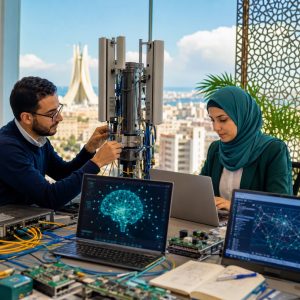
When Algerian founders talk about exits or global scale, the conversation typically gravitates toward super-apps or e-commerce. LabLabee is doing something more quietly radical: it is retraining the engineers who keep global telecommunications networks alive, and it is doing it from Algiers.
Founded in 2021 by Samir Tahraoui and Mahfoud Sidi Ali Mebarek, LabLabee builds hands-on virtual lab environments for telecom professionals who need to master 5G core networks, cloud-native infrastructure, and AI-powered network operations without the luxury of expensive physical hardware. The company closed a $3.4 million seed round in September 2024, led by Reach Capital — a specialist US education technology investor — with participation from Brighteye Ventures, e& capital (the investment arm of UAE operator e&), and two prominent business angels.
The client list reads like a who’s who of global telecoms: Deutsche Telekom, Orange Group, Ooredoo, Axian Group, STC Solutions, Andorra Telecom, and Cetin. LabLabee is not a local success story looking for validation. It is already a global one, built from an Algerian base.
The Market LabLabee Is Addressing
The telecommunications industry is in the middle of the most disruptive technology transition in its history. 5G core networks, cloud-native architectures (OpenRAN, Kubernetes-based network functions), and AI-driven operations are replacing hardware that took decades to master. The engineers who run these networks were trained on equipment that no longer exists in the configurations they are now expected to operate.
The industry’s training problem is structural and urgent. Physical lab environments for 5G and cloud-native telecom are extraordinarily expensive — a single rack configuration for a meaningful 5G training environment can cost hundreds of thousands of dollars. Even large operators cannot afford to provision that infrastructure for every engineer who needs upskilling. And classroom-based certification courses, while useful for theory, do not produce the muscle memory that complex network troubleshooting demands.
LabLabee’s answer is a platform that replicates these environments virtually, with real network topology logic, real failure scenarios, and the same CLI interactions an engineer would face on a live network. The company has partnered with major vendors including Juniper Networks, Windriver, and Amarisoft to ensure the lab environments match the tools operators actually deploy.
This is a platform built for engineers by a team that understands engineering, coming from a country whose universities produce some of the strongest computer science and telecommunications graduates in Africa — graduates who historically had no local market to absorb them.
Advertisement
What This Means for Algeria’s Startup Ecosystem
1. LabLabee proves the B2B SaaS export thesis for Algeria
The dominant narrative about Algerian startups is that they serve the local market: ride-hailing in Algiers, e-commerce for consumers who cannot use international cards, food delivery in Oran. These are legitimate businesses addressing real domestic needs. But they are fundamentally limited by Algeria’s market size and purchasing power.
LabLabee is the proof point that an Algerian startup can build a B2B SaaS product for global enterprise buyers, close a Reach Capital-led seed round from San Francisco, and count Deutsche Telekom and Orange among its paying customers — all while remaining headquartered in Algeria. This matters enormously for the next generation of Algerian founders who are debating whether to stay or relocate.
The message is simple: the talent is here, the product can be world-class, and the buyers will come to you if the problem is real and the solution is differentiated.
2. The US expansion creates a blueprint for Algerian tech diaspora collaboration
LabLabee’s next phase involves entering the US market through partnerships with major cloud hyperscalers — AWS, Azure, and Google Cloud Platform — as an integration partner and training provider. This is not a market that opens easily to newcomers.
To succeed, LabLabee will likely lean on the Algerian and broader Maghrebi diaspora network in Silicon Valley and in major US enterprise hubs. The Algerian diaspora counts tens of thousands of engineers and technologists in the United States, many of them in precisely the sectors LabLabee serves. This is an untapped channel — for customer introductions, for sales partnership, and for product feedback from engineers inside US carriers like AT&T, Verizon, and T-Mobile.
Algerian tech institutions, including CERIST and the ASF, should be actively facilitating introductions between LabLabee and diaspora networks in the US. This is exactly the kind of support that makes the difference between a promising seed-stage company and a Series A-ready global player. Concretely, that means diaspora-led pilot programmes, structured warm-intro pipelines into US carriers, and co-investment vehicles that pair Algerian state capital with diaspora-led syndicates. None of these mechanisms exist at scale today, and building them is a tractable 12-month project for the ecosystem if a single coordinating body commits to it.
3. Telecom operators are the highest-value pilot partners an Algerian startup can have
LabLabee’s partnership with Ooredoo — which operates in Algeria — gives the company a domestic reference customer that carries international credibility. Operators like Ooredoo, Orange, and Djezzy in Algeria are not just potential clients for LabLabee’s platform. They are potential distribution channels for other Algerian tech startups that need enterprise partnerships to get traction.
The precedent LabLabee sets matters: if an Algerian EdTech can close Deutsche Telekom as a client, the ceiling is higher than most ecosystem participants assume. That should recalibrate the ambition level for every B2B startup founder in the country.
Where This Fits in 2026’s Startup Cycle
LabLabee’s seed round was announced in September 2024, but its significance is crystallising in 2026 as the company executes its growth plan. The timing is fortunate: telecoms globally are under pressure to accelerate 5G rollout timelines, cloud-native network modernisation has become a regulatory and competitive imperative in most major markets, and AI integration into network operations is no longer optional for large operators.
LabLabee is positioned in a training market that is structurally growing, competitively uncrowded, and defensible through the quality of its lab environments and vendor partnerships. The question is whether it can convert its EMEA momentum into a US beachhead before better-funded competitors replicate the model.
For Algeria, the stakes are different but equally significant. LabLabee represents the clearest available evidence that Algerian-origin B2B SaaS can compete at the global level. The ecosystem needs to treat it accordingly — with mentorship, with introductions, and with serious investor follow-on when the Series A process opens.
Frequently Asked Questions
What does LabLabee actually sell?
LabLabee provides virtual hands-on lab environments for telecom engineers who need to master 5G core networks, cloud-native infrastructure, and AI-powered network operations. The platform replicates real network configurations without the cost of physical hardware.
Who has invested in LabLabee?
The $3.4 million seed round was led by Reach Capital (a US EdTech specialist VC), with participation from Brighteye Ventures, e& capital (UAE operator e&’s investment arm), and business angels Cedric Sellin and Mohammed Husamaddin.
Why is LabLabee significant for the Algerian startup ecosystem?
LabLabee demonstrates that Algerian-origin B2B SaaS can win global enterprise clients including Deutsche Telekom and Orange Group, and raise capital from specialist international VCs. It is the clearest available evidence that the global B2B export model works from an Algerian base.