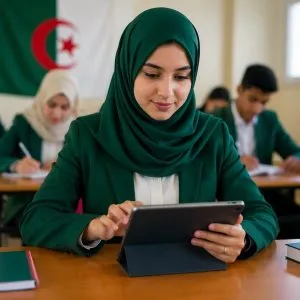
Algeria has 12 million students in general education, 2 million university students — one of the largest university systems in the Arab world — and 4 million people enrolled in vocational training. Youth unemployment stands at 29.7% for the 15–24 age group, according to Ecofin Agency data, driven in significant part by a mismatch between available skills and what employers need. This is, structurally, one of the largest EdTech addressable markets on the African continent.
And yet, as of early 2026, fewer than ten Algerian EdTech startups have raised verifiable external funding. The gap between market size and startup activity is the central puzzle of Algerian EdTech — and understanding it requires looking at the founders, the business models, and the barriers that global platforms have failed to clear.
Why Coursera and Udemy Don’t Work for Most Algerians
The immediate answer to the EdTech gap is not that Algerians don’t want to learn online. The barriers are structural.
Payment. Algeria maintains strict foreign exchange controls. Most individual Algerians cannot hold international credit cards or pay foreign platforms in dollars or euros. Subscriptions to Coursera, Udemy, LinkedIn Learning, or any major global platform require payment infrastructure that the majority of the population simply does not have access to. This is not a content problem — it is a payments infrastructure problem that creates a walled-off market for domestic providers.
Language. Global platforms are predominantly English-language. Arabic content on Coursera represents a small fraction of the catalogue. Algerian students educated in MSA Arabic and French find limited relevant professional development content in languages they are comfortable learning in. The global assumption that professional learners are English-proficient does not hold for a country where 60%+ of the population conducts professional and educational life primarily in Arabic and French.
Relevance. Even where language barriers are overcome, the professional context differs. A course on financial modeling built for US markets will reference accounting standards, regulatory frameworks, and corporate structures that do not apply in Algeria. A course on healthcare management will assume insurance models, hospital structures, and drug approval processes that are foreign to an Algerian nurse or hospital administrator.
Certificate recognition. Perhaps most importantly, Algerian employers and government agencies do not universally recognize international online certificates. A Coursera certificate carries weight in a startup interview; it may carry none in a government ministry or public enterprise HR department.
LabLabee: What $3.4 Million Buys in Algerian EdTech
The most-funded Algerian EdTech company to date is LabLabee, which closed a $3.4 million seed round in September 2024, led by Reach Capital with participation from Classera, Brighteye Ventures, e& capital, and a group of business angels including Cedric Sellin and Mohammed Husamaddin.
The company was founded in 2021 in Oran by Samir Tahraoui and Mahfoud Sidi Ali Mebarek. Tahraoui, a telecom engineer by training, built LabLabee from his own frustration with the gap between academic training and the practical hands-on skills that 5G, cloud-native, and AI infrastructure work demands. In 2022, the startup won the Startup of the Year award at the Total Telecom Congress in London — a signal that it was competing and winning in the global enterprise training market, not just the Algerian one.
LabLabee’s business model is B2B, not B2C. The company sells to telecom operators, technology vendors, industrial companies, system integrators, and universities — not to individual learners. Its clients include Deutsche Telekom, Orange, Ooredoo, and Andorra Telecom. Algérie Telecom lists LabLabee as a product on its enterprise services portal.
The product is a hands-on laboratory platform: learners access virtual network environments where they configure 5G infrastructure, deploy OpenStack cloud, manage Kubernetes clusters, and simulate IMS architecture — the kind of practical experience that traditional classroom instruction cannot easily provide. The training reduces the cost of enterprise hands-on labs by allowing remote, on-demand access without physical equipment.
With the $3.4 million, LabLabee plans to expand into the US market, develop new course tracks in VMware, Red Hat, and Windriver environments, and add modules covering telco security, AI applications in telecommunications, and edge computing. The international expansion trajectory is significant: LabLabee built a world-class product in Oran, validated it with global telecom operators, and is now heading to the US — a path that few Algerian startups have attempted.
Other EdTech Startups to Watch
LabLabee’s B2B telecom training focus leaves the mass consumer and vocational market largely open. Algeria’s broader EdTech landscape — Tracxn counts approximately 46 companies — includes a range of earlier-stage players:
Fennaco Academy operates an online course marketplace targeting Algerian learners with content in Arabic and French across business, language, and professional certification tracks. The platform addresses the payment barrier by accepting local payment methods including BaridiMob and CCP accounts, making it accessible to learners without international cards.
TKAWEN emerged from the University of Badji Mokhtar-Annaba, founded under a 2023 ministerial decree from the Ministry of Higher Education. As a university-backed EdTech, it occupies a distinctive position: it can pursue B2G partnerships with the ministry directly and deploy across Algeria’s 100+ universities without commercial sales cycles. The model trades growth speed for institutional reach.
Synoos Studio focuses on the content production layer — creating Arabic-language educational video content for schools, training centers, and B2B clients. Rather than building a platform, Synoos functions as a content factory, providing the raw material that other platforms and institutions need. In a market where Arabic EdTech content is scarce, this upstream position has strategic value.
CLOC and Zed Academy represent early-stage consumer-focused platforms building subscription libraries of professional and language courses in Arabic and French. Both remain pre-institutional-funding but have built organic user bases.
Regionally, Egypt’s Nafham — the Arab world’s largest school-curriculum video platform, established in 2012 — has extended its coverage to Algeria alongside GCC markets, providing an indication that cross-border Arabic EdTech can work in the Algerian market when the content matches the national curriculum.
Advertisement
Market Sizing: The Numbers Behind the Opportunity
Algeria’s Ministry of National Education manages a school system of 12 million students across 28,000+ institutions. The Ministry of Higher Education oversees 2 million university students across 110 universities and grandes écoles. The Ministry of Vocational Training and Apprenticeship (MFEP) runs a system training over 4 million people annually — and announced plans to add 285,000 new training places for the 2026 intake, including 57,000 new apprenticeship slots.
These numbers create three distinct addressable markets:
- K-12 supplementary learning: Tutorial platforms, exam prep, remedial education for 12M students whose families will pay for supplementary support. This is the segment where Nafham-style platforms compete.
- University and professional certification: 2M students plus a professional workforce seeking recognized certifications. Payment capacity is higher; content depth requirements are greater.
- Vocational and corporate training: The MFEP system is a massive B2G opportunity. Any EdTech platform that can deliver certified vocational training at scale and receive government recognition can access procurement budgets rather than individual consumer wallets.
The corporate training market — where LabLabee operates — is a fourth category growing rapidly as Algerian companies invest in workforce digitalization under the “Algeria Digital 2025” national strategy.
Business Models That Actually Work
The most sustainable Algerian EdTech businesses share one characteristic: they solve the payment problem by avoiding international payment dependencies. LabLabee avoids it entirely by selling to corporations. Fennaco Academy builds on local payment rails. TKAWEN sidesteps it via institutional government relationships.
B2B corporate training offers the highest revenue per customer and the most sustainable margins — a single enterprise contract can be worth 5–10x a year of individual subscriptions. The downside is a longer sales cycle and dependency on the corporate training budget cycle.
B2G government partnerships offer massive scale but require compliance with procurement rules, curriculum approval processes, and political relationships. Margins are typically lower, payment terms are longer, and the risk of regulatory change is higher. TKAWEN’s university origin gives it a structural advantage here.
B2C subscription works in Algeria if built on local payment rails, at price points calibrated to local purchasing power (typically DZD 500–2,000/month for a subscription), and with content genuinely tailored to the Algerian curriculum and professional market.
The riskiest business model is the direct translation of a Western EdTech model — English-only, international credit card, globally oriented content — into the Algerian market without adaptation. This is why Coursera, despite its catalogue breadth, remains inaccessible to most of the target population.
The Darija Problem
Every Algerian EdTech founder eventually faces the same content question: which variety of Arabic? Modern Standard Arabic (MSA/Fusha) is formally correct and understood across the Arab world, but Algerian students find it less engaging for informal learning than the Darija they speak at home. French remains the language of large parts of Algeria’s technical and professional education. And English is rising in priority given the global internet’s English-language dominance.
The practical answer that the best Algerian EdTech teams have arrived at is a hybrid approach: MSA for formal instruction, academic explanations, and content that benefits from pan-Arab distribution; Darija for tutorial narration, motivational content, and anything where relatability drives engagement; French for technical professional certification tracks. This is not a linguistically elegant solution, but it reflects how Algeria’s educated workforce actually communicates.
Content production in this environment is expensive. A single hour of quality Arabic video content costs 3–7 times the equivalent English content to produce, because the pool of bilingual (MSA/Darija) educators who are also comfortable on camera is small. Recruiting and training content creators is a limiting factor that platforms cannot simply buy their way out of — it requires community development and teacher partnership programs.
Funding Landscape
LabLabee’s $3.4 million seed is the benchmark. Below it, most Algerian EdTech companies operate on bootstrapped capital, ASF micro-grants (Algérie Startup Fund), ANSEJ loans, or very early angel funding. The international investors who backed LabLabee — Reach Capital (US-based EdTech specialist), Brighteye Ventures (European EdTech VC), and e& capital (Gulf telco group VC arm) — were drawn by LabLabee’s B2B telecom training angle and its international client base, not by the Algerian consumer market.
The consumer EdTech segment remains largely unfunded by international capital. Regional MENA investors (Algebra Ventures, Flat6Labs, others) have deployed in Egyptian EdTech but have minimal Algeria presence. The ASF’s EdTech investments have been small, and the exit pathway for EdTech investors (IPO via the new COSOB Growth segment, or acquisition by a Gulf EdTech player) is still unproven.
The next catalyst for Algerian EdTech funding may come from strategic investors in the Gulf EdTech space — Saudi, UAE, and Qatari companies building Arabic content libraries — who see Algeria’s 12 million student population as an expansion market rather than a startup investment target.
Frequently Asked Questions
What is edtech startups in algeria?
EdTech Startups in Algeria: LabLabee and the Race to Teach in Arabic covers the essential aspects of this topic, examining current trends, key players, and practical implications for professionals and organizations in 2026.
Why is edtech startups in algeria important for Algeria?
This topic is significant for Algeria because it intersects with the country’s digital transformation goals, economic diversification strategy, and growing technology ecosystem. The article provides specific context for Algerian stakeholders.
How does lablabee: what $3.4 million buys in algerian edtech work?
The article examines this through the lens of lablabee: what $3.4 million buys in algerian edtech, providing detailed analysis of the mechanisms, trade-offs, and practical implications for stakeholders.
Sources & Further Reading
- Algerian Edtech LabLabee Closes $3.4 Million Seed Round — Wamda
- Algerian Edtech Startup LabLabee Secures $3.4M Seed Funding — Daba Finance
- Algeria’s LabLabee Raises $3.4M to Lead Training in 5G, Cloud, and AI Technologies — Launch Base Africa
- Algeria’s LabLabee Closes $3.4M Seed to Expand Offerings and Enter the US — TechPoint Africa
- Algeria Plans 285,000 New Vocational Training Places in 2026 — Ecofin Agency
- Top Startups in EdTech in Algeria — Tracxn
- 2024 Middle East & North Africa EdTech 50 — HolonIQ
- 8 Startups Revolutionising E-Learning in MENA — The Startup Scene
- Algerian Edtech LabLabee Raises $3.4 Million — Empower Africa
- LabLabee — Algérie Telecom Partner Product