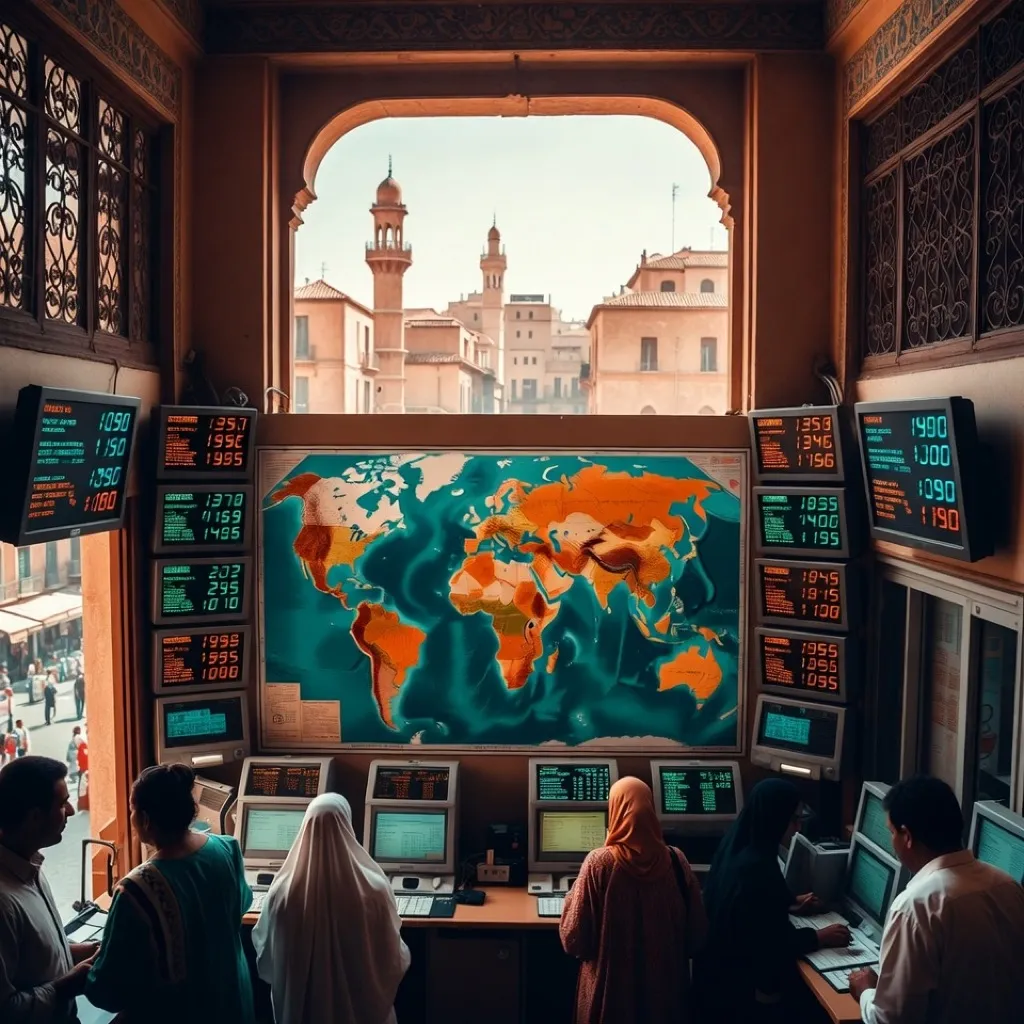
Somewhere between five and seven million Algerians live outside their country. The majority are in France, with significant communities in Canada, Belgium, and the Gulf states. Each year, they send money home — to parents, to siblings, to children at university, to family members who depend on foreign income to cover household expenses that local salaries cannot.
In 2024, the formally recorded value of those transfers was $1.86 billion (the most recent World Bank figure available as of early 2026). The real number is almost certainly higher, because a significant portion of Algeria-bound remittances travel through channels that do not appear in official statistics: hawala brokers, friends and relatives carrying cash on planes, and informal exchange networks that offer better rates than any bank.
Understanding why so much of Algeria’s diaspora remittances flow outside formal channels — and what it would take for fintech to capture that flow — requires examining a specific set of constraints that make Algeria’s remittance market genuinely different from Morocco’s or Senegal’s.
Algeria’s Remittance Market: The Real Numbers
Algeria received $1.86 billion in formal remittances in 2024, up from $1.77 billion in 2023. These figures are recorded by the World Bank and reflect transfers processed through approved operators — licensed banks, Western Union, MoneyGram, and equivalent authorized channels. Full-year 2025 World Bank remittance data for Algeria had not yet been published at the time of writing.
At 1.1% of GDP, Algeria’s remittance dependency is modest compared to other North African economies. Morocco’s remittances equaled 7.8% of GDP in the same year — a figure that reflects both a larger diaspora per capita and, crucially, a much more developed formal remittance infrastructure that captures a larger share of actual transfers.
The diaspora geography matters: 80% of Algeria’s remittances originate from France, according to the European Commission’s JRC research report on North African remittances. France has an estimated two million Algerians, making it the primary sending corridor. Canada, Belgium, and Gulf states are secondary. The France-to-Algeria corridor is, by volume, the only corridor large enough to sustain dedicated product development.
Average transfer sizes and seasonality follow predictable patterns: transfers increase around Eid al-Adha and Eid al-Fitr, when family obligations peak, and before the Algerian academic year. The typical transfer from France is a few hundred euros — small enough that percentage-based fees matter significantly.
The Cost Problem: What Families Actually Pay
A French-Algerian worker in Paris sending €300 to family in Algiers today faces a fee structure that varies significantly by channel:
- Western Union (online): approximately 3-5% for the France-Algeria corridor, depending on send method and amount. Cash pickup at agent locations in Algeria is available within minutes.
- MoneyGram: comparable pricing to Western Union; similar agent network.
- Bank wire transfer: typically 5-8% in combined fees, plus poor exchange rates. Transfer time: 3-5 business days.
- Wise: offers competitive rates for many corridors; Algeria is accessible with limitations — recipients can receive to Algerian bank accounts in some configurations, but the full-service experience available in Morocco or Tunisia is not replicated. Constraints relate to DZD’s non-convertibility.
For a €300 transfer at 5% fee: the family receives the equivalent of €285 after fees, and the effective cost is €15 per transfer. Across millions of annual transfers, the aggregate fee extraction from the Algerian diaspora by traditional money transfer operators runs into hundreds of millions of euros.
The Core Constraint: The Dinar Problem
Algeria’s currency — the dinar (DZD) — is not convertible. It cannot be purchased or exchanged outside Algeria. It cannot be held in foreign accounts. All inward remittances must be received through Bank of Algeria-approved channels, which means the money must enter the Algerian formal banking system before it reaches the recipient.
This non-convertibility is the primary reason that fintech innovation in the France-Algeria remittance corridor has lagged behind comparable corridors. A fintech company building a Morocco-France product can design freely around the dirham’s convertibility. A company building an Algeria-France product must design within a constraint structure that effectively requires a licensed Algerian banking partner for the receiving side — raising capital requirements, regulatory complexity, and operating costs.
The constraint also feeds the informal channel. If the official DZD exchange rate is less favorable than the parallel market rate — which it often has been — then a remitter who sends money through informal channels and has the recipient exchange at parallel rates effectively sends more value home than a remitter using the formal system. Hawala brokers in Paris and Algiers exploit this differential systematically.
Advertisement
What’s Available Now: The Fintech Landscape
Western Union and MoneyGram remain dominant by agent network depth. Algeria has thousands of authorized agent locations — post offices, approved banks, exchange bureaus — that cash Western Union orders. For recipients without bank accounts, this agent network is the only accessible receiving option.
Wise operates in Algeria with notable limitations. The platform can process sends to Algerian bank accounts in certain configurations, but the full-service instant transfer experience Wise provides in Morocco or Tunisia is not yet available. Wise’s “mid-market exchange rate” promise is attractive, but DZD’s non-convertibility limits what that promise can deliver in practice.
WorldRemit and Sendwave offer cash pickup in Algeria through partner bank networks — similar to Western Union’s model but with a digital-first sender experience.
TemTem’s Diaspora feature is the most creative solution available from an Algerian company. Rather than sending cash, the feature allows Algerians abroad to purchase goods and services for family members in Algeria — ordering a grocery delivery, paying a utility bill, or sending a restaurant meal. By transacting in goods rather than currency, TemTem sidesteps the DZD convertibility constraint entirely. The company describes itself as “the first Algerian company to provide such services to our diaspora,” and the product has demonstrable uptake among diaspora users who want to provide for family without the friction of formal remittance.
The gap: no dedicated Algeria-specific digital remittance startup with full DZD delivery and competitive pricing yet exists at meaningful scale. The market opportunity is real; the regulatory constraints are the barrier.
The Informal Channel Reality
Hawala — the trust-based transfer system that uses broker networks to settle value across borders — remains widely used for Algeria-bound remittances. A hawala broker in Paris receives euros from a sender, communicates the amount to a counterpart in Algiers, and the Algiers broker delivers dinars to the recipient. No physical money crosses the border; the system settles periodically through various mechanisms.
Hawala’s appeal in the Algeria context is threefold: it is fast (same-day delivery is common), it can offer parallel market DZD rates that outperform official rates, and it requires no formal bank account or government documentation for the recipient. For rural Algerian families without convenient bank branch access, hawala may be the only practical option.
The regulatory status of hawala in Algeria is ambiguous — it is neither explicitly licensed nor consistently prosecuted, occupying the same grey zone that characterizes much of Algeria’s informal financial sector. For remittance fintech to displace hawala, formal channels need to match it on speed, beat it on rate, and offer receiver convenience that matches or exceeds the informal agent’s local familiarity.
The Morocco Benchmark: What Built-Out Looks Like
Morocco demonstrates what a developed remittance ecosystem generates. Morocco received approximately $11.8 billion in formal remittances in 2024 — 7.8% of GDP — from a diaspora of comparable absolute size to Algeria’s.
The infrastructure difference is stark. CIH Bank and Attijariwafa Bank have dedicated diaspora banking products: accounts designed for non-resident Moroccans, remittance-linked savings products, and international partnerships with WorldRemit and Western Union that provide competitive rates. Morocco’s government incentivizes diaspora engagement with tax advantages on Morocco-based investments and property.
The result is that Moroccan diaspora remittances are overwhelmingly formal — captured in statistics, generating fee revenue for Moroccan financial institutions, and contributing transparently to the national economy. Algeria’s formal remittance capture is a fraction of the real flow.
The Morocco lesson for Algeria is not primarily technical — it is about trust and convenience. Moroccan diaspora members remit formally because doing so is easy, competitive on price, and linked to financial products that reward engagement. When the formal channel is better than the informal channel in all three dimensions, informal channels shrink.
The Regulatory Path Forward
The most consequential regulatory change for Algeria’s remittance market would be a Bank of Algeria framework that specifically licenses remittance fintech operations — separate from the broader PSP framework — with requirements calibrated to the France-Algeria corridor’s specific dynamics.
Short of full DZD convertibility (a monetary policy decision with macroeconomic implications far beyond fintech), several intermediate reforms would meaningfully improve the formal remittance landscape: official API access to Algerian bank receiving infrastructure for licensed international partners; expedited licensing for fintech companies building specifically on the diaspora corridor; and diaspora-specific DZD accounts accessible through digital banking at competitive rates.
The TemTem goods-in-kind model proves that creative workarounds exist within current constraints. Scaling that model — or building analogous ones for utility payments, insurance premiums, or educational fees — could capture significant diaspora financial flows that currently move informally, without requiring full DZD convertibility.
Frequently Asked Questions
What is sending money home?
Sending Money Home: Fintech Startups Targeting Algeria’s Diaspora Remittances covers the essential aspects of this topic, examining current trends, key players, and practical implications for professionals and organizations in 2026.
Why does sending money home matter?
This topic matters because it directly impacts how organizations plan their technology strategy, allocate resources, and position themselves in a rapidly evolving landscape. The article provides actionable analysis to help decision-makers navigate these changes.
How does the cost problem: what families actually pay work?
The article examines this through the lens of the cost problem: what families actually pay, providing detailed analysis of the mechanisms, trade-offs, and practical implications for stakeholders.
Sources & Further Reading
- Algeria Remittances Data — TheGlobalEconomy.com
- Remittances in North Africa: Sources, Scale and Significance — European Commission JRC
- Sending Money from France to Algeria — World Bank Remittance Prices Worldwide
- African Remittance Startups Surge as Inflows Hit Record $56B in 2024 — Tech In Africa
- Why Are Remittance Startups Ignoring the Countries That Need Them Most? — Tech In Africa
- Top 10 Diaspora Remittance Destinations in Africa — Daba Finance
- 8 Young Promising Fintech Startups from North Africa to Monitor in 2025 — Fintech News Africa
- Algeria MTM i-Map Migration and Development — GFMD
- Fintech Algérie 2024: Solutions Paiement Digital — Symloop
- Algeria — Digital Economy — US International Trade Administration