A Record Year for Digital Money in Algeria
Algeria’s digital payment ecosystem just had its strongest year on record. The total value of electronic payments — across point-of-sale terminals, the internet, and mobile phones — reached 939 billion dinars in 2025, up from 643.8 billion dinars in 2024, a 46% increase reported by GIE Monétique, the economic interest grouping that consolidates electronic-payment data for the country’s banks. It is the kind of step-change that turns a payment channel from a convenience into core financial infrastructure.
The headline figure is impressive, but the composition underneath it tells the real story. Online payments — card transactions made over the internet — grew the fastest of any segment, surging 179% to 145 billion dinars across more than 27 million transactions. The average online transaction has grown in tandem, rising from 1,180 dinars in 2020 to roughly 5,400 dinars in 2025 — a sign that Algerians are no longer just topping up phone credit online, but paying for higher-value goods and public services with growing confidence.
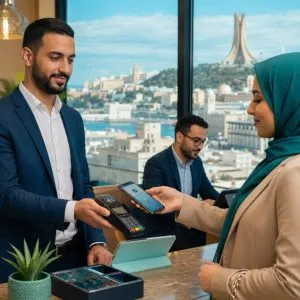
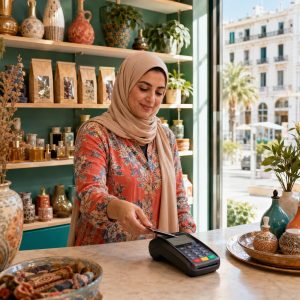
Card acceptance in physical stores moved up just as decisively. The total value processed through point-of-sale (TPE) terminals doubled to 89.5 billion dinars, while the installed terminal base grew 15.61% from 68,140 units in December 2024 to 78,774 by December 2025. The interbank card base passed 21.8 million cards, and the ATM network expanded by 737 machines to reach 4,679 nationwide.
DZ Mob Pay: The Interbank Layer That Closes the Loop
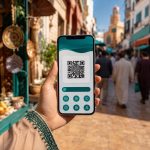
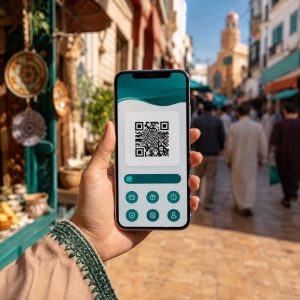
The most strategically important development of 2025 was not a number but a platform. DZ Mob Pay, launched in January 2025, is Algeria’s first fully interbank mobile payment system: it lets a customer at one bank pay a merchant — or send money to an individual — at any other participating bank, instantly, by scanning a QR code. Funds reach the merchant in under ten seconds, with the system built by the Regroupement des Guichets Automatiques (RGA).
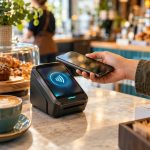
In its first year the platform recorded 95,014 personal accounts and 14,283 merchant accounts — a base built entirely from scratch in twelve months. Crucially, DZ Mob Pay solves the fragmentation that long held mobile payments back: until now, each bank’s wallet largely worked only within that bank. By the close of 2025 the network covered seven banks plus Algérie Poste, expanding to nine with the addition of BADR and Fransabank Algérie, and is targeting 15 participating banks by the end of 2026. On the horizon, SoftPOS technology — planned for late 2026 — will let any merchant with an NFC-enabled smartphone accept contactless card payments without buying a dedicated terminal, dramatically lowering the cost of acceptance for small traders.
Advertisement
What Public Services Did for the Numbers
A defining feature of 2025’s surge is how much of it came from the state moving its own services online. Many public administrations now accept — or require — electronic payment for access to their services, and that single shift pulled millions of citizens into the digital payment habit. The clearest illustration came in December 2025, when the platform recorded an exceptional monthly peak of 3.6 million transactions worth 65.27 billion dinars, driven largely by the first installments of the AADL 3 housing program paid online. When a national program of that scale defaults to online payment, it normalizes the channel for households that might otherwise have waited years to try it.
This is the compounding mechanism behind the growth story: every public service that goes digital creates a reason for a citizen to open a wallet, register a card, or download an app — and once that infrastructure is in place, private commerce inherits a payment-ready customer. The number of integrated web merchants reflects that pull, growing 26.27% to 644 by the end of 2025.
What Algerian Businesses Should Do
The surge creates a clear, time-sensitive opportunity for merchants, banks, and digital service providers to position themselves while adoption curves are still steep. The businesses that build for the digital channel now will own the customer relationships that form over the next three years.
1. Enroll in DZ Mob Pay and online acceptance before the 2026 expansion wave
With the interbank network heading toward 15 banks in 2026 and SoftPOS arriving by year-end, the cost and friction of accepting digital payments are about to drop sharply. Merchants should enroll for QR acceptance and online checkout now, rather than waiting for the rollout to mature. Early adopters capture the customers who are forming new payment habits today — and a merchant already visible inside DZ Mob Pay when a new bank joins inherits that bank’s customers automatically.
2. Treat online checkout as a primary sales channel, not an add-on
With online payment value up 179% and average online ticket sizes more than quadrupling since 2020, the internet channel is where the fastest revenue growth now lives. Retailers, service providers, and SMBs should integrate the SATIM-backed CIB/Edhahabia online gateway, design mobile-first checkout flows, and measure online conversion as rigorously as in-store sales. The 644 integrated web merchants today are a small base relative to the addressable market — meaning first movers in any category still have room to dominate.
3. Build for the public-service payment moment
The single biggest adoption driver in 2025 was citizens paying the state online. Businesses adjacent to public services — utilities, insurance, education, transport, housing — should align their payment options with the channels citizens are already using for AADL, tax, and administrative payments. A customer who just paid a housing installment by card is primed to pay a private bill the same way; meeting them in that moment converts a one-time government transaction into a recurring digital relationship.
Where This Fits in Algeria’s 2030 Cashless Roadmap
The 2025 numbers are not an isolated spike — they are the early curve of a national strategy. Algeria’s Haute instance de numérisation has set out a digital roadmap structured around 25 objectives, including the launch of “Cashless Accounts” to widen financial inclusion and, from 2030, a ceiling that will bar cash payments above 500,000 dinars to improve traceability and strengthen the formal economy. The infrastructure built in 2025 — 21.8 million cards, 78,774 terminals, an interbank mobile rail, and a maturing online gateway — is precisely the foundation that an economy needs before such a transition becomes practical.
What makes the trajectory credible is that the building blocks are reinforcing one another. DZ Mob Pay gives the un-carded a phone-based entry point; SoftPOS lowers acceptance costs for the smallest merchants; public-service digitization supplies the demand; and SATIM’s national instant switch ties the rails together. For Algerian businesses and citizens, the message is the same: the digital payment economy is no longer arriving — it has arrived, it is compounding, and the window to build a position inside it is open now. The country has covered the hardest distance — turning a habit on — and the years ahead are about scaling what is already working.
Frequently Asked Questions
What is DZ Mob Pay and how does it work?
DZ Mob Pay is Algeria’s first fully interbank mobile payment system, launched in January 2025 and built by the Regroupement des Guichets Automatiques (RGA). Users pay merchants or send money to individuals by scanning a QR code, with funds settling in under ten seconds — even when the two parties bank with different institutions. It ended 2025 with more than 95,000 personal accounts and 14,000 merchant accounts, covering seven banks plus Algérie Poste, with a target of 15 banks in 2026.
How big is Algeria’s electronic payment market in 2025?
According to GIE Monétique, electronic payments across terminals, the internet, and mobile reached 939 billion dinars in 2025, up 46% from 643.8 billion dinars in 2024. Online payments grew fastest at 179% (145 billion dinars across 27 million-plus transactions), point-of-sale value doubled to 89.5 billion dinars, and the interbank card base passed 21.8 million cards.
What is Algeria’s 2030 cashless target?
Algeria’s Haute instance de numérisation has set a national digital roadmap built around 25 objectives, including new “Cashless Accounts” to widen financial inclusion. From 2030, cash payments above 500,000 dinars are set to be barred, a measure designed to improve financial traceability and strengthen the formal economy as digital infrastructure matures.
Sources & Further Reading
- Further Reading
- Algeria’s electronic payments reached 939 billion dinars in 2025, up 46% — Algerie Eco
- Electronic payment in Algeria grows 46% in 2025 — Horizons
- Algeria’s e-payment passes 22 million cards — We Are Tech Africa
- DZ Mob Pay to extend to 15 banks by 2026 — Algerie360
- DZ Mob Pay: a mobile payment revolution in Algeria — El Moudjahid
- E-payment 939 billion dinars in 2025, driven by public services and DZ Mob Pay — Algeria Invest
- End of cash: Algeria’s new strategy — Observalgerie
🔗 Related Intelligence

Algeria Payments: The 179% Surge and What Merchants Must Do in 2026
Algeria’s Digital Payment Infrastructure: 78K Terminals, 644 Online Merchants, and a 46% Surge
Algeria’s 46% Payment Surge: How SMEs Can Capture the Digital Revenue Wave
DZ Mob Pay: How Algeria’s Interbank QR Wallet Scales to 15 Banks by 2026