The Numbers Behind the Gap
Algeria’s data center market is projected to grow at 8.6% CAGR from 2023 to 2029 according to 6Wresearch, one of the faster growth trajectories in North Africa. The demand drivers are straightforward: 59.1 million internet subscriptions generating 3.3 billion gigabytes of data consumption per quarter, a national AI strategy mandating cloud infrastructure expansion, and growing public-sector digitization that requires sovereign data processing on Algerian soil.
Yet the supply side tells a starkly different story. Algeria has only a handful of commercial data center operators — identified by ResearchandMarkets as including ICOSNET (telco-neutral colocation), Sonatrach (first Tier-III certified facility), Eurl Host Arts, and Ayrade Technology. For a country of 44 million people with accelerating digital consumption, this is an extreme undersupply. Nigeria, with a broadly comparable economic profile, has over 40 commercial data center facilities. South Africa has more than 60. Even Morocco, with a smaller population, has significant colocation capacity.
The Tier rating distribution compounds the problem. Algeria’s market is dominated by Tier-II rated facilities — adequate for moderate availability requirements but insufficient for the 99.982% uptime tier that financial services, healthcare, and government critical applications require. The absence of widespread Tier-III+ commercial colocation forces enterprises either to build their own dedicated infrastructure (expensive, slow to deploy) or to route workloads to hyperscaler cloud regions in Europe, which creates data sovereignty concerns for regulated sectors.
Advertisement
What Operators Must Build — and What Investors Should Know
1. The Immediate Gap Is Carrier-Neutral, Multi-Tenant Colocation
The most acute shortage is not raw floor space — it is carrier-neutral colocation: facilities where an enterprise can colocate servers and then choose from multiple connectivity providers (Algérie Télécom, Cevital’s networks, ISP wholesale providers) for their circuit requirements. Carrier-locked facilities, where the data center and the connectivity are bundled from a single provider, limit competition and create vendor lock-in that commercial enterprises strongly resist. ICOSNET’s telco-neutral positioning has made it the default choice for enterprises willing to pay a premium, but its capacity constraints mean it regularly turns away new clients.
The Medusa and Africa-1 cable landings in 2026 increase the strategic value of carrier-neutral colocation dramatically: an enterprise colocating in a carrier-neutral Algiers facility will be able to access both new cable systems independently, without dependency on a single operator’s backhaul network. Operators building new carrier-neutral facilities in 2026–2027 will be able to offer multi-cable diversity as a headline feature.
2. Tier-III Certification Is the Commercial Grade Floor for Enterprise Buyers
Sonatrach’s introduction of a Tier-III certified design set a benchmark, but that certification was for an internal facility. The commercial colocation market needs Tier-III certified multi-tenant facilities that any enterprise can access on a standard colocation agreement. Tier-III certification (Uptime Institute) requires concurrent maintainability — meaning any component can be serviced without taking the facility offline — and targets 1.6 hours of downtime per year versus the 28 hours typical of Tier-II.
For international investors and Algerian operators evaluating data center construction, Tier-III certification should be treated as the minimum viable grade for a commercially competitive facility. Enterprises in banking, insurance, telecommunications, and regulated healthcare will not sign colocation agreements for production workloads in facilities below this threshold. The certification cost and design premium (~15–20% above Tier-II construction) is recoverable within 2–3 years at the pricing premium that Tier-III certified space commands.
3. Edge Data Centers in Secondary Cities Are an Underserved Opportunity
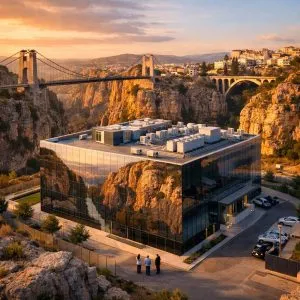
All current Algerian data center capacity is concentrated in Algiers and its immediate region. Yet Algeria’s AI strategy explicitly identifies digital infrastructure expansion beyond the capital as a national priority, and the 5G deployments by Mobilis, Djezzy, and Ooredoo are creating latency-sensitive application demand in Oran, Constantine, Annaba, and Sétif. Edge data centers — smaller facilities (50–500 kW IT load) positioned in secondary cities — reduce application latency for locally-generated data, support government digitization at the wilaya level, and distribute disaster recovery risk that is currently concentrated in a single geographic area.
This opportunity is addressable by medium-scale operators rather than requiring the $50–100M investment typical of a large colocation campus. A 200–300 kW edge data center in Oran serving the western industrial corridor and supporting 5G backhaul aggregation is a viable project in the DZD 800M–1.5B ($6–11M) range, a scale accessible to Algerian private developers with appropriate financing.
The Structural Lesson: Demand Visibility Is Not Investment Signal
Algeria’s data center gap has been visible for years, yet the supply response has been slow. The structural reason is not lack of demand — the 8.6% CAGR and the observable queue of enterprises seeking colocation make demand legible. The reason is the combination of three barriers: land access and permitting complexity for industrial facilities, the difficulty of securing reliable power supply at large scale (data centers require 24/7 uninterruptible power — a challenge given Algeria’s grid reliability in industrial areas), and the limited availability of the specialized engineering firms capable of building, commissioning, and certifying Tier-III facilities.
For investors and developers evaluating the opportunity, the correct framing is not “is there demand?” but “can the enabling conditions be assembled?” The enabling conditions — land, power, engineering, financing, and regulatory clarity — require simultaneous resolution. The operators who have moved (ICOSNET, Sonatrach) did so by internalizing most of these enablers rather than relying on external markets for each. New entrants in 2026 should expect a 24–36 month development timeline from project inception to commercial operations, and should budget contingency for grid interconnection delays that have historically added 6–12 months to data center construction timelines.
The Medusa and Africa-1 submarine cable landings scheduled for Algeria in 2026 add a specific urgency to this timeline. Both cables bring significantly higher international bandwidth capacity to the country, which directly increases demand for local data center space to terminate, aggregate, and distribute that traffic. Enterprises in banking and telecommunications that have been routing latency-sensitive workloads to European cloud regions will face renewed pressure from regulators and internal compliance teams to move those workloads onto Algerian soil once the bandwidth argument — historically used to justify offshore routing — weakens. Data center operators who have commercial capacity available at the moment these cables land will capture a wave of enterprise colocation contracts that competitors still under construction cannot serve. The 2026–2027 period is therefore not just a favorable window for new development — it is a hard deadline for any operator that wants to be positioned for the first large-scale enterprise migration cycle.
Frequently Asked Questions
How many commercial data centers does Algeria currently have?
Algeria has only a handful of commercial data center operators, notably ICOSNET (the largest telco-neutral colocation provider), Sonatrach (which introduced the country’s first Uptime Institute Tier-III certified design facility), Eurl Host Arts, and Ayrade Technology. This compares unfavorably to comparable markets — Nigeria has over 40 commercial data center facilities, South Africa more than 60 — making Algeria one of the most underpenetrated data center markets in Africa relative to its population and economic size.
What is driving Algeria’s data center market growth?
The primary drivers are: 59.1 million internet subscriptions generating 3.3 billion gigabytes of data consumption per quarter (Q2 2025), the national AI strategy requiring cloud infrastructure expansion, growing public-sector digitization at the wilaya and national level, and data sovereignty requirements in regulated sectors (banking, telecommunications, healthcare) that require on-soil data processing. The 5G network deployments by Mobilis, Djezzy, and Ooredoo add a fourth driver: 5G backhaul aggregation infrastructure that needs local data centers to function efficiently.
What is the investment required to build a Tier-III data center in Algeria?
A medium-scale edge data center (200–300 kW IT load) in a secondary city such as Oran or Constantine is viable in the DZD 800M–1.5B ($6–11M) range. A full carrier-neutral colocation campus in Algiers at 2–5 MW IT load typically requires $30–70M depending on land and grid interconnection costs. Investors should budget a 24–36 month development timeline and 6–12 months of contingency for grid interconnection, which has historically been the longest-lead item in Algerian data center projects.
—
Sources & Further Reading
🔗 Related Intelligence
Algeria’s Cloud Market Will Hit $450 Million by 2035: What’s Driving the Growth
Data Center Cooling in a Desert Nation: Algeria’s Unique Infrastructure Challenge

The Algeria–Oman Data Center Template: A Replicable Model for Gulf-Africa Infrastructure Deals
Constantine’s Data Centers: Expanding Enterprise Cloud Beyond Algiers