Why Industrial 5G Is Different From Consumer 5G
Algeria’s five-year 5G wait is over, but the technology that matters most for enterprise value is not the same 5G that consumers experience on their smartphones. Consumer 5G delivers faster downloads and lower ping times — real improvements, but improvements that compete directly with existing 4G capability and with Wi-Fi in most enterprise settings.
The industrial value proposition runs on a different set of technical capabilities:
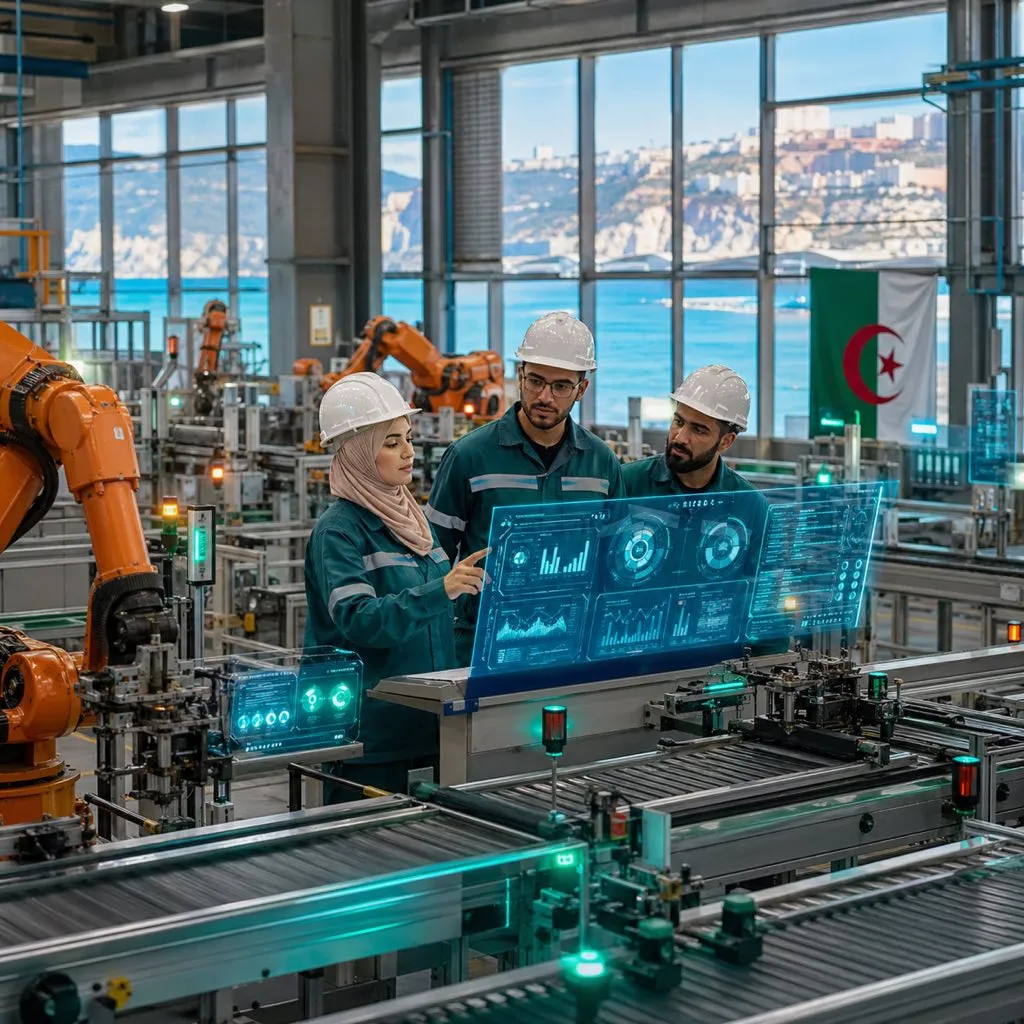
Ultra-Reliable Low Latency Communication (URLLC) enables real-time machine control with round-trip latency below 1 millisecond — necessary for robotic arm coordination, conveyor belt synchronization, and safety systems that must respond faster than a human operator can.
Massive Machine-Type Communications (mMTC) supports up to one million connected devices per square kilometer — the density required for deploying thousands of environmental sensors, vibration monitors, and RFID tags across a large factory floor without congestion.
Network slicing allows operators to carve dedicated virtual networks for industrial use, isolating factory traffic from consumer traffic on the same physical infrastructure and guaranteeing bandwidth for critical applications.
Algeria’s current deployment uses Non-Standalone (NSA) 5G architecture — 5G radio access layered on existing 4G core networks. NSA delivers the speed benefits but not yet the full URLLC and network slicing capabilities. Full Standalone (SA) 5G, which unlocks the industrial use cases, will phase in across the six-year rollout. The enterprise adoption window is now: the time to design the factory network architecture, establish vendor relationships, and run proof-of-concept pilots is during the NSA phase, before SA capacity arrives fully deployed.
Algeria’s Industrial Base — Who Gains First
Algeria has a concentrated industrial base that is a natural first market for 5G industrial adoption. Three sectors stand out by scale and readiness:
Steel and heavy industry. The Bellara Steel Complex in Jijel (operated by Sider-Spain joint venture) and the Tosyali Algérie flat steel facility in Oran represent some of the most capital-intensive industrial investments in Algeria’s recent history. Both facilities operate continuous-cast production lines where real-time sensor data from furnace temperatures, roller pressures, and coil thickness directly affects product quality and energy consumption. A 5G-connected sensor mesh across these facilities — feeding edge computing nodes that apply ML models to predict equipment wear before failure — is a proven use case in comparable European and Asian steel plants.
Automotive assembly. The Volkswagen assembly plant in Relizane and the Renault Algérie Production facility in Oran have both invested in modern assembly line infrastructure. These facilities use a mix of manual assembly and semi-automated processes, with increasing pressure from parent companies to report on production efficiency metrics and supply chain visibility. 5G-enabled connected tools — torque wrenches that report tightening data in real time, AR-assisted assembly guidance systems, and automated guided vehicles — are already standard in Volkswagen and Renault factories in Europe. The Algeria operations will face pressure to close the capability gap as parent company Industry 4.0 programs mature.
Petrochemicals and energy. Sonatrach’s refinery and petrochemical complexes — at Skikda, Annaba, and Arzew — operate infrastructure where predictive maintenance is not a productivity enhancement but a safety requirement. Unplanned downtime in an active refinery creates explosion and environmental risks. 5G-connected vibration sensors, thermal imaging systems, and digital twin platforms that model plant behavior against sensor data are investment cases with both economic and regulatory dimensions in the petrochemical sector.
Advertisement
What Algerian Enterprise IT Leaders Should Do
1. Commission a 5G-readiness audit for your primary production site before operator coverage reaches your wilaya
The initial 5G coverage covers eight pilot wilayas (Algiers, Oran, Constantine, Sétif, and four additional provinces) with nationwide expansion over six years. Enterprises in the pilot wilayas should use the 2026 period to run a structured 5G readiness audit covering: (a) existing wired and Wi-Fi network topology in production areas, (b) current SCADA and industrial control system (ICS) architecture, (c) endpoints and sensors that could be 5G-enabled, and (d) the latency and bandwidth requirements of planned IoT applications. This audit is the prerequisite for any vendor engagement or pilot design. Enterprises in provinces not yet in the rollout plan should begin the audit now so they are ready to deploy the moment coverage arrives — waiting for coverage before starting the architecture work adds 12-18 months of unnecessary delay.
2. Design a private 5G network architecture for campus or factory floor deployment
The most capable industrial 5G deployments are not operated on public operator networks. They use private 5G — dedicated spectrum and base station hardware installed on the enterprise’s own premises, operated either by the enterprise IT team or by an operator under a managed service agreement. Private 5G eliminates the latency variability and bandwidth sharing of public networks, allows full control over network slicing configurations, and keeps industrial control traffic completely isolated from any external network. ARPCE has not yet published a formal private spectrum allocation framework for industrial 5G in Algeria, but enterprises should engage ARPCE directly and work with Mobilis, Djezzy, or Ooredoo on managed private network agreements. The operators have a commercial incentive to accelerate enterprise private network offerings — this is a negotiating opportunity rather than a regulatory barrier.
3. Select an edge computing partner before you select IoT hardware
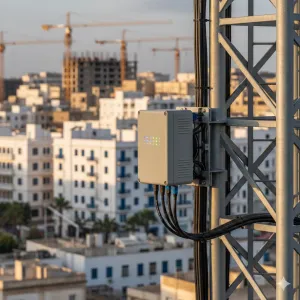
The most common mistake in industrial IoT deployments is buying sensors and connectivity hardware before establishing the edge computing architecture that processes sensor data. 5G moves the data — but data collected at millisecond intervals from hundreds of sensors generates volumes that cannot be economically or securely routed to a central cloud data center for processing. Mobile Edge Computing (MEC) nodes, deployed at the base station or on the factory premises, perform the initial data processing and model inference locally, passing only aggregated insights to the cloud. Algeria-compatible MEC options include Ericsson’s Edge Gravity (Ericsson is the primary RAN vendor for Mobilis) and Nokia’s MX Industrial Edge (Nokia has an active presence in Algeria through Algerie Telecom partnerships). Establish the MEC architecture and vendor relationship before committing to IoT sensor hardware — the sensor choice should follow from the processing architecture, not precede it.
Where This Fits in Algeria’s 2026 Industrial Ecosystem
The 5G industrial adoption playbook described here does not operate in a vacuum. It connects to two parallel infrastructure investments that collectively change what is possible for Algerian industry.
The Oran AI Supercomputing Center, now under construction in the Akid Lotfi district, provides the training compute layer that feeds industrial AI models. Sensor data collected from factory floors can be anonymized, aggregated, and used to train predictive maintenance models on domestic GPU infrastructure — a workflow that was previously either prohibitively expensive (renting GPU time from foreign hyperscalers) or technically impractical (insufficient local compute).
The Medusa submarine cable, scheduled to reach Algeria by end of 2026, provides the international bandwidth backbone for enterprises that need to synchronize industrial data with global supply chain systems, ERP platforms, or parent-company data centers in Europe. A Renault Algérie production facility reporting assembly line metrics to the Renault Group global ERP in France, or a Tosyali Algeria steel facility sharing quality assurance data with its Turkish parent, needs stable, high-bandwidth connectivity to European cloud regions — which Medusa provides.
The combination of 5G on the factory floor, domestic AI compute for model training, and high-bandwidth international connectivity for data synchronization is the infrastructure stack for genuine Industry 4.0 deployment. All three components are becoming available in Algeria within the same 24-month window — a convergence that creates a narrower-than-it-appears adoption opportunity.
Frequently Asked Questions
What is the difference between NSA and SA 5G, and why does it matter for industrial use cases?
Non-Standalone (NSA) 5G uses 5G radio access but relies on an existing 4G core network, delivering higher speeds but not the ultra-low latency (below 1 ms) or network slicing needed for real-time industrial control. Standalone (SA) 5G uses a fully 5G core, unlocking URLLC, mMTC, and network slicing. Algeria’s current deployment is NSA. SA capability will phase in over the six-year rollout, with critical industrial applications — robotic control, safety systems — becoming viable once SA coverage reaches specific facilities.
How much does a 5G private network deployment typically cost for an Algerian factory?
Private 5G deployments at the scale of a medium-sized factory (50,000 sq m, 500-2,000 connected devices) typically run $500,000-$2 million for hardware (base stations, edge compute nodes) plus 12-18 months of integration work. Managed service agreements with operators can reduce upfront capital cost but increase 5-year total cost. The ROI models from European industrial deployments suggest 2-4 year payback periods for predictive maintenance applications in continuous-process industries (steel, petrochemicals, cement) where unplanned downtime costs $50,000-$500,000 per hour.
Which Algerian industries should prioritize 5G industrial IoT deployment first?
Industries with continuous-process production lines where unplanned downtime has the highest cost see the fastest ROI: petrochemicals (Sonatrach refineries), steel (Bellara, Tosyali), and cement. These are followed by assembly industries (automotive, electronics) where connected tools and assembly guidance systems have documented quality improvement benefits. Consumer goods manufacturing and food processing are third-tier priorities with longer payback periods.
Sources & Further Reading
- Algeria 5G Launch: Mobilis, Djezzy, and Ooredoo Commence Rollouts — Developing Telecoms
- Algeria Opens 5G Deployment Amid Infrastructure and Coverage Concerns — Ecofin Agency
- Algeria Officially Switches On 5G — MEA Tech Watch
- Algeria Rolls Out 5G Network with Six-Year Expansion Plan — North Africa
- Edge Computing in Enterprise 2026 — Calmops