The Software Moment in Robotics
For decades, robotics has been a hardware story. The industry’s milestones have been physical: Boston Dynamics’ backflipping humanoid, Amazon’s warehouse robots, Tesla’s Optimus prototype. Investment has flowed toward companies building better actuators, sensors, grippers, and mechanical platforms. The implicit assumption was that the bottleneck in robotics was the body — that if we could build a robot that moved like a human, intelligence would follow.
That assumption has inverted. In February 2026, the largest investments in robotics are flowing not to companies building robot bodies but to companies building robot minds. Physical Intelligence raised $600 million at a $5.6 billion valuation — backed by Jeff Bezos — for its universal robot foundation model. RLWRLD secured $41 million to train robot AI models inside live factory environments. And Nvidia, at CES 2026, released a suite of physical AI models designed to give any robot platform the intelligence to perceive, plan, and act in the physical world.
The parallel to the language model revolution is deliberate and instructive. Before GPT-3 demonstrated in 2020 that a single large model could perform thousands of language tasks, natural language processing was dominated by specialized systems — one model for translation, another for sentiment analysis, another for summarization. The foundation model approach replaced this fragmentation with a single, general-purpose system that could be adapted to any task.
Robotics in 2025 occupied a position analogous to NLP in 2019. Every robot application — warehouse picking, surgical assistance, agricultural harvesting, industrial assembly — required a custom-built control system trained on that specific task. A robot trained to pick packages could not sort them. A robot trained for one factory layout could not adapt to another. The labor of programming each robot for each task was the primary cost of deployment, far exceeding the cost of the robot hardware itself.
Foundation models for robotics promise to change this equation fundamentally.
Physical Intelligence: The $5.6 Billion Bet
Physical Intelligence (Pi) is the highest-profile company pursuing the robot foundation model approach. Founded by researchers from UC Berkeley, Stanford, and Google, the company’s thesis is that the same scaling laws that transformed language models apply to robot control: train a sufficiently large model on sufficiently diverse robot interaction data, and it will develop general-purpose physical intelligence that transfers across robot bodies and tasks.
The $600 million raise at a $5.6 billion valuation, with Jeff Bezos among the investors, makes Pi the most highly valued robotics AI company in history. The Bezos connection is not coincidental: Amazon operates the world’s largest fleet of warehouse robots and stands to benefit enormously from general-purpose robot intelligence that could reduce the programming cost of deploying robots across its hundreds of fulfillment centers.
Pi’s approach involves training transformer-based models on vast datasets of robot interactions — recorded demonstrations by human operators, simulated interactions in virtual environments, and autonomous exploration by robot systems in real-world settings. The resulting model encodes a general understanding of physical interaction: how objects respond to forces, how to plan sequences of actions to achieve goals, how to adapt when something unexpected happens.
The company has demonstrated its model controlling multiple robot platforms — different arm configurations, different gripper types, different sensor suites — performing tasks that the model was not explicitly trained on. The demonstrations are impressive but carefully staged, and the gap between a laboratory demonstration and reliable operation in a chaotic real-world environment remains significant.
What distinguishes Pi from previous robotics AI efforts is the scale of both the model and the training data. Previous robot learning systems trained on thousands or tens of thousands of interaction episodes. Pi’s model trains on millions of episodes, combining real-world demonstrations with synthetic data from physics-accurate simulations. The hypothesis — unproven but theoretically grounded — is that the same emergent capabilities that appeared in language models at scale (reasoning, generalization, few-shot learning) will appear in physical AI models given sufficient data and compute.
RLWRLD: Learning Inside the Factory
RLWRLD (pronounced “real world”) represents a complementary approach to Physical Intelligence. Where Pi builds a general-purpose foundation model in the lab, RLWRLD trains its models inside live factory environments, learning from the actual conditions that robots must navigate in production.
The company raised $41 million to deploy its training infrastructure — a combination of sensors, compute hardware, and edge AI systems — directly onto factory floors. Robot platforms equipped with RLWRLD’s system learn by interacting with real products, real conveyors, and real environmental conditions, guided by reinforcement learning algorithms that optimize for task completion while respecting safety constraints.
RLWRLD’s advantage is data realism. Simulated environments, no matter how physics-accurate, cannot perfectly replicate the variability of real-world manufacturing: the way a specific material flexes when gripped, the optical properties of a specific product under specific lighting, the vibrations and noise of a specific factory floor. By training in production environments, RLWRLD’s models encounter and adapt to these real-world conditions from the start, potentially reducing the sim-to-real transfer gap that has limited previous robot learning approaches.
The tradeoff is speed and scalability. Training in real factories is slower than training in simulation (physical actions take real time) and requires physical access to production environments (not every factory is willing to host experimental AI training on their production line). RLWRLD’s business model involves partnerships with manufacturers who provide access to their facilities in exchange for early access to the resulting AI capabilities.
Nvidia’s Physical AI Platform Play
Nvidia’s release of physical AI models at CES 2026 represents the platform play that could accelerate the entire sector. Rather than building specific robot applications, Nvidia is providing the foundational AI models, simulation infrastructure, and deployment frameworks that other companies — both startups and established robot manufacturers — use to develop intelligent robot systems.
Nvidia’s approach has three components. First, Isaac Sim, a physics-accurate simulation platform powered by Nvidia’s Omniverse technology, provides the virtual environment where robot AI can be trained at scale. Isaac Sim enables thousands of simulated robots to train simultaneously, compressing months of real-world training into hours of simulated experience.
Second, Nvidia released pre-trained physical AI models — including models for object manipulation, navigation, and human-robot interaction — that developers can use as starting points for specific applications. These models are to robotics what GPT is to language applications: a general-purpose foundation that can be fine-tuned for specific tasks with relatively small amounts of task-specific data.
Third, Nvidia’s Jetson computing platform provides the edge hardware that runs AI models on robot platforms in real-time. The latest Jetson modules deliver the compute performance required for real-time perception, planning, and control at power levels that fit within a robot’s energy budget.
Nvidia’s physical AI strategy mirrors its successful approach in the data center: provide the complete hardware and software stack that makes it easy for others to build on Nvidia’s platform, and capture value at every layer. If the robotics foundation model approach succeeds, Nvidia is positioned to be the dominant platform provider regardless of which specific companies win in specific application domains.
Advertisement
The Parallel to the LLM Revolution
The robotics foundation model thesis draws explicitly on the lessons of the large language model revolution. That revolution followed a specific pattern: large, general-purpose models trained on diverse data at scale developed emergent capabilities that specialized models could not match. The resulting shift — from dozens of specialized NLP systems to a single foundation model adapted for many tasks — compressed years of application development into months and made AI accessible to organizations without deep ML expertise.
Advocates of the robot foundation model approach argue that the same pattern will play out in robotics. The key ingredients are the same: transformer architectures that can process diverse input modalities, scaling laws that predict how model capability improves with size and data, and training infrastructure that can generate diverse interaction data at scale.
The analogy has important limitations. Language is fundamentally digital — it can be tokenized, processed, and generated in discrete symbols. Physical interaction is continuous, high-dimensional, and unforgiving. A language model that generates a slightly wrong word produces a mildly incoherent sentence. A robot model that generates a slightly wrong force vector breaks the object it is trying to manipulate — or worse, injures a person nearby.
The safety requirements for physical AI are qualitatively different from those for digital AI. A chatbot that hallucinates causes embarrassment. A robot that hallucinates causes property damage or bodily harm. This asymmetry means that robotics foundation models must achieve significantly higher reliability than language models before they can be deployed at scale, which may slow the adoption curve relative to the rapid deployment of LLMs.
Implications for Warehouses, Logistics, and Manufacturing
The immediate commercial applications for robotics foundation models are in structured environments with high volumes of repetitive physical tasks: warehouses, logistics hubs, and manufacturing facilities. These environments share characteristics that make them amenable to current robot AI capabilities — predictable layouts, standardized objects, relatively constrained task sets — while offering clear economic returns that justify investment.
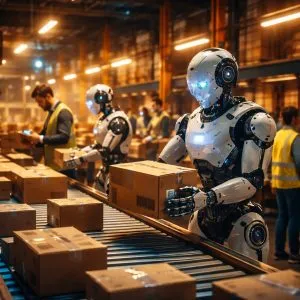
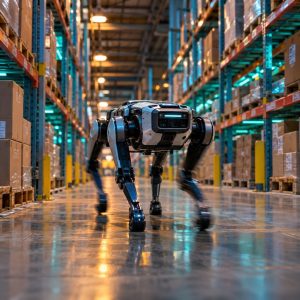
In warehouse operations, the current state of the art involves robots that can navigate autonomously (autonomous mobile robots, or AMRs) and robots that can pick specific items from shelves (pick-and-place systems). These systems are effective but narrow: an AMR cannot pick items, and a picking robot cannot navigate. Foundation models that enable a single robot platform to perform multiple tasks — navigate to a shelf, identify the correct item, pick it, transport it to a packing station, and place it for shipping — would dramatically increase the return on investment for warehouse robotics.
Amazon, which deploys over 750,000 robots across its fulfillment network, is the most obvious beneficiary. The company currently uses separate robot systems for transportation, sorting, and picking, each requiring independent programming and management. A foundation model that enables general-purpose robot behavior could allow Amazon to replace multiple specialized systems with fewer, more versatile platforms — reducing capital costs, simplifying operations, and enabling faster deployment in new facilities.
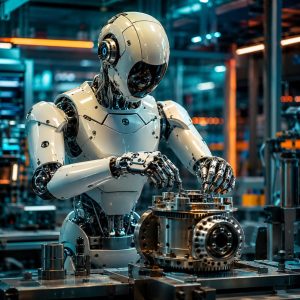
In manufacturing, the opportunity is in small-batch, high-mix production — the manufacturing paradigm where products change frequently and production runs are short. Traditional industrial robots excel at repetitive tasks but require extensive reprogramming for each new product or process. Foundation models that enable robots to learn new tasks from a small number of demonstrations — analogous to the few-shot learning capability of language models — would make robotics economically viable for manufacturers who currently cannot justify the programming cost for short production runs.
The Hardware Question
The software-first thesis does not mean that robot hardware is irrelevant. It means that the bottleneck has shifted. Ten years ago, the constraint on useful robotics was the physical platform: sensors were too expensive, actuators were too imprecise, and computing hardware was too bulky. Those constraints have been substantially relaxed. High-quality depth cameras cost under $200. Precise servo actuators are available as commodity components. Edge AI processors deliver the compute needed for real-time control in compact, power-efficient packages.
The result is that capable robot hardware is becoming a commodity. Multiple companies offer general-purpose robot arm platforms at price points under $30,000 — a fraction of the cost of traditional industrial robots. Humanoid robot platforms, while still expensive and limited, are being developed by Tesla, Figure AI, 1X Technologies, and others with the explicit goal of becoming general-purpose physical platforms.
In this environment, the differentiator is intelligence, not mechanics. A $25,000 robot arm with sophisticated AI that can learn new tasks in hours is more valuable than a $100,000 industrial robot that requires weeks of programming for each new application. The economics increasingly favor investing in AI software — which scales with zero marginal cost across robot platforms — over investing in custom hardware that scales linearly with deployment.
This shift has profound implications for the robotics industry’s structure. Hardware companies that do not develop or integrate AI capabilities risk commoditization. AI companies that are hardware-agnostic — like Physical Intelligence, which designs its models to work across robot platforms — capture disproportionate value. The parallel to the smartphone industry, where software platforms (iOS, Android) captured more value than hardware manufacturers (except Apple), is apt.
What Comes Next
Robotics foundation models are at the earliest stage of their development arc. The demonstrations are promising but the production deployments are limited. The gap between a robot that can pick up diverse objects in a controlled lab setting and a robot that operates reliably for 20 hours a day in a chaotic warehouse environment is substantial.
The most likely near-term trajectory involves foundation models deployed for specific, high-value applications in structured environments — warehouse picking, quality inspection, repetitive assembly — rather than general-purpose robotics. These applications provide the revenue and real-world data that fund continued model improvement, creating the data flywheel that accelerated language model development.
The medium-term trajectory — 3-5 years — could see foundation models enabling robots to learn new tasks from minimal demonstration, dramatically reducing the deployment cost and time for robotics in manufacturing, logistics, and potentially service environments. This would represent the equivalent moment in robotics to GPT-3 in language: the demonstration that general-purpose capability, not specialized programming, is the path to broad deployment.
The long-term trajectory — 5-10 years — involves robots with physical intelligence sophisticated enough to operate in unstructured environments alongside humans. Healthcare, construction, agriculture, and household applications represent enormous markets that require this level of capability. Whether foundation models can achieve this level of physical intelligence, or whether fundamentally different approaches will be required, remains an open question.
What is not in question is the direction of investment and research attention. The robotics industry’s center of gravity has shifted from hardware engineering to AI software. Physical Intelligence’s $5.6 billion valuation, Nvidia’s physical AI platform, and the growing constellation of startups training robot foundation models all point to the same conclusion: the real breakthrough in robotics is software, and it is happening now.
Frequently Asked Questions
What is robotics foundation models?
Robotics Foundation Models: The Real Breakthrough Is Software, Not Hardware covers the essential aspects of this topic, examining current trends, key players, and practical implications for professionals and organizations in 2026.
Why does robotics foundation models matter?
This topic matters because it directly impacts how organizations plan their technology strategy, allocate resources, and position themselves in a rapidly evolving landscape. The article provides actionable analysis to help decision-makers navigate these changes.
How does physical intelligence: the $5.6 billion bet work?
The article examines this through the lens of physical intelligence: the $5.6 billion bet, providing detailed analysis of the mechanisms, trade-offs, and practical implications for stakeholders.
Sources & Further Reading
- Physical Intelligence Raises $600M at $5.6B Valuation — The Information
- RLWRLD Raises $41M to Train Robot AI in Live Factories — TechCrunch
- Nvidia Releases Physical AI Models at CES 2026 — Nvidia Blog
- The Robot Foundation Model Thesis — Sequoia Capital
- Amazon’s 750,000 Robot Fleet and the Future of Warehouse Automation — Reuters