February’s Funding Frenzy
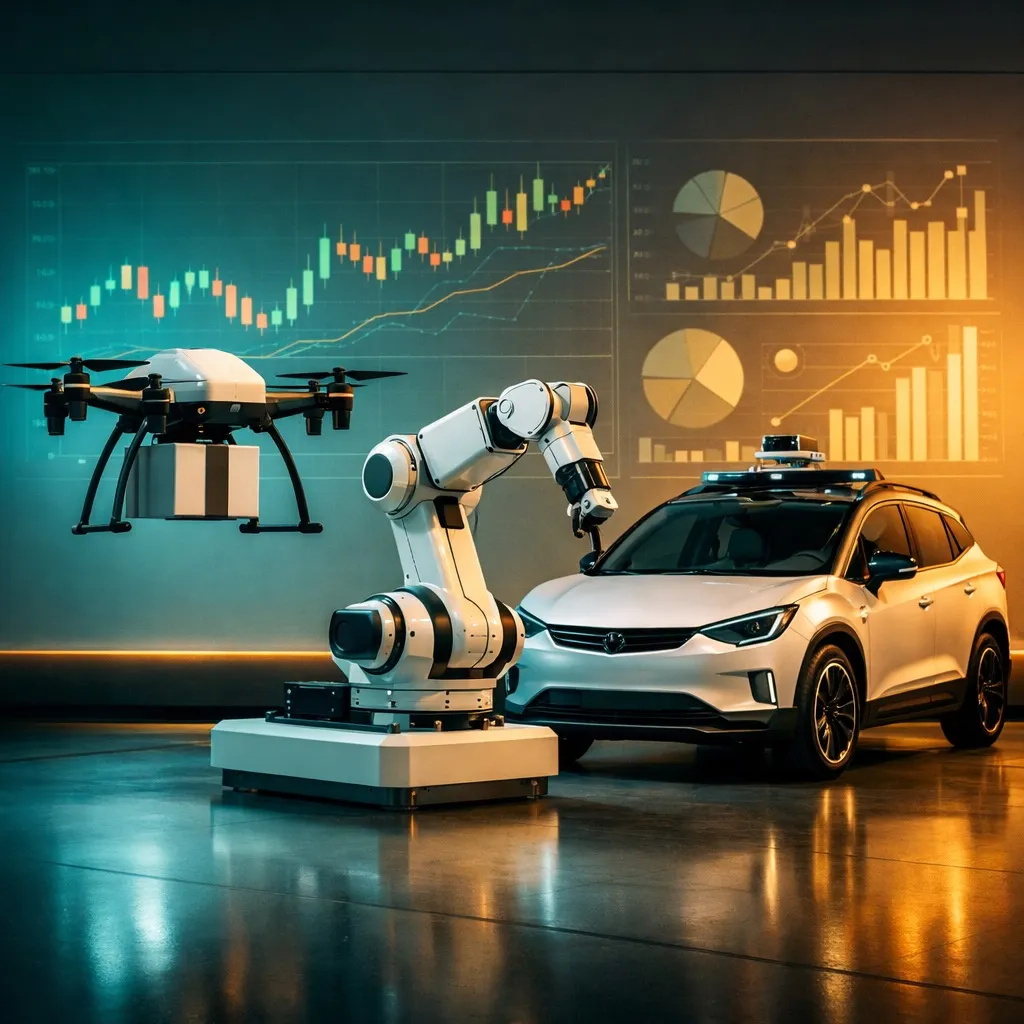
February 2026 will be remembered as the month physical AI became impossible to ignore. In a span of weeks, companies building autonomous systems that operate in the physical world raised a combined $19 billion-plus — a figure that would have constituted a strong year for the entire autonomous vehicle sector just three years ago.
The headline number belongs to Waymo, which secured approximately $16 billion in one of the largest private funding rounds in technology history. But the breadth of the funding wave is what distinguishes this moment. Wayve raised $1.2 billion for its end-to-end learned driving approach. Waabi closed $1 billion with Uber committing to deploy 25,000 of its autonomous trucks. Bedrock Robotics pulled in $270 million for construction automation. Skyryse secured $300 million for autonomous flight systems. Physical Intelligence raised $600 million for universal robot foundation models.
Each company addresses a different domain — passenger vehicles, trucking, construction, aviation, general-purpose robotics — but they share a common thesis: the combination of transformer-based AI models, improved sensors, and abundant training data has pushed physical-world autonomy past a critical capability threshold. The technology is no longer a research project. It is an engineering and scaling challenge — the kind of challenge that venture capital was built to fund.
Waymo’s $16 Billion Statement
Waymo’s raise is remarkable not just for its size but for what it represents about Alphabet’s commitment to autonomous driving after years of skepticism from Wall Street. The company has been operating commercial robotaxi services in Phoenix, San Francisco, and Los Angeles, and has crossed the threshold of hundreds of thousands of paid rides per week.
The $16 billion infusion — combining Alphabet’s own capital with external investors — is intended to fund expansion to new cities, fleet growth, and the development of the sixth-generation autonomous driving system. Waymo’s advantage is data: with billions of miles of real-world driving experience, the company possesses a training dataset that no competitor can replicate quickly.
The competitive dynamics have shifted dramatically from the autonomous vehicle hype cycle of 2018-2020. Cruise, once Waymo’s primary rival, suspended operations in late 2023 after a pedestrian-dragging incident in San Francisco and was eventually wound down by General Motors. Aurora Innovation pivoted to trucking. Argo AI shut down entirely. The field has consolidated around Waymo for passenger vehicles and a handful of trucking startups.
This consolidation makes Waymo’s position stronger but not unassailable. Tesla continues to expand its Full Self-Driving system, which takes a fundamentally different approach — camera-only, consumer-owned vehicles, supervised autonomy gradually transitioning to full autonomy. The Waymo-Tesla competition may define the autonomous vehicle market for the next decade: purpose-built robotaxis versus autonomy-enabled personal vehicles.
The Trucking Bet: Waabi and the Uber Alliance
Waabi’s $1 billion round attracted attention primarily for Uber’s commitment to deploy 25,000 autonomous trucks using Waabi’s technology. This is not a letter of intent or a memorandum of understanding — it is a contractual commitment from the world’s largest ride-hailing company to integrate autonomous trucking at scale.
Waabi’s approach centers on what founder Raquel Urtasun calls “AI-first” autonomy. Rather than relying on hand-coded rules and high-definition maps — the traditional approach that Waymo pioneered — Waabi uses large-scale simulation and generative AI to train its driving system. The company claims this approach requires far less real-world testing data, dramatically reducing the cost and time to deploy in new geographies.
The Uber partnership makes strategic sense for both sides. Uber Freight has built one of the largest digital freight brokerage platforms in North America, connecting shippers with carriers across a network that handles billions of dollars in freight annually. Autonomous trucks that can operate on predictable highway routes — the easiest use case for self-driving technology — would dramatically reduce Uber Freight’s costs while addressing the chronic truck driver shortage that constrains the industry.
The 25,000-vehicle commitment is ambitious enough to be transformative if executed. For context, there are approximately 3.5 million truck drivers in the United States. Replacing even a fraction of long-haul routes with autonomous trucks would represent a fundamental restructuring of the logistics industry, with implications for employment, infrastructure, and the economics of goods movement.
Advertisement
Beyond Vehicles: Construction, Aviation, and General Robotics
The February funding wave extended well beyond autonomous vehicles, signaling that physical AI investment is broadening to encompass any domain where machines operate in the physical world.
Bedrock Robotics’ $270 million raise targets construction, an industry where labor shortages and safety hazards create strong demand for automation but where the unstructured environment has historically defied robotic solutions. Bedrock’s approach uses foundation models trained on construction site data to enable robots that can navigate unpredictable terrain, handle diverse materials, and coordinate with human workers in real-time. The company targets earthmoving, grading, and foundation work — repetitive, physically demanding tasks where automation can improve both productivity and safety.
Skyryse’s $300 million funds the development of autonomous flight systems for helicopters and vertical takeoff aircraft. The company’s SkyOS operating system aims to make any aircraft autonomous-capable through a retrofit approach — adding sensors, computers, and software to existing airframes rather than requiring entirely new aircraft. This strategy addresses a critical bottleneck: the small aircraft and helicopter market cannot justify the development cost of purpose-built autonomous aircraft, but retrofit autonomy could make the existing fleet of 500,000+ aircraft dramatically safer and eventually pilot-optional.
Physical Intelligence’s $600 million round, covered in detail in a companion article on robotics foundation models, represents perhaps the most ambitious bet. The company is building universal robot foundation models — AI systems that can control any robot body to perform any physical task, much as GPT-4 can process any text prompt. If successful, this approach would decouple robot intelligence from robot hardware, enabling rapid deployment across warehouse, manufacturing, and logistics applications.
Why Now: The Convergence
The concentrated burst of physical AI funding reflects a convergence of four factors that have been building independently for years and are now reinforcing each other.
First, transformer-based AI models have proven capable of handling the multimodal, real-time decision-making that physical-world autonomy demands. The same architectural innovations that enabled ChatGPT and GPT-4 — attention mechanisms, scaling laws, in-context learning — apply to processing sensor data from cameras, lidar, and radar. Companies like Wayve and Waabi have demonstrated that end-to-end learned driving systems, trained on driving data the way language models are trained on text, can match or exceed the performance of hand-engineered rule-based systems.
Second, sensor costs have collapsed. Lidar units that cost $75,000 in 2018 now cost under $500. Cameras, radar, and computing hardware have followed similar trajectories. The bill of materials for an autonomous vehicle sensor suite has dropped by 90% in five years, making autonomous systems economically viable for applications — like trucking and construction — where the per-unit value proposition must be compelling.
Third, the training data ecosystem has matured. Simulation environments like Waabi World and NVIDIA Omniverse can generate billions of realistic driving scenarios, supplementing real-world data collection. Federated learning enables companies to improve their models from fleet data without centralizing sensitive driving information. The data flywheel that was theoretical in 2020 is operational in 2026.
Fourth, and perhaps most importantly, real-world deployments have validated the technology. Waymo’s robotaxi service in multiple cities has accumulated an extraordinary safety record compared to human drivers. Autonomous trucking pilots on interstate highways have demonstrated reliability in commercial freight operations. These are no longer demonstrations — they are businesses generating revenue and proving that autonomous systems can operate safely at scale.
The Capital Question
Nineteen billion dollars in a single month raises an inevitable question: is this a rational allocation of capital or a bubble driven by FOMO and the availability of cheap money?
The bull case is straightforward. The total addressable market for physical-world autonomy — encompassing passenger vehicles, trucking, logistics, construction, agriculture, mining, and aviation — exceeds $10 trillion annually. Even modest automation of these sectors would generate returns that justify current investment levels. The technology has crossed critical capability thresholds, real-world deployments validate the approach, and the competitive landscape has consolidated around a manageable number of serious players.
The bear case focuses on execution risk and timeline uncertainty. Autonomous vehicle companies have been promising imminent deployment since 2016, and full autonomy remains limited to specific geographies and conditions. Regulatory frameworks are evolving but incomplete. The liability question — who is responsible when an autonomous system causes harm — remains legally unresolved. And the transition from pilot programs to mass deployment will require infrastructure, insurance, regulatory, and social changes that technology alone cannot accelerate.
The likely reality sits between these extremes. Physical AI will be deployed at meaningful scale in specific, high-value domains — highway trucking, geofenced robotaxi services, structured warehouse environments — within 2-3 years. Broader deployment across unstructured environments will take longer. The companies that survive will be those that can generate revenue from near-term applications while investing in the longer-term vision. The $19 billion raised in February 2026 provides substantial runway for exactly this kind of patient, staged deployment.
Frequently Asked Questions
What does “The $19 Billion Month” mean?
The $19 Billion Month: Physical AI and Autonomous Systems Hit Escape Velocity covers the essential aspects of this topic, examining current trends, key players, and practical implications for professionals and organizations in 2026.
Why does the $19 billion month matter?
This topic matters because it directly impacts how organizations plan their technology strategy, allocate resources, and position themselves in a rapidly evolving landscape. The article provides actionable analysis to help decision-makers navigate these changes.
How does waymo’s $16 billion statement work?
The article examines this through the lens of waymo’s $16 billion statement, providing detailed analysis of the mechanisms, trade-offs, and practical implications for stakeholders.
Sources & Further Reading
- Waymo Secures $16 Billion in Record Autonomous Vehicle Funding Round — Financial Times
- Waabi Closes $1B as Uber Commits 25,000 Autonomous Trucks — TechCrunch
- Physical Intelligence Raises $600M for Robot Foundation Models — The Information
- Bedrock Robotics Raises $270M to Automate Construction — Bloomberg
- The State of Autonomous Vehicle Technology in 2026 — MIT Technology Review