A Concentrated Wave of New 4G Capacity Across 44 Wilayas
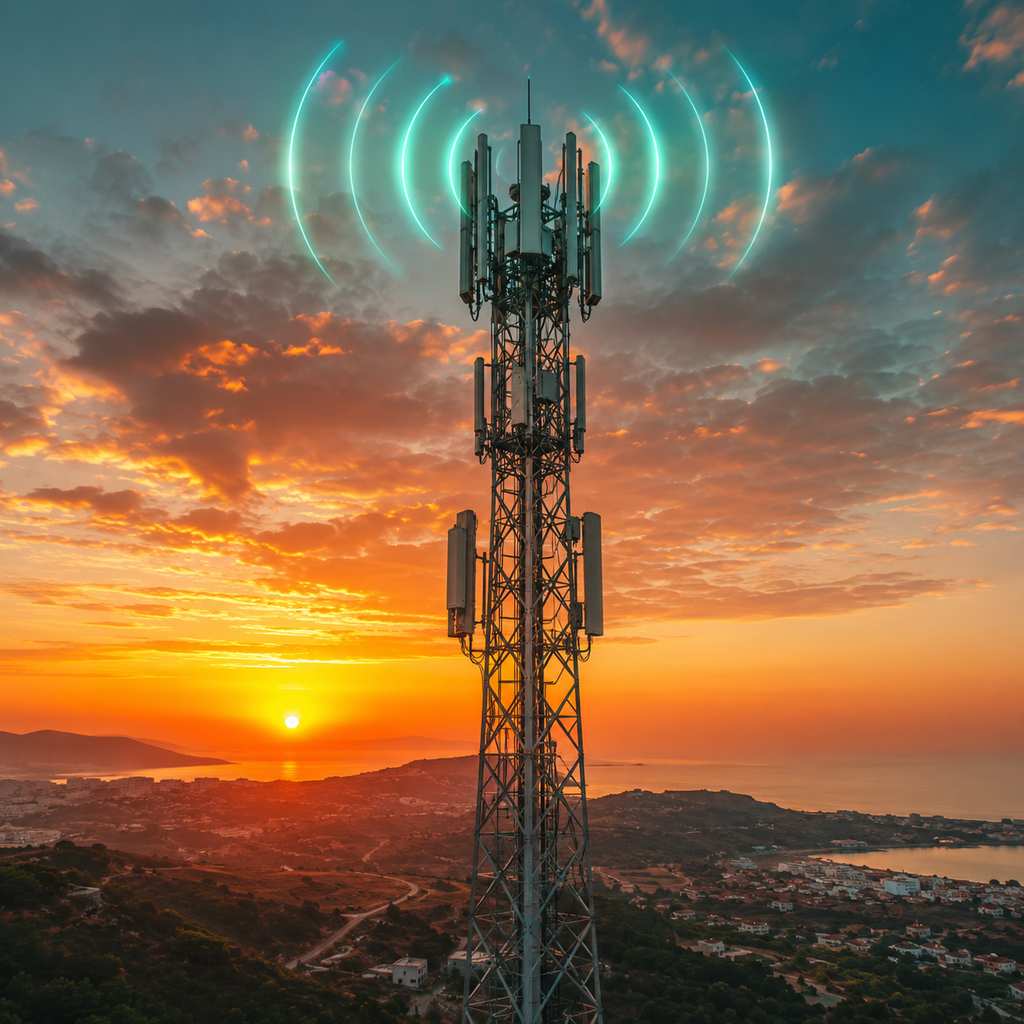
On 15 February 2026, Algerie Telecom announced one of its most concentrated network reinforcement campaigns to date: the deployment of 345 new 4G base stations spread across 44 wilayas. According to the announcement covered by Managers, the program runs in two phases — a first wave of 195 stations being installed through March 2026, followed by a second phase adding at least 150 more.
What makes this build-out notable is not just the headline number but where the stations are going. The deployment is engineered to do two things at once: thicken capacity in high-density urban zones where the existing network is congested, and extend reach into isolated interior and southern regions that have historically sat at the edge of reliable mobile internet. As Algeriezoom reported, the new stations are eNodeB units running 4G-LTE with latest-generation equipment, chosen to deliver higher download speeds and steadier connection stability for streaming, telework, e-learning, and online banking.
The timing reflects real demand. Algeria’s mobile base is large and overwhelmingly 4G: the market counted 54.87 million GSM subscriptions at the end of June 2025, of which 48.7 million — roughly 88.8% — were 4G subscriptions, per figures cited in Ecomnews Med’s coverage. When that many users share a network, adding base-station density is the most direct lever for improving everyday experience.
Why Base-Station Density Is the Real Story
For non-specialists, it helps to decode the mechanics. A base station — in 4G terms, an eNodeB — is the radio node that connects mobile devices to the core network. Each station serves a finite area and a finite number of simultaneous users before throughput per user begins to drop. Two things degrade mobile experience: being far from a station (coverage gaps) and sharing one station with too many users (congestion).
Adding 345 stations attacks both problems. In dense neighbourhoods of Alger, Oran, and Constantine, the new units increase the number of cells covering the same population, so each cell carries fewer users and each user gets a larger slice of available capacity — faster, steadier speeds at peak hours. In remote zones around Tamanrasset, Adrar, or the southern highway corridors, new stations fill physical coverage holes, turning “no signal” or “edge-of-network” areas into usable 4G.
The national framing makes the ambition explicit. Following a 12 February 2026 ministerial meeting on sector priorities, officials emphasised rural coverage, highway-corridor connectivity, and emergency-service accessibility, setting a target of minimum service on southern highways — including the ability to place emergency calls — by June 2026, with broader coverage completion targeted by the end of 2026. As Agence Ecofin noted in its coverage, the historic operator is accelerating its 4G internet rollout to keep pace with rising demand. The reinforcement plan also dovetails with a wider connectivity push: Phase 1 targets some 1,400 zones of 500 to 2,000 inhabitants, while a follow-on national program aims to reach 4,500 additional such zones by 2027.
This is a build-out aimed squarely at usable, everyday performance. The choice to lead with latest-generation eNodeB equipment — rather than simply re-pointing older hardware — signals an emphasis on throughput per user and stability, not just raw map coverage. For users in the interior, the difference is tangible: the gap between a signal bar that exists and a connection that actually carries a video call or a payment confirmation is precisely the gap this density push is designed to close.
Advertisement
What the Expanded Coverage Layer Opens for Builders
A denser, more reliable mobile layer is not just a consumer convenience — it is infrastructure that businesses build on top of. Field-service operations, logistics fleets, mobile payment acceptance, ride-hailing, agritech sensors, and any app that assumes “the user has a stable connection” all become more viable as coverage quality rises and dead zones shrink. For Algerian SMEs and developers, the practical question is how to position for the expanded mobile-access layer.
What Algerian Businesses Should Do
1. Re-test your mobile product against real coverage maps, not just city-centre assumptions
Many Algerian apps and services are quietly designed for the connectivity profile of central Alger and a handful of wilaya capitals. As the 345 stations come online across 44 wilayas, the addressable footprint for mobile-first services widens. Audit where your users actually are, instrument your app to log connection quality by region, and re-test core flows — checkout, upload, video — on lower-throughput links so the experience holds up in newly-covered interior zones rather than only on a fast urban connection.
2. Design for graceful degradation and offline-first behaviour
Even with denser coverage, mobile networks vary block by block and hour by hour. Build for the network you have, not the one you wish for: cache aggressively, queue writes locally and sync when a stable link returns, compress images and payloads, and avoid blocking the entire interface on a single slow request. Offline-first patterns turn the expanding-but-uneven coverage layer into a dependable foundation rather than a source of churn, and they pay off most precisely in the remote zones this build-out is reaching.
3. Plan field and logistics operations around the 2026 coverage milestones
If your operation depends on connectivity along the southern highway corridors or in interior wilayas — logistics, distribution, field maintenance, transport — map your routes against the publicly stated milestones: minimum service on southern highways by June 2026 and broader completion targeted by year-end. Sequence rollouts of connected field tools, telematics, and real-time dispatch to follow coverage as it firms up, and keep a fallback (SMS, store-and-forward, or satellite for the most remote legs) for routes still on the edge.
4. Treat the mobile layer as a channel, not an afterthought
With 48.7 million 4G subscriptions, mobile is where Algerian users already are. Make sure your web presence is genuinely mobile-fast — lightweight pages, fast first paint, payment flows that work on a phone — and consider whether a focused mobile app or progressive web app would serve newly-connected users better than a desktop-era site. The build-out is effectively enlarging your potential market reach; the businesses that prepare their mobile channel now are positioned to meet that demand as it arrives.
Building on the Expanded Coverage Layer
The 345-station program is best read not as a one-off announcement but as a marker of where Algeria’s mobile infrastructure is heading: toward denser urban capacity and steadily widening interior reach, anchored to concrete 2026 milestones. For a country where the overwhelming majority of internet access is mobile, improving the base-station layer is one of the highest-leverage moves available — it raises the floor for everyone building connected products at once.
For SMEs, developers, and enterprise mobile teams, the takeaway is to build ahead of the curve rather than behind it. Coverage that is uneven today is being filled in on a published timeline, and services designed now for a wider, more reliable footprint will be ready to capture demand the moment the signal arrives. The strategic opportunity is to treat the expanding mobile-access layer as a platform — and to ship products that assume the connected wilaya of 2027, not the coverage map of 2024.
Frequently Asked Questions
Q: How many new 4G base stations is Algerie Telecom deploying, and where?
Algerie Telecom announced on 15 February 2026 the deployment of 345 new 4G base stations across 44 wilayas. The first phase installs 195 high-throughput eNodeB stations through March 2026, and a second phase adds at least 150 more. The stations target both congested high-density urban zones and isolated interior and southern regions.
Q: When will the new coverage be available, especially in remote areas?
Phase 1’s 195 stations are being installed through March 2026. Officials set a target of minimum service on southern highway corridors — including emergency-call capability — by June 2026, with broader coverage completion targeted by the end of 2026. A follow-on national program aims to reach 4,500 additional zones of 500–2,000 inhabitants by 2027.
Q: What does this mean for businesses and developers in Algeria?
A denser, more reliable mobile layer widens the addressable market for any location-dependent or mobile-first service — field operations, logistics, mobile payments, agritech, and more. Businesses should re-test their products against real regional coverage, design for offline-first resilience, and sequence connected field deployments to the 2026 coverage milestones to build ahead of the curve.
Sources & Further Reading
- Further Reading
- 345 nouvelles stations pour améliorer la qualité du réseau 4G en Algérie — Managers
- Algérie Télécom : un plan de renforcement de sa couverture réseau Internet 4G — Ecomnews Med
- Algérie Télécom lance un plan national pour renforcer Internet — Algeriezoom
- Algérie Télécom : un plan exceptionnel de renforcement du réseau 4G — Algerie Eco
- Algerie Telecom to strengthen 4G coverage with 345 additional base stations — Telecompaper
- Algérie : l’opérateur historique accélère la couverture du réseau Internet 4G — Agence Ecofin
🔗 Related Intelligence

Algeria’s Mobile Networks Tested: Real-World 4G/5G Speeds, Coverage Gaps

Algerie Telecom 400G Backbone: The Upgrade Powering Algeria’s Digital Future
Rural Connectivity: Algeria’s Push to Connect 4,500 Areas by 2027

Algeria’s 5G Commercial Launch: Enterprise IoT Connectivity Roadmap for 2026